Blog

Between 2009 and 2020, Josh published more than 10,000 blog posts. Here, you can access his blog archives.

2020
2019
2018
2017
2016
2015
2014
2013
2012
2011
2010
2009

Op-Ed in NY Times: “America Needs Closure on the Travel Ban”

June 11th, 2017

Tonight, the New York Times published my Op-Ed, urging the Court to schedule the travel ban case for arguments in June, and decide as soon as practicable. Whether the Court rules for, or agains the President, it will signal to the lower courts how to deal with this unpresidented president.

Here is the introduction:

President Trump’s revised travel ban has surged from his signature to the Supreme Court’s docket in less than three months. Under normal procedures, a case granted for review this late in the term would be argued by Thanksgiving with a possible resolution as late as June 2018. This case, indeed this president, is anything but normal. The legality of the travel ban, which implicates the commander in chief’s core statutory and constitutional authority over national security, demands an immediate resolution by the Supreme Court — one way or the other.

When necessary, the justices have quickly answered separation-of-powers disputes in less than a month’s time. Here, such a speedy resolution is essential not only to address the legality of this executive order but, more broadly, to signal to the lower courts how to treat President Trump’s unprecedented behavior in this case and beyond. With all the briefs scheduled to be filed on Monday, the court should follow its practice from previous urgent cases: Schedule argument for 10 days hence, with a resolution as soon as practicable. Letting this issue linger over the summer, or longer, would deny the parties, the courts and our republic what is truly needed: finality.

Here is the conclusion:

The legal status of President Trump’s executive order, and indeed that of his entire administration, needs finality, sooner rather than later. Even if five justices plan to strike down the executive order, they should do so now, and not in the fall, or worse, one year from now. The lower courts desperately need guidance. Should judges look to Mr. Trump’s Twitter feed to determine his true intent? Should the judiciary privilege statements from the commander in chief that conflict with those of the Justice Department? Are all of Mr. Trump’s actions that affect Muslims, at home and abroad, perpetually tainted by his campaign statements? If the Supreme Court signals that the answer to those questions is yes, then the lower courts may declare open season on this administration in contexts far beyond the travel ban. If a more circumspect Supreme Court signals that the answer is no, then, perhaps, the lower courts will fall into line.

Far beyond this interim order, all of President Trump’s foreign and domestic policies will be infected by these same critical disputes. The Supreme Court may be able to evade review here, but these issues are certain to repeat themselves. The nine justices cannot punt these complicated matters, hoping someone else deals with them. All of the issues are fully developed, and ready for resolution now. The buck stops here.

ConLaw Final Exam Grades and Comments

June 9th, 2017

I have submitted grades for Constitutional Law. You can download the exam question, and the A+ paper (If this is yours, please drop me a line!).

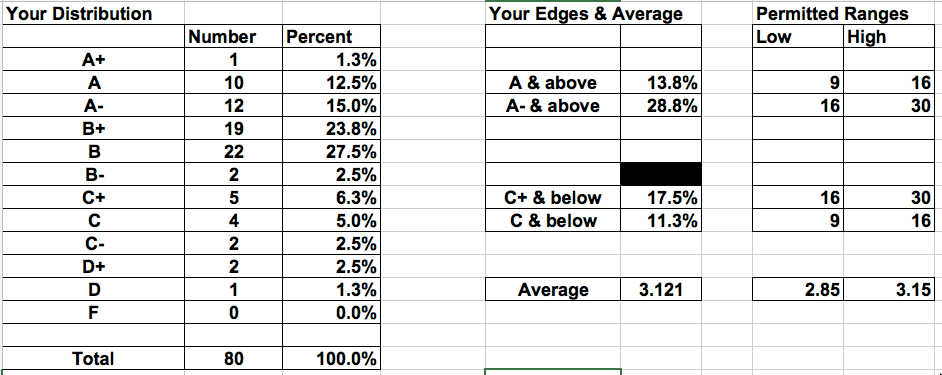
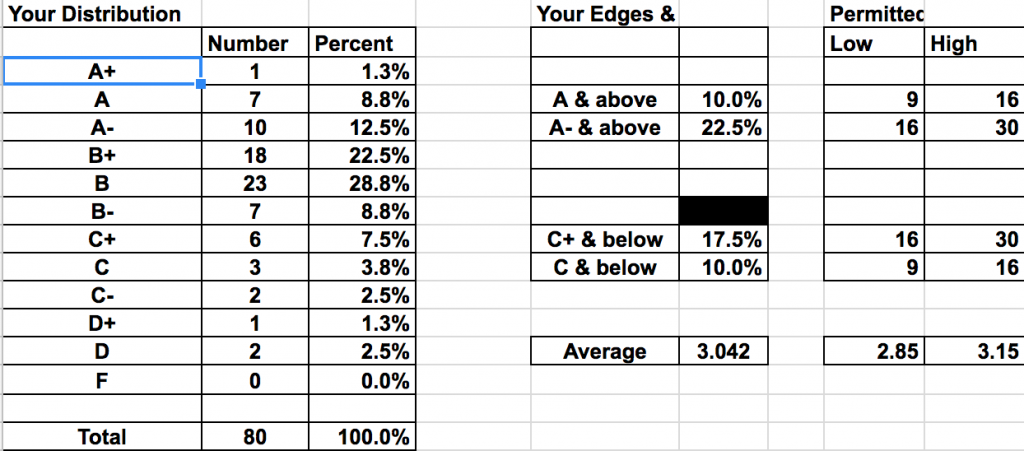
This was an extremely difficult test, by design, because I had high expectations. For the most part, you met those expectations. Here is the breakdown of the grades. On the whole, the grades were quite good, and I am very proud of the class. The students who scored below a C- were unable to finish, and left portions of the exam blank.

Here is the final exam distribution, which was on the upper-end of grades A- and above, and on the lower ends of grades C+ and below.

The mean of 3.121 is a stark improvement from the midterm, which had an average of 3.042:

I would like to provide some high-level thoughts on each question.

Part I

This question was premised on a hypothetical raised by one of your classmates during the final week of class: could Congress criminalize the live-streaming of a murder. When I asked the class what you all thought, on one raised their hands. That was my cue to make it an exam question, with a twist. Instead of live-streaming a murder, here, Bert & Ernie (fraternal twins, separated at birth, who were married), committed a sex act on the internet. This question involved laws by both Texas and Congress, criminalizing the act of incest itself, and the broadcast of sex acts. As the A+ paper noted in the very first sentence, “Awkward.”

1. The first question asked you to assess the constitutionality of TRICK (Texans Reject Incestuous Couples because won’t somebody please think of the Kids) under the 14th Amendment’s Due Process Clause. The critical issue here was whether the Court’s gay-rights precedents (Lawrence, Windsor, and Obergefell) should be extended to protect consensual, adult incest.  Specifically, was “moral disapproval” a valid state interest. The best papers compared and contrasted sodomy from incest, and explained why the protections should or should not be extended. One wrinkle: because two males were at issue, who could not reproduce, concerns about hereditary defects were simply inapplicable. (Conversely, heterosexual couples who both have recessive genes are allowed to reproduce without the government’s concerns).

2. The second question asked you to assess the constitutionality of SIBLING (Scrutinizing Internet Broadcasts because Livestreamed Incest is Not Good) under the 1st Amendment’s free speech clause. Many of you jumped the gun and talked about due process here. That was the prompt for question #3.  It is not only important to read the question, but the fact pattern. Even though the title of the bill had the word “livestream” in it, the actual text of the bill only prohibited the recording of the incest act. Here, the case was distinguished from the crush films at issue in United States v. Stevens. Can Congress criminalize the mere recording of a consensual sex act? This raised the question of obscenity, and in particular the Miller test, and Ashcroft v. Free Speech Coalition.

3. Here you have to assess SIBLING under the 5th Amendment’s due process clause (because we are talking about a federal law). Unlike question 2, here you had to discuss the legality of a law that criminalizes the recording of a sex act between biological brothers and sisters. Unlike question 1, it was not enough to say that there is a due process right to engage in sex. The issue involves the broader recording of the act. Beyond that distinction, cases like Lawrence should also be cited here. Many students picked up on the fact that the law only applies to biological brothers and sisters, and not parents and children. In terms of narrow tailoring, this under-inclusiveness suggests the law was enacted to directly target Bert and Ernie.

4. Congress’s authority to enact SIBLING must be derived, if at all, from a combination of the Commerce and Necessary and Proper Clauses. Again, because the law applied only to the recording, and not transmission of the sex acts, there is not a clear exercise of interstate commerce. Further, is recording, without a “jurisdictional hook” an economic activity under Lopez/Morrison. If it is economic activity, does it have a substantial effect of interstate commerce (Wickard/Raich)? If not, can this be seen as part of a comprehensive regulatory scheme (Scalia in Raich)? If so, is it both necessary and proper to intrude on fundamental rights (NFIB). This question had many layers.

5. The final part asked you to consider how the courts should consider laws premised on “moral disapproval” and traditional notions of morality. Did Windsor and Obergefell eliminate these grounds as possible rational bases for laws? Can incest laws survive after Obergefell?

Part II

The second question represented my best effort to interject present-day conflicts into a time in our past: in response to the Zimmerman Telegram, the Governor of Texas plans to build a wall on the southern border to repel a threatened Mexican invasion, but in a “tweet,” admits the true purpose is to stem the flow of migrant workers. These fact patterns write themselves! (I muss confess to a slight alteration of historical accuracy, as Governor Hobby was elected a few months after the Zimmerman Telegram was sent; his wife did attend South Texas College of Law).

1. In response to Governor Hobby’s wall-building plan, Congress and President Wilson enacted ONCE (Only Congress Can Exclude Act of 1917 ). (In another deviation from history, Governor Hobby was in fact a strong supporter of President Wilson). Section 2 of the bill prevent state executive-branch officials from building a wall. This provision implicates the commandeering doctrine, though we are eight decades before Printz v. United States. However, the basis of Printz was still available: the necessary and proper clause. Specifically, was it proper for Congress to tell the Governor what to do. But then was the Governor ordered to do anything, or simply stop doing anything. This question was heightened by the fact that foreign policy was implicated, an area where the states are subordinate to the federal government. Also relevant was the preemption doctrine, and M’Culloch v. Maryland, as Congress was trying to supplant state law that conflicted with federal law.

2. Section 3 of once, which prohibited state judges from assisting with the construction of the wall, yielded a different answer than the previous question. Under the supremacy clause “state judges” are in fact bound by federal law. Justice Scalia made this distinction in Printz, but it can be derived directly from Article VI. Even if you drew this conclusion, you still have to decide whether presiding over an eminent domain proceeding amounts to assisting with the construction of the wall. Also, does the court have jurisdiction if a federal law preempts the state statute. (As an aside, here Judge Andy in Brownsville was an homage to U.S. District Judge Andy Hanen who sits in Brownsville; also, this property professor enjoyed labelling the ranch Blackacre).

3. The third question asked you to consider Texas’s draft under both the Due Process Clause of the 14th Amendment and the First Amendment’s Free Exercise Clause, as applied to a Pacifist quaker who did not want to serve in the national guard. With respect to the Due Process Clause, the leading case I was thinking of, that no one cited, was Jacobson v. Massachusetts, which involved compulsory vaccination. Some years later, Justice Holmes cited Jacobson in Buck v. Bell, and said if the government can force you to be vaccinated, and serve in the military, then it can sterilize you. Also relevant was Lochner and the early substantive due process cases. Some students wrote about Slaughterhouse and liberty of contract–that is, the pacifist was being forced to work for the government, and could not negotiate his wages. The Free Exercise claim was much tougher, because I did not want you to rely on modern cases. (Here the A+ paper erred). A leading authority that we studied was Madison’s Memorial and Remonstrance.

4. The fourth question asked you to consider a law requiring public school students, without exception, to pledge allegiance to the Texas flag. I deliberately modified the Texas pledge to omit any reference to God, to avoid any free exercise of establishment clause issues. Again, in 1917, there was not much free speech jurisprudence to go with. Some students discussed the experiences of the alien and sedition act, which were very much on point.

5. The final question asked to what extent courts should consider the Governor’s subjective motivations, as reflected in his “tweet” (message sent by a carrier pigeon named Tweet). Here, Yick Wo and Lochner were directly on point. In the former case, the Court searched for the “evil eye” behind facially neutral legislation. In the latter, the Court second-guessed New York’s determinations of what is actually required for public safety. Many students incorporated the Baptist and Bootlegger analysis, which was very good.

On the whole, I was very proud. Well done.

Guest on Fox Business to Discuss the Travel Ban and the Supreme Court

June 5th, 2017

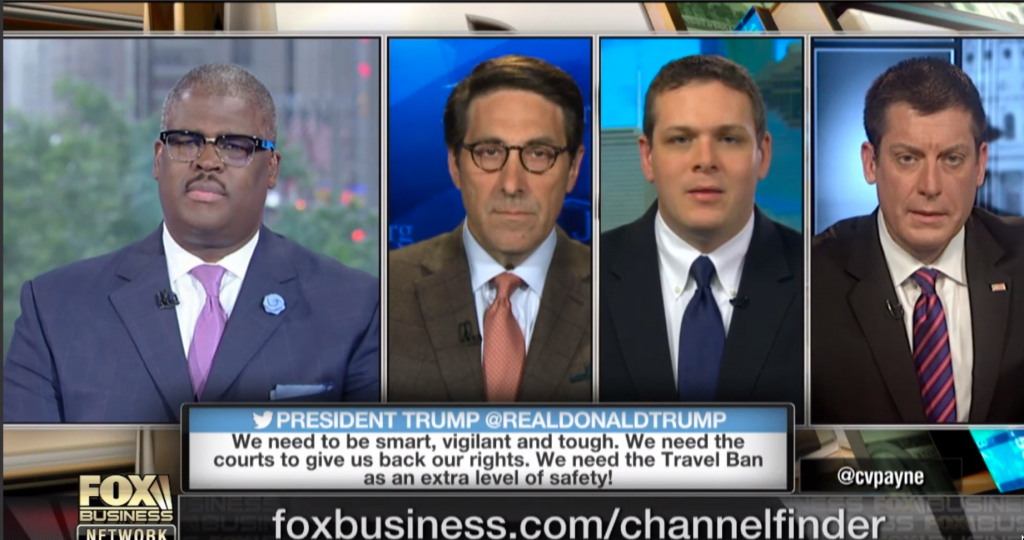
Today I appeared on Making Money with Charles Payne on the Fox Business Network, alongside Jay Sekulow (ACLJ) and Ford O’Connell. I discuss the somewhat provocative notion (first hinted at by Jack Goldsmith in February and echoed today by Joseph Fishkin) that Trump may be trying to lose the case, and if a terrorist attack happens, he can pin it on the courts. I hope I am wrong about this.


All The President’s Tweets

June 5th, 2017

Early this morning, apparently in response to a segment on Morning Joe, President Trump unleashed a Twitter storm about the travel ban cases, one of which has been appealed to the Supreme Court.

These missives followed his Saturday-night tweet, issued shortly after the terrorist attack on London Bridge:

As a threshold matter, it is entirely inappropriate for Presidents to comment on cases while they are pending before the judiciary. Calling the courts “slow and political” is beyond the pale. I dedicated an entire chapter in my book Unraveled on presidential commentary from Franklin D. Roosevelt to Barack Obama concerning pending Supreme Court cases. Alas, we have moved far beyond the usual bounds of objections, so I will put this aside for the moment. Far more pressing is what these barbs reveal about the President’s grasp of his own administration, and how it affects the appeal in IRAP v. Trump.

First, his tweets show utter disregard for the Justice Department’s legal strategy. According to the Solicitor General, the 90-day ban on entry from certain countries was never meant to be a permanent policy. Rather, it was a pause designed to provide the government an opportunity to reassess its vetting procedures. By insisting on calling the policy a “travel ban”—notwithstanding his attorney’s insistence to the courts that this is not what the policy about—the President undermines the Solicitor General’s arguments about the nature of the policy. Here, the “sole organ” puts his foot in his mouth.

Second, it is confounding that Trump blames the Justice Department for the second executive order, which he refers to as “watered down” and “politically correct.” In court, the lawyers have explained, correctly in my mind, that the second order was crafted to respond to the Ninth Circuit’s decision in Washington v. Trump upholding a preliminary injunction on the first order. Alas, Trump’s comments, once again, undercut that strategy. More pressingly though, his remarks mistake who runs the show in our separation of powers system. The buck stops here. If the President did not want to sign the revised order, he did not have to. To be more precise, his own White House Counsel should bear whatever responsibility exists for the fact that the President signed the order. As a whole, these tweets are far less probative of the current travel ban litigation, and far more revealing about the President’s lack of knowledge, both about how his own administration works and the contents of his signature policy.

Third, and perhaps most troubling, what does Trump mean when he calls for the Justice Department to seek a “much tougher version”? Is he referring back to the initial January 2017 executive order, or is he referring to an even tougher version that will be released after the current one winds its ways through the courts? As usual, parsing the President’s 140-character bursts is fraught with difficulties. If he is referring to the latter, then did he inadvertently tip what he intends to do after the Supreme Court completes its review?

Finally, much ado has been made today about the fact that he called it a “travel ban” and referred to the current version as “watered down.” This is not new language from Trump. The plaintiffs have read his previous reference to the “watered down” order to refer back to his original promise on the campaign trail to ban all Muslims, but for reasons I discuss in Part I of my series on IRAP v. Trump, this is not a plausible construction of his entire remarks from that speech.

That said, Trump’s use of the word “ban” raises questions. During a January 31 press conference, a reporter asked Sean Spicer about the President referring to it as a “ban.” Spicer denied that it was a ban, citing Homeland Security Secretary Kelly’s statement to the contrary. It is remarkable that the President’s own cabinet cannot get on the same page as the President. Why did Trump call it that? “He’s using the words that the media is using,” Spicer replied. The reporter followed up “It’s his words, his tweet.” Spicer replied, “I think that the words that are being used to describe it are derived from what the media is calling this. He has been very clear that it is extreme vetting.” This phrase, “extreme vetting,” is also how Trump described the order in his final tweet this morning.

What does all of this mean for the Supreme Court’s resolution of IRAP v. Trump? Under Kerry v. Din and Kleindienst v. Mandel, the Court’s review for legitimacy and bona fides is limited to the four corners of the policy. If the Justices abide by those precedents, none of these statements will be relevant. However, in the broader context of the applications for stay and petitions for certiorari, these tweets may raise several questions. First, if the government is already doing “EXTREME VETTING” to “help keep our country safe” while the executive order is enjoined, is it necessary to stay the district court’s injunction as the government requests? Second, does the government plan to issue a “much tougher version” of the revised executive order? If so, when would it be issued, and how would that effect the timing and potential mootness of the cert petition? Third, does the President actually support the revised travel ban, which he has repeatedly criticized as “watered down”?

In general, talkative clients pose distinct difficulties for attorneys, as statements outside the court can frustrate strategies inside the court. These difficulties are amplified exponentially when the client is the President of the United States, and he continuously sabotages his lawyers, who are struggling to defend his policies in an already-hostile arena. I do not envy the Solicitor General’s office.

Cross-Posted at Lawfare

Analysis of IRAP v. Trump Part V: Judge Shedd and Judge Agee’s Dissents, and the Government’s Petitions for Certiorari and Applications for Stay

June 2nd, 2017

This is the final part of a five-part series on the Fourth Circuit’s recent en banc decision in IRAP v. Trump. Part I analyzed how the court considered pre- and post-inauguration statements. Part II analyzed how the court marshals the Supreme Court’s precedents concerning standing, reviewability of immigration decisions, and the Establishment Clause. In Part III, I analyzed the concurring opinions of Judges Keenan, Thacker, and Wynn. Part IV analyzed Judge Niemeyer’s dissent. Part V will analyze the dissents of Judges Shedd and Agee and discuss the possible paths ahead following the Solicitor General’s appeal to the Supreme Court.


National Security

Judge Shedd’s dissent, which was joined by Judges Niemeyer and Agee, charged that the majority opinion disregards the “potentially grave consequences for our country.” Citing the Supreme Court’s decision in Boumediene v. Bush (2008), Judge Shedd stresses that the “President and his national security advisors (unlike federal judges at all levels, lawyers, and commentators) have constant access to information ‘that may describe new and serious threats to our Nation and its people.’” The parenthetical is an unsubtle indictment of the majority, which, through a misreading of Mandel, performs what Judge Niemeyer refers to as “its own review of the national security justifications supporting the Order.” Remarkably, the en banc court privileges the determinations of “the comments of former national security officials made in an amicus brief” over the position of current national security officials.” Furthermore, Judge Shedd observes that many of these “former government officials  . . . openly oppose this President.”

At bottom, the Fourth Circuit approach reflects some form of strict scrutiny, or what Judge Shedd calls a “least-restrictive means test.” In his view—which I share—this is not the appropriate standard of review for national security cases, especially where Mandel calls only for a facial review of the policy. (See Part IV.) And even if the President had an improper motive, the court still must conclude that those implementing the policy—the Attorney General and Secretary of Homeland Security—share that motive. The dissent notes that there is, however, no allegation of “bias on the part of his Cabinet officials,” nor have the plaintiffs challenged “the integrity of the Attorney General and Secretary of Homeland Security.” If this is so, Judge Shedd asks, then the lower court erred when it “essentially ignored or rejected their detailed national security advice to the President.”

It is worth stressing that even the dissenters in Mandel, who took a position against the government, emphasized how different the constitutional analysis would be if actual national security interests were at stake. “I put the issue that bluntly because national security is not involved,” wrote Justice Douglas. “Nor is the infiltration of saboteurs” involved. The Roosevelt appointee added that Congress did not vest the Attorney General with the “discretion to pick and choose among the ideological offerings”—that is, speakers on one topic or another—rather, “the Attorney General is left only problems of national security, importation of heroin, or other like matters within his competence.” Justice Marshall added, “Government may prohibit aliens from even temporary admission if exclusion is necessary to protect a compelling governmental interest,” such as [a]ctual threats to the national security.” These are lessons the Fourth Circuit should well consider.


Standing and Injury

Judge Agee’s dissent concerned justiciability. “In their haste to reach the merits of the plaintiffs’ Establishment Clause claim,” he noted, “my colleagues in the majority neglect to follow the longstanding and well-defined requirements of Article III of the United States Constitution.” For reasons I discussed in my prior post, some of the plaintiffs have suffered a cognizable Article III injury, but to reach that result the majority’s analysis goes far beyond the Court’s precedent. Here, I will focus on a different aspect of Judge Agee’s dissent: the interplay between standing for purposes of the Immigration and Nationality Act, and standing for the Establishment Clause. As a threshold matter, the Supreme Court has recognized that plaintiffs are required to “demonstrate standing separately for each form of relief sought.” Judge Agee notes that en banc court “haphazardly merges alleged injuries unique to two different claims, and personal to different people, to manufacture standing.”

In Mandel, the Court recognized that aliens outside the United States could not bring constitutional challenges, such as asserting a First Amendment right to communicate with Americans. However, American scholars could assert a First Amendment right to communicate (in person!) with the alien. (The word “standing” appears nowhere in Mandel; I am noncommittal on whether this decision comports with modern standing jurisprudence.) Likewise, aliens who are subject to the travel ban cannot, in their own right, bring an Establishment Clause claim. Rather, the only parties that could bring the claim are the alien’s associates (relative or organization) within the United States. But such a suit is not so simple. While there is ample precedent to support the notion that Americans can bring a First Amendment-speech claim in order to interact with others, there is no similar precedent establishing that Americans can bring a First-Amendment-Establishment Clause claim on behalf of others. Judge Agee explains, “Plaintiffs do not have standing to allege violations of the Establishment Clause on behalf of their immigrant relatives.”

The injury that the plaintiffs assert must be premised on the Immigration and Nationality Act, which specifically countenances spouses, relatives, and other organizations being able to petition for visas. But even here, the asserted injury is not yet ripe. Judge Agee notes that with respect to one of the plaintiffs, “[h[is alleged injury is based on a mere conjecture that his wife will have her embassy interview and obtain a discretionary visa within the ninety-day suspension period of the Executive Order when the State Department has cautioned, well before the Executive Order, that it may take an indefinite period to schedule interviews much less adjudicate visa applications.” For reasons I highlighted in Part IV of this series, I am not convinced the Mandel test is applicable until an actual denial is issued. The Solicitor General makes a similar point in his petition for a writ of certiorari: “Mandel’s substantive standard applies to challenges to decisions to deny visas to aliens seeking entry. It does not govern every issue concerning immigration—such as post-removal detention.” Though there ultimately may be an injury, the challenge is not proper at this juncture.


From Richmond to Washington

This case is on a collision course with the Supreme Court. In at least two points in his dissent, Judge Niemeyer spoke directly to the Justices. First, of the Fourth Circuit’s reliance on campaign statements, he wrote that “[t]he Supreme Court surely will shudder at the majority’s adoption of this new rule that has no limits or bounds.” Second, with respect to the majority’s reading of Mandel, he wrote that “[u]nless corrected by the Supreme Court, the majority’s new approach, which is unsupported by any Supreme Court case, will become a sword for plaintiffs to challenge facially neutral government actions, particularly those affecting regions dominated by a single religion.”

The dissenters also highlight, subtly, how a decision against President Trump, in the earliest days of his administration, could hobble the administration going forward. Judge Niemeyer worries that “our courts will be faced with the unworkable task of determining when this President’s supposed religious motive has sufficiently dissipated so as to allow executive action toward these or other majority” (emphasis added). I emphasized “this President,” because indeed, such rulings would invariably apply only to this President. The majority invokes what Quinta Jurecic refers to as a “jurisprudence for an oathless president.” Chief Judge Gregory attempts to cabin the decision to Trump, and Trump alone:

If and when future courts are confronted with campaign or other statements proffered as evidence of governmental purpose, those courts must similarly determine, on a case-by-case basis, whether such statements are probative evidence of governmental purpose. Our holding today neither limits nor expands their review (emphasis added).


The deference we give the coordinate branches is surely powerful, but even it must yield in certain circumstances, lest we abdicate our own duties to uphold the Constitution” (emphasis added).

Judge Shedd acknowledged that though this decision may amount to a “political defeat for this President . . . it is shortsighted to ignore the larger ramifications of this decision.” Specifically, “the President and his national security advisors (and perhaps future Presidents) will be seriously hampered in their ability to exercise their constitutional duty to protect this country” (emphasis added). I emphasized future Presidents, because any decision that the Supreme Court reaches will invariably be cited in future legal challenges, no matter how the Justices attempt to narrow it. Such a narrowing effort need not be quite as explicit as Chief Justice Rehnquist’s admonition in Bush v. Gore that “[o]ur consideration is limited to the present circumstances.” But in the context of the separation of powers, a “ticket good for one [president] only” is a very dangerous precedent. And that is precisely what the Fourth Circuit issued.


The Solicitor General’s Filings

Late Thursday evening, the Solicitor General filed three documents with the Supreme Court: a petition for certiorari in IRAP v. Trump; an application for a stay pending disposition of the cert petition in IRAP v. Trump; and an application for a stay pending appeal to the Ninth Circuit in Hawaii v. Trump, or in the alternative, a petition for certiorari before judgment. These filings begin a game of three-dimensional chess.

President Trump’s revised executive order, issued on March 6, 2017 and set to go into effect ten days later, envisioned an intricate process to prevent terrorists from entering the United States—a process that was, of course, truncated by the ensuing litigation. Section 1(a) established that it is the executive’s policy to “improve the screening and vetting protocols and procedures associated with the visa-issuance process” and the U.S. Refugee Admission Program (USRAP). Section 1(e) provides “brief descriptions” of why nationals from Iran, Libya, Somalia, Sudan, Syria, and Yemen “continue to present heightened risks to the security of the United States.” Section 1(f) concludes that “until the assessment of current screening and vetting procedures required by section 2 of this order is completed, the risk of erroneously permitting entry of a national of one of these countries who intends to commit terrorist acts or otherwise harm the national security of the United States is unacceptably high.” Section 2, which has seven sections, provides the details to implement this inward facing review process and outward facing travel ban. The 90-day suspension of entry in Section 2(c) was not an end unto itself, but was designed to provide the government with an opportunity to reassess its vetting procedures.

Two different nationwide injunctions have prevented the government from enforcing key provisions of Executive Order 13,780. On March 16, 2017, the day the order was to go into effect, Judge Theodore D. Chuang of the District of Maryland entered an injunction in IRAP v. Trump barring the executive branch from enforcing Section 2(c) of the order. Section 2(c) suspends entry of certain aliens from six nations for 90 days from the effective date of the order. However, Judge Derrick K. Watson of the District of Hawaii’s injunction more broadly enjoined the executive branch “from enforcing or implementing Sections 2 and 6 of the Executive Order across the Nation.” Two days later, the Solicitor General filed a motion for clarification, asking whether the order “enjoins purely internal activities of the government as described in both Sections 2 and 6, such as Section 2’s provisions addressing agency review of global vetting procedures that was to take place during the suspension-of-entry period.” Judge Watson promptly denied the motion for reconsideration, stating that “there is nothing unclear about the scope of the Court’s order.” Sections 2 and 6 remained enjoined. The Ninth Circuit’s denied the Solicitor General’s request to stay the injunction.


What Next?

I suspect that at least four Justices are inclined to grant the petitions for certiorari, though that review is complicated by the wildcard of the Hawaii injunction. There are three possible outcomes.

First, at any moment—perhaps before the respondent’s reply briefs are due to the Supreme Court on June 12–the Ninth Circuit could issue its ruling that could narrow the injunction to Section 2(c), such that the government can perform its internal deliberations. This decision would restart the clock, and potentially moot the case before the Supreme Court hears it. Amir Ali writes that “By continuing to block the entry ban, but allowing the government to conduct its 90-day review, the Ninth Circuit can give the challengers back this powerful argument to put an end” to the travel ban. Under this route, the challenge could be mooted by the time the case finally hears arguments. In such a case, the case could become moot. Specifically, under the Munsingwear doctrine, if a case becomes moot while pending before the Court, the lower court decisions are vacated. Justice Douglas explained nearly six decades ago that “[t]he established practice of the Court in dealing with a civil case from a court in the federal system which has become moot while on its way here or pending our decision on the merits is to reverse or vacate the judgment below and remand with a direction to dismiss.” This option would allow the Court to wipe off the books the flawed decisions of the Fourth and Ninth Circuits without forcing it to put its stamp of approval on the travel ban (for now at least).

Second, Mark Tushnet urges the Supreme Court to take the “easy out”: “Grant the stay of the Hawaii injunction, thereby allowing the government to proceed with its internal review of screening procedures, deny the stay of the Fourth Circuit injunction, and do whatever the heck they want about the petition for certiorari.” This case, he writes, “will then almost certainly be moot by the time it’s argued, and all that would be left would be to clean things up, presumably by directing that whatever injunctions are still in effect should be vacated.” Like with the first option, under the Munsingwear doctrine, the lower court decisions would also be vacated.

Then there is door number three. Marty Lederman writes that regardless of what happens to Hawaii v. Trump, the 90-day period will expire on June 14, 2017:

Section 2(c) of the Order provides that “the entry into the United States of nationals of [the six designated] countries be suspended for 90 days from the effective date of this order.”  And Section 14 of the Order specifically provides that the “effective date” of the Order was 12:01 a.m. on March 16.  Accordingly, the E.O. itself provides that the suspension prescribed in Section 2(c) ends at 12:01 a.m. on Wednesday, June 14, whether or not any courts have enjoined its implementation in the interim.

Under his reading, the district court injunctions cannot toll the process because the President’s order established a date certain. I’m inclined to agree with Will Baude, who writes that “[t]he order will last until it has done what it says it is going to do, namely suspend entry for 90 days.”

Further, this is not how the government has construed Judge Watson’s order. Acting Solicitor General Jeffrey Wall said that after the Hawaii ruling, his clients put their “pencils down.” For those who put stock in statements made on cable news, last week Homeland Security Secretary told Chris Wallace on Fox News Sunday that it could not review new vetting procedures because “we are enjoined.” The Court is not bound by the executive branch’s interpretation of its own executive order, but this position is entitled to some degree of deference, especially where the government represents that it is trying in good faith to comply with a court’s ruling and act in a lawful manner.

Later in his post, Lederman suggests that to avoid the mootness problem, the President could issue another order “extending the entry ban beyond June 14–say, to X days after the Secretary begins the Section 2(a) assessment, rather than to a date certain.” But, as Lederman notes, this would not affect the fact that the original March executive order—the order that is the subject to the litigation—would still retain the June 14 date certain.

If the Court is inclined to keep the case, it can do so through the voluntary cessation doctrine, especially if the specifics of a new executive order are identical to the earlier one. As the Court noted in Friends of Earth v. Laidlaw Environmental Services (2000), “a defendant claiming that its voluntary compliance moots a case bears the formidable burden of showing that it is absolutely clear the allegedly wrongful behavior could not reasonably be expected to recur.” In this situation, the government would represent the exact opposite: it intends to continue the conduct through the new executive order, not that it would cease that behavior. Here, the Court could avoid the suggestion of mootness based on the revised executive order. (I discuss the voluntary cessation doctrine here, in the context of the withdrawal of the January 2017 travel ban.)

After several months of the lower courts dictating the pace of this litigation, now the ball is in the Supreme Court. If the Justices want to take the case, the mootness doctrine will not stop them. If the Justices want to vacate the lower-court decisions, without issuing a ruling on the merits, Munsingwear provides an out. If the Justices want to schedule a special sitting in September, and hear this case on an even faster schedule than the SG requested, they can do that also. Now, all we can do is wait.
Cross-Posted at Lawfare