Blog

Between 2009 and 2020, Josh published more than 10,000 blog posts. Here, you can access his blog archives.

2020
2019
2018
2017
2016
2015
2014
2013
2012
2011
2010
2009

Analysis of IRAP v. Trump Part III: The Concurring Opinions of Judges Thacker, Keenan, and Wynn

May 31st, 2017

This post is the third part of a four-part series on the Fourth Circuit’s recent en banc decision in IRAP v. Trump. Part I analyzed how the court considered pre- and post-inauguration statements. Part II analyzed how the court marshals the Supreme Court’s precedents concerning standing, reviewability of immigration decisions, and the Establishment Clause.

In this post, I will focus on the far more modest concurring opinions of Judges Keenan and Thacker, which were aimed right at the Supreme Court, and the less modest concurring opinion of Judge Wynn. Part IV will analyze the three dissents from Judges Niemeyer, Shedd, and Agee, which were aimed at highlighting for the Supreme Court how their colleagues selectively cited the record and deviated from precedent.

Judge Thacker’s Statutory Argument

Judge Thacker’s concurring opinion (pp. 129-47) parts with the majority opinion on both the constitutional and statutory questions. On the Establishment Clause question, she “would not consider remarks made by candidate Trump before he took his presidential oath of office.” However, limiting her review to “remarks made or sentiments expressed after January 20, 2017,” she would still find a violation of the Establishment Clause. As I indicated in Part I of my series on this case, my view is that Judge Thacker reads certain statements from Trump and his associates out of context and reaches unsupported conclusions about the president’s post-inauguration purpose. I won’t rehash those arguments here. Instead, I’ll focus on the second place where Judge Thacker differs from her colleagues.

The majority opinion declines to reach the statutory question about whether the travel ban violates the Immigration and Nationality Act (INA). In contrast, Judge Thacker “conclude[s] Appellees have demonstrated a likelihood of success on the merits of their argument that Section 2(c), as it applies to immigrant visas, violates 8 U.S.C. § 1152(a)(1)(A)” of the INA (p. 129). This conclusion does not appreciate the important distinction between entry and visa issuance under the statute.

§§ 1152 and 1182

Recall that there are two relevant statutory provisions. The first provision, 8 U.S.C. § 1182(f), gives the president the power to deny or restrict entry to certain classes of aliens “[w]henever the President finds that the entry of any aliens or of any class of aliens into the United States would be detrimental to the interests of the United States.”

The second provision, 8 U.S.C. § 1152(a)(1)(A), prohibits the government from discriminating based on nationality (but not religion) with respect to the issuance of immigrant visas. It states that, with exceptions, “no person shall receive any preference or priority or be discriminated against in the issuance of an immigrant visa because of the person’s race, sex, nationality, place of birth, or place of residence.” 8 U.S.C. § 1152(a)(1)(B) provides that subparagraph (A) does not “limit the authority of the Secretary of State to determine the procedures for the processing of immigrant visa applications or the locations where such applications will be processed.”

As a threshold matter, Judge Thacker limits her analysis to immigrant visas—properly, in my view, but thereby rejecting the line of argument put forth in parallel litigation by Neal Katyal, who urged the Ninth Circuit to extend § 1152(a)’s prohibition to immigrant visas and non-immigrant visa alike. Under Judge Thacker’s reasoning, § 1152(a) could not provide relief to those seeking non-immigrant visas. For that reason, the statutory argument does not resolve the entire case and the plaintiffs’ constitutional arguments must be considered at least as they apply to non-immigrant visas. In that sense, Judge Thacker’s position, which cannot address the legality of the travel ban as a whole, could still impact other areas of immigration law (pp. 140-49).

The core question is how § 1152 and § 1182 interact. Since the outset of this litigation, I have written that the statutory provisions are not in conflict because they operate based on different areas of immigration law. (See Parts I, II, III, and IV). Section 1182 accords the president broad discretion to bar entry into the United States, and Section 1152, which prohibits nationality-based discrimination, concerns the issuance of immigrant visas. The government reads the statutes in the same way. In fact, Solicitor General Wall explained that this is how the State Department has interpreted these provisions for decades, a position that warrants some degree of deference.

Judge Thacker rejects the government’s construction of these statute. She writes that it is “circular logic” for the government to argue that “when an alien subject to [EO-2] is denied an immigrant visa, he is not suffering discrimination on the basis of nationality of the sort prohibited by Section 1152(a)(1)(A); instead, he is being denied a visa because he has been validly barred from entering the country.” Under this logic, as she sees it, “an alien is barred from entry because he does not have and cannot attain a visa, but he is denied a visa because he is barred from entry.” Thus, she concludes, “the visa issuance and entry concepts are intertwined to the point of indistinguishability.”

Contrary to Judge Thacker’s assertion, the government’s position is not circular. In immigration law, a visa is a necessary but not sufficient condition for entry. This point, that the two statutory provisions deal with “two distinct actions in the context of immigration” and that aliens with a valid visa may still not be allowed to enter, is one that Judge Keenan highlights in her concurring opinion (in the only part not joined by Judge Thacker). As Judge Keenan points out, an alien with a visa could be denied admission “for a variety of reasons set forth elsewhere in the INA.” For example, a person with a valid visa could be denied entry at the airport due to the fact that he has a communicable disease or by providing incorrect information to a federal. Entry and visas are certainly related, but are not “intertwined to the point of indistinguishability.” More importantly, as Judge Keenan notes, Judge Thacker’s analysis has the effect of disregarding the usage of different terms in the “plain language” of the statute itself: “entry” and “visas.”

Assuming that § 1152 controls the travel ban, Judge Thacker adduces two primary reasons why the non-discrimination provision prevails.

First, Judge Thacker asserts that “[r]eading § 1182(f) as bestowing upon the President blanket authority to carry out a suspension of entry, which involves rejecting a particular country’s immigrant visa applications as a matter of course, would effectively nullify the protections in § 1152(a)(1)(A) and create an end-run around its prohibitions against discrimination” (p. 145). But § 1152(a)(1), as a whole, need not be so read. Subparagraph (B) of the provision allows the Secretary to adopt “procedures for the processing of immigrant visa applications” that could explicitly be based on national origin. That is, subparagraph (B) states that subparagraph (A) “shall [not] be construed to limit” the Secretary’s authority. Judge Thacker argued that reading subparagraph (B) in this fashion should render subparagraph (A) a nullity.

In my view, this is incorrect. The general policy is that visas should be issued without concern for nationality. The history of this provision reveals that Congress’s primary concern was to eliminate nationality-based quotas, which were a staple of our immigration law before 1965. But when the Secretary deems it necessary, he can adopt special procedures for issuing visas that take into consideration nationality. Simple examples could include the adoption of different procedures for embassies in certain countries where the risk of fraud is higher. Broader examples could include, as here, the adoption of stronger vetting processes to screen out risks of terrorism. The prohibition is not nearly as strict as subparagraph (A) suggests. In any event, the best way to avoid reading subparagraph (A) as a nullity is to treat “entry” and the issuance of visas as separate concepts. This reading is buttressed by § 1182(f), which gives the Secretary the ultimate trump card: deny entry to classes of aliens, even if they have validly issued visas, based on national security concerns. The greater power to deny entry includes the far lesser power to deny a visa.

Second, Judge Thacker notes that when enacting § 1152 more than a decade after § 1182, Congress intended to curtail the president’s authority under the older provision. But there appears to be nothing in the legislative history of the 1965 INA to suggest that Congress was attempting to restrict the president’s power over denial of entry. In addition, as a matter of experience, Judge Thacker fails to account for historical practice, such as the fact that President Reagan expressly barred Cubans from entering the United States under § 1182. In his Proclamation 5517 (1986), he justified this exclusion on the ground that he “found that the unrestricted entry into the United States as immigrants by Cuban citizens would . . . be detrimental to the interests of the United States.”

Judge Thacker was no doubt aware of the proclamation, as Judge Wynn addresses it in his concurring opinion. Judge Wynn argues in footnote 11, however, that this single action was never reviewed by a court, may be unconstitutional, and is not sufficient to establish a new precedent. While I agree that past practice does not suggest an action is constitutional, presidential custom provides a helpful gloss on our laws and the parameters of executive power. But beyond this gloss, there is another canon of statutory interpretation that bears on the resolution of these questions. Indeed, it is the elephant in the room: Article II.

Inherent Article II Power

President Trump’s denial of entry to nationals of six countries, like President Reagan’s denial of entry to Cubans, is premised not entirely on § 1182 but also on the president’s Article II authority. That invocation of power has implications for how we should interpret the parameters of his power, and the relevant statutory framework.

As I noted in one of my earlier posts on the topic, § 1182 can be viewed as a reaffirmation of the president’s Article II authority to turn away those at the border he deems detrimental to American interests. On this view, the president would not even need statutory authority. Consider if in the immediate aftermath of Pearl Harbor, even before the Declaration of War, President Roosevelt unilaterally halted the entry of Japanese nationals into the United States until Congress could act. Even in the absence of congressional authorization, such a temporary measure would almost certainly be lawful. (FDR had such statutory authority to bar entry to aliens pursuant to his declaration of a “national emergency,” though I suspect this statute was a reaffirmation of what the Commander in Chief would already do in such a scenario).

Here, however, we do not need to worry about unilateral authority in this case, because Congress gave the President. explicit statutory authority. This delegation brings us within Justice Jackson’s first tier of Youngstown. Here, presidential power is at its maximum, and judicial scrutiny is at a minimum. Courts should avoid any construction of § 1152 or § 1182 that intrudes on the president’s authority to deny entry to those he deems dangerous. But there is no need to rely on an avoidance canon, because both statutes are best read to allow the President to deny entry to classes of aliens, an act separate and apart from the issuance of visas.

Note that Judge Wynn directly addresses the argument concerning inherent constitutional authority:

Additionally, because the Executive Order cites the Immigration Act as the sole statutory basis for the President’s authority to proclaim Section 2(c)’s suspension on entry, I need not, and thus do not, take any position on the scope of the President’s delegated power to deny entry to classes of aliens under other statutes. Likewise, because the claim at issue relates only to Section 2(c)’s compliance with the Immigration Act, I do not address whether, and in what circumstances, the President may deny entry to classes of aliens under his inherent powers as commander-in-chief, even absent express congressional authorization. See The Prize Cases, 67 U.S. 635 (1862) (p. 98).

The Obama administration was hesitant to defend their actions based on inherent Article II powers, preferring instead to rely on intricate and multi-factored statutory arguments, aimed at cabining the authority of the Presidency. (See Jack Goldsmith’s commentary about the release of detainees at Guantanamo Bay and the longer-than-sixty-day bombing campaign of Libya). The Trump administration, perhaps like the Bush administration before it, may not be so hesitant. To the extent these statutory arguments prevail on appeal, the government may raise constitutional avoidance arguments.

Along similar lines, Judge Wynn suggests that Congress (and by extension, the president) has greater powers to exclude aliens during times of war. By implication, we are not at war, and such power is therefore lacking. Citing Justice Frankfurter’s concurring opinion in Korematsu (a case that is worlds apart from IRAP v. Trump), Judge Wynn argues that “Congress’s constitutional power to control immigration—and authority to delegate that control—fundamentally differs in a time of war.” He adds, “The Supreme Court’s broadest statements regarding the scope of the president’s delegated powers over immigration—which are relied upon by the Government—are in cases in which Congress expressly declared war and authorized the president to deny entry to aliens as part of his prosecution of the conflict.”

Are we at war? This argument raises the question of whether the 2001 and 2002 Authorizations for Use of Military Force, which both the Obama and Trump administrations have used to fight ISIS, provide support for the president’s terrorism-based travel ban. (To be precise, I do not think either AUMF provides authority to cover conflicts with ISIS). This is yet another reason to read the statues to avoid reaching these thorny constitutional questions. The Supreme Court has shied away from this question, as reflected in its decision to reverse Justice Douglas’s holding in Schlesinger v. Holtzman that the bombing runs in Cambodia were part of an undeclared, unconstitutional war.

Judge Keenan’s Concurring Opinion

Judge Keenan’s concurring opinion (pp. 81-93) proposes a different statutory argument. Unlike Judge Thacker’s reading of the INA, which would provide relief only to those seeking immigrant visas, Judge Keenan’s position would be something of a silver-bullet that wins the case for the challengers without touching on the constitutional question. In short, she argues that President Trump’s proclamation did not make sufficient findings to meet the requirements of Section 1182(f), and thus lacks the authority to deny entry to aliens from the six selected nations.

Recall that the second executive order provides that the unrestricted entry of nationals from the six target countries “would be detrimental to the interests of the United States” and then “direct[s] that the entry into the United States of nationals of those six countries be suspended for 90 days from the effective date of this order, subject to the limitations, waivers, and exceptions set forth in sections 3 and 12 of this order.”

Judge Keenan explains that Trump’s findings are too speculative to meet the stringent requirements of § 1182(f). She writes that “[t]he plain language of Section 1182(f) permits a president to act only if he ‘finds’ that entry of the aliens in question ‘would be detrimental to the interests of the United States’” and that “an unsupported conclusion will not satisfy this “finding” requirement.” Accordingly, she walks through the four corners of the executive order—avoiding any campaign-trail missives—and concludes that the “the Second Executive Order does not state that any nationals of the six identified countries, by virtue of their nationality, intend to commit terrorist acts in the United States or otherwise pose a detriment to the interests of the United States” (p. 88).

Here is her key analytical move: § 1182(f) concerns the exclusion of individuals, not countries. In contrast, President Trump’s executive order focuses on countries, not individuals. Because the executive order “does not identify a basis for concluding that entry of any member of the particular class of aliens, namely, the more than 180 million nationals of the six identified countries, would be detrimental to the interests of the United States,” the order does not meet the requirements of Section 1182(f), the text of which “plainly requires more than vague uncertainty regarding whether their entry might be detrimental to our nation’s interests” (p. 89).

In short, § 1182(f) mandates that the president find that “the entry of any aliens or of any class of aliens into the United States would be detrimental to the interests of the United States” (emphasis added). Judge Keenan asserts, and the Solicitor General’s argument does not dispute, that the executive order only concerns aliens that may be detrimental. So the question is: would the Supreme Court halt the travel ban because of the difference between would and may?

This is a very sophisticated textual argument, which I flagged on Lawfare and in the NY Daily News following oral arguments. Critically, it offers the Supreme Court a way to rule against the executive without impairing other government policies—indeed only Presidents Reagan and Trump employed § 1182(f) against nationals of specific country, rather than nationals with offending affiliations. It also avoids reaching difficult constitutional questions concerning the Establishment and Due Process Clauses. (Though constitutional avoidance may caution against such a construction).

Were this a run-of-the-mill statutory interpretation case, I would be inclined to agree with Judge Keenan’s textualist approach. But such is not the case. I think Judge Keenan’s parsimonious construction of § 1182(f) is inconsistent with the loose mode of statutory interpretation employed by the Supreme Court in Dames & Moore v. Regan.

Dames & Moore v. Regan

After the Iran hostage crisis, President Reagan agreed to suspend court proceedings involving Iran and to nullify pending attachments of Iranian property. The Dames & Moore company, which had a valid judgment against Iran, argued that Reagan’s actions were not supported by statutory authority. The opinion by Justice Rehnquist reaffirmed Justice Jackson’s seminal concurring opinion three decades earlier in Youngstown Sheet & Tube Co. v. Sawyer explaining that the president’s powers are their height when he is acting pursuant to congressional authorization and at their “lowest ebb” when acting contravention of congressional will. (Fun fact: Justice Rehnquist clerked for Justice Jackson the year Youngstown was decided; and Chief Justice Roberts clerked for Justice Rehnquist the year Dames & Moore was decided).

In Youngstown, recall that Justice Jackson found that Congress had not given President Truman the statutory authority to seize the steel mills to avert a labor strike. Along similar lines Justice Frankfurter noted in his concurring opinion, that Congress expressly considered granting the president such authority, but withheld it: “By the Labor Management Relations Act of 1947, Congress said to the President, ‘You may not seize. Please report to us and ask for seizure power if you think it is needed in a specific situation.’”

Under the Youngstown rubric, § 1182(f) is worlds apart from the Labor Management Relations Act of 1947. Here, we have a direct delegation of authority for the president to deny entry to those he deems detrimental to the interests of the United States. Against this backdrop, reading too much into the distinction between may versus would is inconsistent with the framework of cases affecting presidential power and national security. Indeed, as I’ve argued since the outset of this case, the statutory analysis reveals that we are in Jackson’s first tier, and scrutiny must be at a minimum.

But were the inquiry difficult under Youngstown, the task becomes far easier under Justice Rehnquist’s extremely flexible gloss from Dames & Moore. To find the requisite statutory authority to uphold President Reagan’s suspension of claims against Iran, the unanimous Court employed a form of interpretive limbo, reaching to two statutes that bear only indirectly on what President Reagan did: the International Emergency Economic Powers Act (IEEPA) and the Hostage Act. Neither expressly permitted the suspension of claims, but the Court did not find that fact dispositive. Justice Rehnquist deemed “both statutes highly relevant in the looser sense of indicating congressional acceptance of a broad scope for executive action in circumstances such as those presented in this case.” He explained:

We think both statutes highly relevant in the looser sense of indicating congressional acceptance of a broad scope for executive action in circumstances such as those presented in this case. . . . . Congress cannot anticipate and legislate with regard to every possible action the President may find it necessary to take, or every possible situation in which he might act. Such failure of Congress specifically to delegate authority does not, “especially . . . in the areas of foreign policy and national security,” imply “congressional disapproval” of action taken by the Executive. Haig v. Agee, ante at 453 U. S. 291. On the contrary, the enactment of legislation closely related to the question of the President’s authority in a particular case which evinces legislative intent to accord the President broad discretion may be considered to “invite” “measures on independent presidential responsibility,” Youngstown, 343 U.S. at 343 U. S. 637 (Jackson, J., concurring). At least this is so where there is no contrary indication of legislative intent and when, as here, there is a history of congressional acquiescence in conduct of the sort engaged in by the President. It is to that history which we now turn. (emphasis added)

In contrast, President Trump did precisely what § 1182(f) authorized him to do: deny entry to classes of aliens he deems detrimental. You don’t need to turn to a “looser” approach, or consider “closely related” measures to find that President Trump had the requisite statutory authority to act. Congress said so in the statute with unequivocal language.

For these reasons, I don’t think Judge Keenan’s textual argument will prevail. The Court has never employed such a stringent and rigid approach to construing Congress’s delegations to the president in matters of national security. To the contrary, the Court in Dames & Moore adopted extremely dubious constructions of statutes to find support for executive actions—far more implausible than reading the word “would” in § 1182(f) more permissibly.

Finally, construing § 1182(f) in the narrow fashion Judge Keenan suggests requires reconsideration of two questions addressed earlier. First, President Reagan’s proclamation concerning Cuban nationals made no specific findings about why Cuban nationals “would” be detrimental to the interests of the United States, beyond generalized concerns about “normal migration procedures between the two countries.” To say Trump’s declaration is void is to say Reagan’s declaration was also void. Second, even in the absence of the statute, the president arguably has the power to exclude certain aliens based on Article II and the 2001 and 2002 Authorizations for Use of Military Force. (Again, I disagree with the Obama and Trump administration’s constructions of the AUMF, but they could advance this argument in court). Reading the statute so narrowly would require the Court to broach that issue. Or, the Court can simply read § 1182(f) as Dames & Moore compels, and find the president met the requirements.

Judge Wynn’s Concurring Opinion

I turn last to Judge Wynn’s concurring opinion (pp. 94-128), which sounds in the major question doctrine. He writes, “the Immigration Act provides no indication that Congress intended the ‘broad generalized’ delegation of authority in Section 1182(f) to allow the President ‘to trench . . . heavily on [fundamental] rights’” (p. 96). That is, if Congress had intended to allow the president to encroach on protected classes or classifications, it would have made the delegation explicit. Or, as Justice Scalia noted in MCI v. AT&T, Congress “does not, one might say, hide elephants in mouseholes.”

Under Judge Wynn’s self-styled “delegation of authority cannon,” when a statute does not provide explicit evidence of that delegation and the delegation potentially encroaches on fundamental rights, the delegated powers must be construed narrowly.

The Supreme Court’s 1958 decision in Kent v. Dulles is important to Judge Wynn’s point. As I noted in the Harvard Law Review, long before the articulation of the major question doctrine in cases like MCI v. AT&T and FDA v. Brown & Williamson Tobacco, “the Court recognized [in Kent] that Congress does not cryptically delegate to agencies unbounded discretion to burden constitutional rights.” Judge Wynn’s position parallels the brief I co-authored in the Little Sisters of the Poor case, contending that the Affordable Care Act did not delegate to the executive branch the authority to infringe on religious liberty. Our brief contended that Congress never delegated to the agencies the power to decide which religious organizations receive “exemptions,” and which receive mere “waivers.” As a result, the regulation in question was beyond the departments’ ken.

The theory has gained influence elsewhere. For example, Judge Kavanaugh’s recent dissent from denial of rehearing en banc in the net neutrality case calls for a reinvigoration of what he calls the major rule doctrine. I second that call—though I suspect IRAP v. Trump is not the appropriate case.

Judge Wynn’s approach offers the benefit of avoiding a constitutional ruling; that is, the court could strike down the proclamation as ultra vires, instead of as unconstitutional. But the problem with his approach is that where the challenged action is itself unconstitutional, the major question doctrine adds nothing to the equation. To apply the major question doctrine, the court would still have to reach the question of whether the proclamation is unconstitutional. As he notes on page 106, his analysis requires determining whether “Section 1182(f) would encroach on the core constitutional values set forth in the First, Fifth, and Fourteenth Amendments.” This framework is avoidance in name only. Indeed, the statutory argument in the concurring opinion is indistinguishable from the constitutional argument in the majority opinion, relying on the same sorts of evidence to find animus.

Cross-Posted at Lawfare
Property I Final Exam Grades and Comments

May 30th, 2017

Hello everyone. I apologize for interrupting your summer break with this note. I have submitted grades for Property. You can download the exam question, and the A+ paper (If this is yours, please drop me a line!). I am very proud of this class–these are among the highest grades I’ve given yet in Property I.

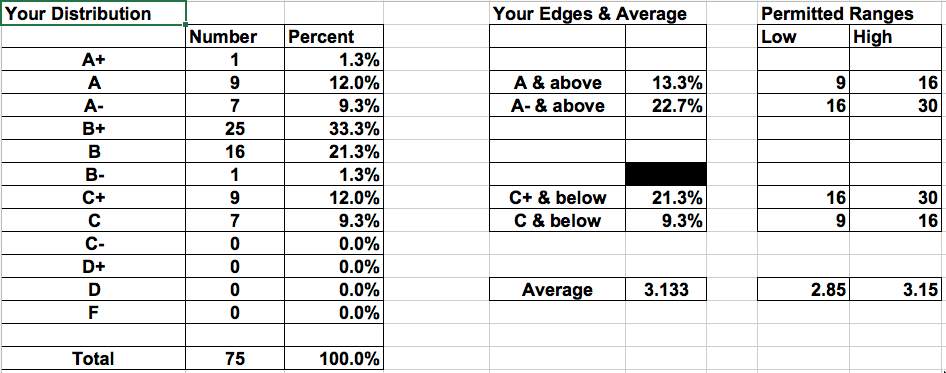
Here is the distribution for the final exam. The mean was 3.13.

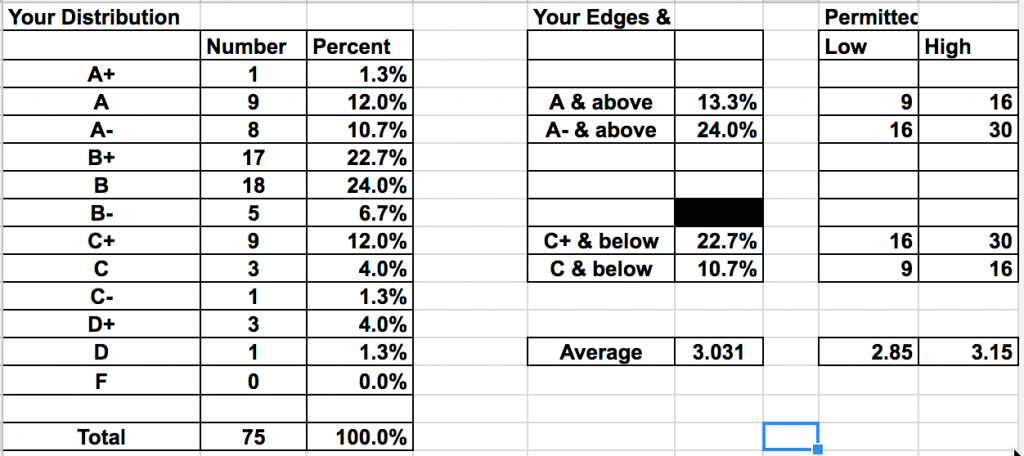
This is a significant improvement from the midterm, where the mean was 3.03.

In this post, I will provide some high-level feedback on the Terminator-themed exam.

Question 1.

1. The first question concerned the ownership of post-apocalyptic Los Angeles following Skynet’s “Judgment Day.” The best answers to this question involved our discussion of acquisition by conquest, stemming from Johnson v. M’Intosh. Some students assessed whether Skynet was civilized or savaged. Other answers incorporated discussions of Locke’s labor theory, as well as those of Pufendorf and Grotius.

2. This question concerned ownership of the man-machine chimera, Arnold. The best answers considered the doctrine of acquisition by creation, which we studied in INS v. AP and White v. Samsung. Further, because Arnold was also created with John’s eternal cells, Moore v. Board of Regents, and the related story of Henrietta Lacks, were on point.

3. This question involved the intellectual property rights of the manual to the time machine, which Arnold memorized and reproduced. Indeed, he improved upon it. These factors were relevant to deciding whether he violated any common law (no statutory patent) claims. INS v. AP and White v. Samsung was also relevant here.

4. This question involved a very, very complex conveyance involving present and future interests for Sarah, John, and John’s father (who we later learn to be Arnold). There were several acceptable answers here, though some stronger than others. First, John has a life estate pur autre vie that is subject to an executory limitation. Several students wrote that he has a fee simple determinable (due to the “so long as”), but his interest is better viewed as an estate that lasts until his father dies. The key point though is that the life estate is itself subject to an executory interest. They’re stacked. Specifically, John’s father has a shifting executory interest. But that is not enough. John’s father’s shifting executory interest is itself subject to a condition subsequent (due to the “but if”). Accompanying that condition subsequent is a right of entry in Sarah. I would also accept that Sarah had a contingent remainder (the heir is ascertained, but there is a condition precedent based on father’s survivorship). With this latter answer, because John is Sarah’s heir, he has a future interest as well. There were other permutations that were also acceptable. This question was designed so that you could explain why the interests line up one way or the other.

5. This policy question asks why in a post-Apocalyptic world property rights are important. The answer to this question concerns our very first week of class, when we discussed why we have property rights. Think of Robinson Crusoe (or Tom Hanks) alone on the island. Property rights serve no purpose. But when another castaway joins him, there is now a fierce competition for scarce resources, and property rules allow them to exist in (relative) harmony. Several students also referenced the Case of the Speluncean Explorers and acquisition by conquest/discovery.

Question 2

1. This question involved a fairly complicated community property question. California, like Texas, does not permit married couples to have joint tenancies in the same sense that common law property states allow. They are what we referred to in class as quasi-joint tenancies. This question takes a few twists and turns due to a possible ouster (locking Arnold out), Arnold’s mortgage (like the opening of a boxing ring), and John’s tenancy in common (which does not interfere with the couple’s joint tenancy).

2. This question called for an application of California’s “pro rata” rule, which concerned some payments made before and after the marriage. Here, the model answer missed the mark, as it applied Texas’s “time of vesting” rule. Five payments ($5,000 total) were made before the marriage. Those are Sarah’s separate property. Five payments ($5,000 total) were made after the marriage with joint assets. In the event of divorce, Sarah would receive her initial $5,000, and half of the joint-payments ($2,500) for a total of $7,500.

3. The ownership of the motorcycle involves several elements. First, Terminator stole it, such that his right is subordinate to the true owner. Second, Terminator promised Arnold that he could have the motorcycle “from my cold dead hands.” Was this an actual inter vivos gift? Or a gift causa mortis, as Arnold unplugged Terminator? Or did he, because Terminator later reanimated? Pardon my mixed 80s references, merging Terminator with the Princess Bride (“As you wish.”). Third, after Arnold is wounded, he promises it to John when he (Arnold) dies. But Arnold goes forward in time to 2029, and does not die for decades. Was this an inter vivos gift or a testamentary gift?

4. Question #4 was the flip side of question #3 from the first part. The answer here in large measure depended on how you handled the prior question. In short, John’s father (Arnold) had died, so the life estate pur autre vie terminated. Sarah had not exercised her right of entry, but that descends to her (only) heir John, who can now enter and claim it in fee simple. If you wrote that Sarah had a remainder, there is no need to enter. (As a side, the question established that John was Sarah’s only living heir, as the remainder of her family was wiped out on Judgment Day).

5. The final question was one asked by a student in class: why bother protecting marital property. We spent several spirited minutes discussing this question, which discussed fairness, efficiency, and equality of the sexes. Stronger answers brought in discussions of coverture, the Married Women’s Property Act, and community property regimes.

Thank you all for a wonderful semester.


Analysis of IRAP v. Trump Part II: The Fourth Circuit’s Misuse of Mandel, Din, Lemon, and Town of Greece

May 28th, 2017

This is the second part of a four-part series on the Fourth Circuit’s recent en banc decision in IRAP v. Trump. Part I analyzed the majority’s assessment of Trump and associates’ pre- and post-inauguration statements. This part will analyze how the court marshals the Supreme Court’s precedents concerning standing, the reviewability of immigration decisions, and the Establishment Clause.

In Part III, I will focus on the far more modest concurring opinions of Judges Keenan and Thacker, which were aimed right at the Supreme Court and the far less modest concurring opinion of Judge Wynn. Part IV will analyze the three dissents from Judges Niemeyer, Shedd, and Agee, which aimed at highlighting for the Supreme Court how their colleagues selectively cited the record and deviated from precedent.

Standing

In my writings on the travel ban cases, I have spent little time addressing justiciability. While the revised executive order drastically shrank the universe of people that were affected by the travel ban, that number is still greater than zero, so ultimately some party could articulate a cognizable injury. I do, however, disagree with the Fourth Circuit’s determination that the travel ban inflicts an Article III injury because it “sends a state-sanctioned message condemning [the plaintiff’s] religion and causing him to feel excluded and marginalized in his community” (p. 34). Specifically, citing McCreary County v. ALCU, Chief Judge Gregory explains that “flowing from [the executive order] is the alleged state-sanctioned message that foreign-born Muslims, a group to which Doe #1 belongs, are ‘outsiders, not full members of the political community.’” Further, the court notes “this harm is consistent with the ‘[f]eelings of marginalization and exclusion.’” But the injury requirement of Article III is not so inclusive. [Update: My analysis of what I originally termed “snowflake standing” focused on the court’s approach to finding Article III injury, and in no way reflected on the plaintiffs, who have suffered cognizable harms. I apologize and meant no disrespect to the plaintiffs and have reworded to better reflect that intention.]

As Judge Agee notes in dissent, there is often a “difficulty of determining injury in Establishment Clause cases.” (p. 191). The Fourth Circuit observed in Moss v. Spartanburg (2012) that “[m]any of the harms that Establishment Clause plaintiffs suffer are spiritual and value-laden, rather than tangible and economic.” Yet, Moss stressed that plaintiffs “possess standing when they are ‘spiritual[ly] affront[ed]’ as a result of ‘direct’ and ‘unwelcome’ contact with an alleged religious establishment within their community” (emphasis added). The majority opinion repeatedly cites Moss, but excluded the latter discussion requiring the affront to be “direct.”

In Moss, the Fourth Circuit found no injury for a student who had no “personal exposure” to a school’s policy promoting off-campus religious instruction, even though the “mere awareness of its existence” made him feel “‘like an outsider.’” In contrast, other students who actually received solicitations about the religious program suffered an injury because they “changed their conduct in adverse ways as a result of their perceived outsider status.” From this, Judge Agee summarizes that the injury cannot be purely sentimental, but must be “immediate and concrete,” and come “into direct contact with the alleged Establishment Clause violations.” Article III demands no less.

This fracture lies at the core of the travel ban case, affecting both standing and the merits: whose rights does the executive order violate? Judge Agee explains:

[T]he Executive Order here applies only to prospective immigrants. The order’s focus faces outward towards the alien residents of the subject countries, not inward towards persons in the United States like the plaintiffs . . . . What matters is whether the plaintiff came into direct contact with the religious establishment. And that is not the case here simply because the President is the party signing an order . . . . Plaintiffs do not have standing to allege violations of the Establishment Clause on behalf of their immigrant relatives. (pp. 199-204) (emphasis added).

The majority, which does not cite the entirety of Moss, stops short of asserting that the plaintiffs “have standing to allege violations of the Establishment Clause on behalf of their immigrant relatives.” Rather, Chief Judge Gregory relies on the threatened “prolonged family separation” as the basis for Article III standing. This proposition rests on some sort of constitutional right to familial relations, but does not say so explicitly, and makes no effort to comport with Moss’s “direct” requirement. Judge Wynn, however, is far more forward in his concurring opinion:

Here, aliens who are denied entry by virtue of the President’s exercise of his authority under Section 1182(f) can claim few, if any, rights under the Constitution. But when the President exercises that authority based solely on animus against a particular race, nationality, or religion, there is a grave risk—indeed, likelihood—that the constitutional harm will redound to citizens. For example, we hold today that the denial of entry to a class of aliens solely based on their adherence to a particular religion likely violates the Establishment Clause by sending “a state-sanctioned message that foreign-born Muslims . . . are ‘outsiders, not full members of the political community.’” Ante at 38 (quoting Moss v. Spartanburg Cty. Sch. Dist. Seven, 683 F.3d 599, 607 (4th Cir. 2012)) . . . . (pp. 109-10) (emphasis added).

Though aspirational, this reasoning has no grounding in Supreme Court precedent. Nor does this form of stigma-standing have a limiting principle, as Judge Agee notes:

Despite the majority’s holding, the stigma that plaintiffs claim to have suffered is not a cognizable injury because it is simply a subjective disagreement with a government action. To allow these plaintiffs to pursue their claims based on an idiosyncratic projection of stigmatization is to grant every would-be Establishment Clause plaintiff who develops negative feelings in response to some action by the Government a court proceeding in which to vent his subjective reactions as a legal claim . . . . The majority does not provide any principled instruction on how its sweeping standing ruling is cabined to this particular case, and thus its holding far oversteps the bounds of traditional judicial authority. (pp. 196-97).

On appeal, if the Supreme Court finds an Article III injury, it could do so without reaching the question of stigmatization. It should take the more limited approach, as the Fourth Circuit’s holding yields a truly limitless approach to standing.

Mandel and Din

The majority’s opinion hinges on the interplay between the Supreme Court’s decision in Kleindienst v. Mandel (1972) and Justice Kennedy’s concurring opinion in Kerry v. Din (2005). The former case concerned the reviewability of the Attorney General’s denial of a waiver to a Belgian Marxist who sought to lecture at American universities. The latter case involved the reviewability of a consular officer’s denial of a spousal visa for an Afghan national who had purportedly engaged in “terrorist activities.” (For more background on these cases, see this post). Most relevant for our purposes is how Justice Kennedy’s concurring opinion in Din interpreted Mandel.

The district court limited Mandel and Justice Kennedy’s opinion to reviewing decisions of a “consular officer” who acts in bad faith:

Finally, Defendants argue that because the Establishment Clause claim implicates Congress’s plenary power over immigration as delegated to the President, the Court need only consider whether the Government has offered a “facially legitimate and bona fide reason” for its action. See Mandel, 408 U.S. at 777. This standard is most typically applied when a court is asked to review an executive officer’s decision to deny a visa. See, e.g., Din, 135 S. Ct. at 2140 (Kennedy, J., concurring).

Following this reasoning, the opinion concluded that the Mandel test “does not apply to the ‘promulgation of sweeping immigration policy’ at the ‘highest levels of the political branches.’”

The Fourth Circuit, in contrast, rejects this narrow reading of Justice Kennedy’s opinion, instead determining that Justice Kennedy’s decision permits the court to look “behind” the President’s policy when there is evidence that the executive action is not “bona fide,” the second factor identified in Mandel. Where bad faith is alleged, the court need not afford deference to the executive action:

Where plaintiffs have seriously called into question whether the stated reason for the challenged action was provided in good faith, we understand Mandel, as construed by Justice Kennedy in his controlling concurrence in Din, to require that we step away from our deferential posture and look behind the stated reason for the challenged action. In other words, Mandel’s requirement that an immigration action be “bona fide” may in some instances compel more searching judicial review (p. 50).

Using this framework, Chief Judge Gregory dismisses the Attorney General and Homeland Security Secretary’s defense of the travel ban as “pretext” and instead concludes that the executive order is not “bona fide” (p. 52). As a result, the court opts to “look behind” the document.

This analysis misreads precedent. The operative phrase in Mandel is “facially legitimate and bona fide reason.” Both “legitimate” and “bona fide” are best read as being modified by “facially.” It is not “legitimate” on the face, but “bona fide” as a whole. The lack of good faith must be represented on the face of the action, not beyond its face. Indeed, this is how the Court applied the test in Mandel, Din, as well as in Fiallo v. Bell (1977). In each case the plaintiffs made specific allegations of bad faith that were extraneous to the policy at issue. But because the four corners of the policy did not suggest bad faith was in play, the Court refused to peek behind the curtain. Judge Niemeyer explains in dissent:

If the majority’s understanding had been shared by the Supreme Court, it would have compelled different results in each of Mandel, Fiallo, and Din, as in each of those cases the plaintiffs alleged bad faith with at least as much particularity as do the plaintiffs here. In Mandel, the allegations were such that Justice Marshall, writing in dissent, observed that “[e]ven the briefest peek behind the Attorney General’s reason for refusing a waiver in this case would reveal that it is a sham.” Id. at 778 (Marshall, J., dissenting). In Fiallo, Justice Marshall, again writing in dissent, pointed to the fact that the statute in question relied on “invidious classifications.” Fiallo, 430 U.S. at 810 (Marshall, J., dissenting). And in Din, the plaintiffs argued that the consular decision should be reviewed because it fell within the “limited circumstances where the government provides no reason, or where the reason on its face is illegitimate.” Brief for Respondent at 31, Din, 135 S. Ct. 2128 (No. 13-1402), 2015 WL 179409. But, as those cases hold, a lack of good faith must appear on the face of the government’s action, not from looking behind it.

Perhaps more troubling is that the en banc court treated Justice Kennedy’s opinion with the care of a Ginsu knife. As Judge Niemeyer notes in dissent, Chief Judge Gregory “carelesss[ly]” sliced and diced Din (p. 163):

As support for its dramatic departure from Supreme Court precedent the majority relies on a scattershot strain of quotations drawn out of context from one sentence in Din. The carelessness of the majority’s presentation is demonstrated simply by a comparison of its characterization of Din and the actual language of Din taken in context. Here is how the majority characterizes Din:

Justice Kennedy explained that where the plaintiff makes “an affirmative showing of bad faith” that is “plausibly alleged with sufficient particularity,” courts may “look behind” the challenged action to assess its “facially legitimate” justification. Ante at 50.

And here is what Justice Kennedy in Din actually said, with the language quoted by the majority in bold:

Absent an affirmative showing of bad faith on the part of the consular officer who denied Berashk a visa—which Din has not plausibly alleged with sufficient particularity—Mandel instructs us not to look behind the Government’s exclusion of Berashk for additional factual details beyond what its express reliance on § 1182(a)(3)(B) encompassed. Din, 135 S. Ct. at 2141 (emphasis added).

As Judge Niemeyer explains in dissent, Din allows the court to peek behind the curtain only when the policy, on its face, is not bona fide:

Nowhere did the Din Court authorize going behind the government’s notice for the purpose of showing bad faith. The plaintiff had to show facially that the notice was in bad faith, i.e., not bona fide. The majority’s selective quotations from Din, which conceal Din’s faithful application of Mandel, are simply misleading.

While Justice Kennedy is always free to change his mind, and reimagine his old opinions in one direction or the other, the lower courts may not do so for him.

Lemon and Town of Greece

The majority’s Establishment Clause analysis is very difficult to square with the Supreme Court’s precedents and Congress’s practices. Two decades ago, immigration scholar Enid F. Trucios-Haynes observed in the Georgetown Immigration Law Journal that applying the Supreme Court’s Establishment Clause jurisprudence to long-standing immigration laws “is particularly awkward.” Under either the Lemon test or the related “endorsement” test, a facially neutral law with a non-secular purpose is constitutionally suspect. A law that prefers religion over non-religion is very likely unconstitutional. A law that overtly prefers certain religious sects over others is almost certainly unconstitutional. Yet, immigration law routinely does all of the above, and neither Congress nor the courts have expressed the slightest concern for the Establishment Clause—that is, until President Trump’s executive orders. Further, as Judge Niemeyer noted in dissent, “the Supreme Court has never applied the Establishment Clause to matters of national security and foreign affairs.” There are many reasons to think the court’s “normal constitutional tools” are simply inapplicable in this context (pp. 52-53).

More pressingly, it is unclear precisely what test ought to govern the Establishment Clause, and whether the Lemon test survives. Once again, Judge Niemeyer splays our fragmented First Amendment jurisprudence: “While there is no question that it binds us, Lemon’s test, and particularly its inquiry into government purpose, has repeatedly been criticized as open-ended and manipulable.” He cautions the majority to be “wary of jumping when on thin ice.”

The majority, perhaps sensing Lemon is on a shaky footing, takes a cue from the constitutional law professors’ amicus brief. In a footnote, Chief Judge Gregory cites the Court’s recent decision in Town of Greece v. Galloway, which involved the constitutionality of prayers before legislative meetings. In that case, Justice Kennedy upheld the policy because “[i]n no instance did town leaders signal disfavor toward nonparticipants or suggest that their stature in the community was in any way diminished.” Relying on this observation, the Fourth Circuit determined that “EO-2 would likely fail any purpose test, for whether religious animus motivates a government action is a fundamental part of our Establishment Clause inquiry no matter the degree of scrutiny that applies . . . . There is simply too much evidence that EO-2 was motivated by religious animus for it to survive any measure of constitutional review.”

This analysis, once again, returns to the applicability of domestic Establishment Clause cases to foreign policy cases. Justice Kennedy majority opinion in Town of Greece, however, provides a critical distinction. He wrote:

In no instance did town leaders signal disfavor toward nonparticipants or suggest that their stature in the community was in any way diminished. A practice that classified citizens based on their religious views would violate the Constitution, but that is not the case before this Court (emphasis added).

The key word is citizens.

Congress routinely classifies aliens based on religious views. The non-discrimination statute (on which Judge Thacker’s concurring opinion relies) explicitly omits religion for the grounds on which immigrant visas can be withheld:

Except as specifically provided in paragraph (2) and in sections 1101(a)(27), 1151(b)(2)(A)(i), and 1153 of this title, no person shall receive any preference or priority or be discriminated against in the issuance of an immigrant visa because of the person’s race, sex, nationality, place of birth, or place of residence.

Another longstanding statute provides special visas for those “carrying on the vocation of a minister of that religious denomination.” The implementing regulations specify that “[e]xamples of vocations include nuns, monks, and religious brothers and sisters.” Through the Lautenberg Amendment, our immigration law has afforded special status to “[a]liens who are (or were) nationals and residents of the Soviet Union and who are Jews or Evangelical Christians shall be deemed” to be subject to persecution, unless there was sufficient evidence to the contrary. It is certainly true, as Justice Kennedy explained, “A practice that classified citizens based on their religious views would violate the Constitution.” But such is not true for non-citizens outside the United States.

In any event, the executive order does not classify aliens based on their religion. It is facially neutral and far less religious than actions that Court has upheld in the domestic context. Limited to the four-corners of the executive order, the majority musters only one item to suggest it is not facially bona fide. Section 11 of the March 6, 2017 executive order, which was not subject to challenge, is titled “Transparency and Data Collection.” Subsection (i) asks the Attorney General and Secretary of Homeland Security to collect “information regarding the number of foreign nationals in the United States who have been charged with terrorism-related offenses while in the United States.” Subsection (ii) asks for “information regarding the number of foreign nationals in the United States who have been radicalized after entry into the United States and who have engaged in terrorism-related acts.” And most relevant for our purposes, subsection (iii) seeks “information regarding the number and types of acts of gender-based violence against women, including so-called “honor killings,” in the United States by foreign nationals.” This is the best evidence the court can find of the fact that the executive order is not facially bona fide.

The majority explains in a footnote:

Plaintiffs suggest that EO-2 is not facially neutral, because by directing the Secretary of Homeland Security to collect data on “honor killings” committed in the United States by foreign nationals, EO-2 incorporates “a stereotype about Muslims that the President had invoked in the months preceding the Order.” . . . . The Amici Constitutional Law Scholars go so far as to call the reference to honor killings “anti-Islamic dog-whistling.” Brief for Constitutional Law Scholars 19 n.3. We find this text in EO-2 to be yet another marker that its national security purpose is secondary to its religious purpose. (p. 60).

I’ll concede that honor killings are a reference to Islam, and not other religions. But this reporting requirement comes nowhere near the standard needed to find a violation of the Establishment Clause, let alone bad faith. Imagine if the executive order included a copy of the Ten Commandments, adorned by “two Stars of David, and the superimposed Greek letters Chi and Rho as the familiar monogram of Christ,” as the monument outside the Texas capitol did in Van Orden v. Perry. Or imagine if the President had opened the executive order with the invocation, “We acknowledge the saving sacrifice of Jesus Christ on the cross,” as did the ministers who spoke in the Town of Greece. In both of these cases, the Court upheld as constitutional explicit invocations of religion. These precedents simply do not support the supposition that a requesting information about violence against women in the form of honor killings—even if it is a practice that is predominantly associated with Muslims—is not bona fide.

Finally, it is worth stressing that Justice Kennedy joined both the majorities in both Van Orden and Town of Greece. He also joined part II of Justice Scalia’s dissent in McCreary County, rejecting Justice Souter’s purposivist analysis. That said, in Church of the Lukumi Babalu v. City of Hilaeah, he wrote that “[i]n our Establishment Clause cases, we have often stated the principle that the First Amendment forbids an official purpose to disapprove of a particular religion or of religion in general.” Trying to read the tealeaves on Justice Kennedy’s jurisprudence is always a fraught endeavor.

The Fourth Circuit’s Establishment Clause analysis, alas, is a strange brew that will not stand on appeal.

Cross-Posted at Lawfare

Analysis of IRAP v. Trump Part I: The Fourth Circuit’s Reliance on Pre- and Post-Inauguration Statements

May 27th, 2017

Reading the Fourth Circuit’s en banc opinion in International Refugee Assistance Project v. Trump, one would think the court’s analysis amounts to routine application of well-settled precedent. But a close examination reveals the decision to be anything but.

According to Chief Judge Gregory’s self-assigned seventy-page majority opinion, an American who seeks to be reunited with his alien wife suffers a constitutional injury because he felt like an “outsider.” Because the President’s travel ban is not “bona fide,” the court privileged cable news hits from Rudolph Giuliani and Stephen Miller over official statements of the Departments of Homeland Security, Justice, and State, to conclude that the policy was in fact animated by animus. Finally, because the President’s facially neutral executive order “drips with religious intolerance,” the court can pick apart the purported national security rationales to find them mere afterthoughts.

Regrettably, the decision is pocked by precedential lacunas. Ignoring the errors highlighted by the three pointed dissents, the majority opinion covers these gaps with papier-mâché bulwarks, seemingly designed to last only as long as needed to hold President Trump at bay. At bottom, the judicial resistance to the travel ban amounts to a not-too-transparent exercise of motivated reasoning: construe precedents as broadly or narrowly as needed and draw all inferences in the light least charitable to the President. Motivated reasoning is not new to the judiciary—all men are mortal—but it is brazen in the travel ban cases.

In this four-part series, I will begin by analyzing the majority opinion, which was joined in whole or in part by seven judges, with a focus on its reliance on Trump’s pre- and post-inauguration statements. Part II will assess how the court marshals the Supreme Court’s precedents concerning reviewability of immigration decisions and the Establishment Clause. In Part III, I will focus on the far more modest concurring opinions of Judges Keenan and Thacker, which were aimed at the Supreme Court, and the far less modest concurring opinion of Judge Wynn. Part IV will analyze the three dissents from Judges Niemeyer, Shedd, and Agee, which were aimed at highlighting for the Supreme Court how their colleagues selectively cited the record and deviated from precedent.

I offer no prediction about whether the Supreme Court will ultimately uphold the travel ban, and there is a distinct possibility it will deny certiorari altogether in the absence of a circuit split. But if review is granted, I fully expect the Court to clean up the doctrinal hash from the lower courts. Such a public service is reason enough to take the case, lest future Presidents feel bound to comply with these unjustified strictures.

Trump’s Statements on the Campaign Trail

The majority opinion’s biggest error lies in its reliance on Trump’s statements on the campaign trail. Judge Thacker, who concurred with the majority’s holding, wrote separately to emphasize the problem with relying on such statements:

I agree with the majority’s conclusion that Appellees have standing to challenge the constitutionality of § 2(c) of EO-2 and that EO-2 likely violates the Establishment Clause. However, in my view, we need not — and should not — reach this conclusion by relying on statements made by the President and his associates before inauguration. While on the campaign trail, a non-incumbent presidential candidate has not yet taken the oath to “preserve, protect and defend the Constitution,” U.S. Const. art. II, § 1, and may speak to a host of promises merely to curry favor with the electorate. Once a candidate becomes President, however, the Constitution vests that individual with the awesome power of the executive office while simultaneously imposing constraints on that power. Thus, in undertaking the Establishment Clause analysis, I believe we should focus our attention on conduct occurring on President Trump’s inauguration date, January 20, 2017, and thereafter. Indeed, for the reasons below, looking to pre-inauguration conduct is neither advisable nor necessary.

She is exactly right. Alas, the other six judges in the majority were content to cherry pick statements from the campaign trial, and read them out of context to prove a single point: Trump never abandoned his initial Muslim ban, and everything said and done to the contrary was pretextual. The court notes that “Candidate Trump later recharacterized his call to ban Muslims as a ban on nationals from certain countries or territories” (p. 20) (emphasis added).

The court’s use of the word “recharacterized” marks an important rhetorical move: it rejects the notion that Trump replacement of the Muslim ban with a territory-based ban was intended to promote national security and instead views the territory-based ban as a pretext for the original Muslim ban.

To that end, the court walks through a number of statements made by Donald Trump and his associates, both before and after the inauguration, to establish this improper purpose. In this section, I will highlight each statement identified by the court and provide the full context. Consistently, the majority read these statements in the most uncharitable light, eliding key words that suggest ambiguity, or alternatively, more benign motives.

First, the court excerpts then-candidate Trump’s interview on “60 Minutes.”

On July 17, 2016, when asked about a tweet that said, “Calls to ban Muslims from entering the U.S. are offensive and unconstitutional,” then-candidate Trump responded, “So you call it territories. OK? We’re gonna do territories” (pp. 20-21).

The full transcript is far less clear of what Trump intended to convey than this excerpt suggests:

Lesley Stahl: –in December you tweeted, and I quote you, “Calls to ban Muslims from entering the U.S. are offensive and unconstitutional.”

Donald Trump: So you call it territories. OK? We’re gonna do territories. We’re gonna not let people come in from Syria that nobody knows who they are. Hillary Clinton wants 550 percent more people to come in than Obama–

Lesley Stahl: So you–

Donald Trump: –who doesn’t know what he’s–

Lesley Stahl: –so you’re changing–

Donald Trump: –so we’re going to–

Lesley Stahl: –your position.

Donald Trump: –no, I– call it whatever you want. We’ll call it territories, OK?

Lesley Stahl: So not Muslims?

Donald Trump: You know– the Constitution — there’s nothing like it. But it doesn’t necessarily give us the right to commit suicide, as a country, OK? And I’ll tell you this. Call it whatever you want, change territories, but there are territories and terror states and terror nations that we’re not gonna allow the people to come into our country. And we’re gonna have a thing called “Extreme vetting.” And if people wanna come in, there’s gonna be extreme vetting. We’re gonna have extreme vetting. They’re gonna come in and we’re gonna know where they came from and who they are.

The court looks to this statement as evidence that “Trump also suggested that he would attempt to circumvent scrutiny of the Muslim ban by formulating it in terms of nationality, rather than religion.” Admittedly, Trump is “characteristically incoherent,” but his comment does not reflect an admission to “circumvent” the law. He did not actually say he was sticking with the Muslim ban. He was not admitting to Lesley Stahl on “60 Minutes” that his purported abandonment of the Muslim Ban was a sham. The court reads this statement in with jade-colored glasses.

Next, the court quotes at length from Trump’s appearance on “Meet the Press” a week later:

When asked whether he had “pulled back” on his “Muslim ban,” Trump replied, “We must immediately suspend immigration from any nation that has been compromised by terrorism until such time as proven vetting mechanisms have been put in place.” J.A. 480. Trump added, “I actually don’t think it’s a rollback. In fact, you could say it’s an expansion. I’m looking now at territories. People were so upset when I used the word Muslim. Oh, you can’t use the word Muslim. Remember this. And I’m okay with that, because I’m talking territory instead of Muslim.” J.A. 481. Trump continued, “Our Constitution is great. . . . Now, we have a religious, you know, everybody wants to be protected. And that’s great. And that’s the wonderful part of our Constitution. I view it differently.” (p. 21).

The court omitted the remainder of the exchange, which reiterated that the policy was premised on territories:

Why are we committing suicide? Why are we doing that? But you know what? I live with our Constitution. I love our Constitution. I cherish our Constitution. We’re making it territorial. We have nations and we’ll come out, I’m going to be coming out over the next few weeks with a number of the places. And it’s very complex–

Far more than with Lesley Stahl, Trump expressed—as clearly as he can—that he abandoned the religious ban and is “talking territory instead of Muslim.” (Trump’s utter inattention to the rules of grammar and syntax reveals why trying to reassemble his clauses to make sense is a fruitless endeavor).

Next, the court jumps forward to after the election, but before the inauguration:

On December 19, 2016, following a terrorist attack in Germany, President-Elect Trump lamented the attack on people who were “prepared to celebrate the Christmas holiday” by “ISIS and other Islamic terrorists [who] continually slaughter Christians in their communities and places of worship as part of their global jihad.” Two days later, when asked whether recent violence in Europe had affected his plans to bar Muslims from immigrating to the United States, President-Elect Trump commented, “You know my plans. All along, I’ve been proven to be right. 100% correct. What’s happening is disgraceful.”

The majority opinion looks at this exchange as illustrating that the recent attacks did not “affect[] his proposed Muslim ban” (p. 56). I’m not so sure. The court does not quote the question that was asked. The reason is that the question was very difficult to understand, as cameras were clicking very loud. As best as I can discern, as President-Elect Trump was about to enter Mar-a-Lago, a reporter asked whether the terrorist attack in Germany “has caused you to rethink or reevaluate your plans to create a Muslim register or ban Muslim immigration to the United States.” A moment later, a reporter asks Trump a more audible question, and he asks her to repeat the question. Watch it yourself here.

Two factors give me pause before concluding that Trump reiterated his “plans” to implement both a Muslim ban and a Muslim registry. First, Trump’s campaign expressly repudiated the notion of a Muslim registry, stating, “President-elect Trump has never advocated for any registry or system that tracks individuals based on their religion, and to imply otherwise is completely false.” Rather, the campaign supported “[t]he national registry of foreign visitors from countries with high terrorism activity that was in place during the Bush and Obama Administrations.” In a muddled interview with NBC News in November 2015, Trump discussed some sort of registry “system” but promptly tweeted “I didn’t suggest a database—a reporter did. We must defeat Islamic terrorism & have surveillance, including a watch list, to protect America.” Subsequently, Trump denied wanting such a registry. Did he or didn’t he plan “all along” to implement a Muslim registry? Fact-checkers cut their teeth on this sort of stuff. Indeed, Politifact in 2015 stated “His comments and the media coverage of them have left us confused.” Join the club. Judges should be hesitant before relying on off-the-cuff statements that are inconsistent with Trump’s own prior repudiations.

Second, even assuming Trump heard the question, he seldom actually answers question as asked. It is maddening. (The court’s sanitized excerpt omits this important context). Because nothing in the Trump’s answer was specific enough to link up to the question asked, I would dismiss this as Trump’s usual braggadocio, and telling people that he was right all along. (As an aside, he often takes credit for opposing failed policies he in fact supported, such as the Iraq War). In any event, despite the question asked, nothing in Trump’s answer is specific enough to assess. But I’ll concede this pre-inauguration response is far more ambigous than others.

Statements about Christian Refugees

The court moves on to discuss statements made after the inauguration concerning Christian refugees:

The President gave an interview to the Christian Broadcasting News on January 27, 2017, the same day he issued the First Executive Order. In that interview, the President explained that EO-1 would give preference to Christian refugees: “They’ve been horribly treated. Do you know if you were a Christian in Syria it was impossible, at least very tough to get into the United States? If you were a Muslim you could come in, but if you were a Christian, it was almost impossible . . . .” J.A. 461. He found that situation “very, very unfair.”

Judge Thacker notes in her concurring opinion that “[t]he statements of the President, his advisor, and the text of EO-1 made crystal clear a primary purpose of disfavoring Islam and promoting Christianity.” (emphasis added).

Legal writers should avoid the word “clear” at all costs, because it reflects a lack of an actual argument. Doubly so for “crystal clear.” On its face, Trump’s statement merely reflects that the first executive order provided extra protections religious minorities in all countries. That is Christians in majority-Muslim nations or Muslims in majority-Christian nations. Beyond ipse dixit, there is no showing that this statement reflects anti-Muslim animus.

Further, this policy is not unique in providing protections for refugees based on religious status. Consider, for example, the validity of § 599D of the 1989 Foreign Operations, Export Financing, and Related Programs Appropriations Act—the so-called Lautenberg Amendment—which provides that “[a]liens who are (or were) nationals and residents of the Soviet Union and who are Jews or Evangelical Christians shall be deemed” to be subject to persecution, unless there was sufficient evidence to the contrary. My colleague Peter Margulies reminds me that the Hebrew Immigrant Aid Society (HIAS), a plaintiff in IRAP v. Trump, supported the Lautenberg Amendment. Indeed, HIAS recently lauded President Obama’s extension of the Lautenberg Amendment, which “ensures a safe means of exit for Iranian religious minorities” as well as “Ukrainian religious minorities.” Providing special protection for persecuted religious minorities—protections that aliens of others faiths lack—is a well-established facet of our immigration law. This much is crystal clear.

“We All Know What That Means”

Next, the court turns to the President’s remarks upon signing the first executive order: “Just before signing EO-1, President Trump stated, “This is the ‘Protection of the Nation from Foreign Terrorist Entry into the United States.’ We all know what that means.” J.A. 403.

As I’ve suggested in several other posts, before deciding what Trump meant by this statement, judges and law clerks should first watch the full video of Trump making this comment in front of the Vice President, Secretary of Defense, and a room full of military officers. He doesn’t mean what the court says he means.


Trump was talking about defeating terrorism, not implementing a Muslim ban. At this point, jurists who use this quote to insinuate that Trump was talking about a Muslim ban, are, to borrow Justice Souter’s explanation in McCreary County, “turn[ing] a blind eye to the context in which [the action] arose.’”

Rudy Giuliani’s Statements

Next, the court turns to the lynchpin of the litigation, the January 28, 2017 statement of former Mayor Rudy Giuliani:

The following day, former New York City Mayor and presidential advisor Rudolph Giuliani appeared on Fox News and was asked, “How did the President decide the seven countries?” J.A. 508. Giuliani answered, “I’ll tell you the whole history of it. So when [the President] first announced it, he said ‘Muslim ban.’ He called me up. He said, ‘Put a commission together. Show me the right way to do it legally.’” J.A. 508. Giuliani said he assembled a group of “expert lawyers” that “focused on, instead of religion, danger—the areas of the world that create danger for us. . . . It’s based on places where there [is] substantial evidence that people are sending terrorists into our country.” J.A. 508–09.

Once again, the court insinuates that Trump asked Giuliani how to secretly enact a Muslim ban. But neither the majority nor the concurring opinions included the entirety of Giuliani’s remarks. He said, “I put a commission together with Judge [and former Attorney General] Mukasey, with Congressman [and Chairman of the Homeland Security Committee] McCaul, [Representative and former Chair of the Homeland Security Committee] Pete King, whole group of other very expert lawyers on this.”

This explanation shifts the frame. If the court were to determine that Giuliani was in fact enabling a secret-Muslim ban, then it would have to determine the same was true of former-Attorney General Mukasey. But the judges do not suggest this. (Note that in Aziz v. Trump, Judge Brinkema also used similar ellipses to omit the former AG’s role.)

Judge Thacker states the issue far more bluntly in her concurring opinion:

As Rudy Giuliani, an advisor to the President, explained on January 28, 2017, EO- 1 did all this with the purpose of discriminating against Muslims. Giuliani was quite clear that the President wanted to enact a “Muslim ban” and had assembled a commission to study how to create a “Muslim ban” legally. J.A. 508. Per Giuliani, EO-1 was the President’s attempt at a legal “Muslim ban.”

Giuliani did not say this. The court’s motivated reasoning causes it to read significance into Giuliani’s use of the pronoun “it” to conjure up the worst-case scenario. “It” refers to the lawful ban of aliens from certain nations, not the original Muslims. Peter Margulies likewise observes:

Judge Gregory’s paraphrase of Giuliani’s account assumes the very fact in contention: what “it” means . . . . Judge Gregory’s leap to the conclusion that “it” means a “Muslim ban” is surely one inference, but it’s not the only one. The “it” in Giuliani’s explanation could also refer to pausing certain immigration temporarily, in order to assess whether the United States’ current criteria for screening immigrants actually work.

Further proving this point, Representative McCaul stated expressly what Giuliani suggested: the Muslim ban was unconstitutional, so they instead advised to impose a territory ban. Here’s the Texas Tribune’s account:

“We drafted a memo back last May or June to advocate to candidate Trump why a Muslim ban was unconstitutional and to look at vetting in high threat areas,” McCaul said. “I had no participation in this executive order.” McCaul characterized the memo as “advocating a shift from a Muslim ban, which [Trump] was campaigning on, which we thought was unconstitutional, rather to an enhanced vetting process of immigrants and refugees based on risk—not religion—from high-threat areas.”

The court’s uncharitable reading of Giuliani does not befit a federal court tasked with construing an official executive order.

On this last point, I will return to Judge Thacker’s concurring opinion. On pages 134-35, she cobbles together a series of cases to suggest that is not only appropriate to consider statements made by the Presidents and his advisors, but that precedent supports it. She writes:

Giuliani is purportedly a member, and claims to be chairman, of an expert legal commission assembled to study how to create a lawful way to ban Muslims from entering the country and an acknowledged advisor to the President. See J.A. 508–09. Courts routinely analyze statements and reports from presidential commissions such as the one of which Giuliani is a member. See, e.g., Bartnicki v. Vopper, 532 U.S. 514, 533 (2001) (citing and quoting President’s Commission on Law Enforcement and Administration of Justice, The Challenge of Crime in a Free Society 202 (1967) to demonstrate importance of privacy in communications); Osborne v. Ohio, 495 U.S. 103, 111 (1990) (citing Attorney General’s Commission on Pornography to establish state’s interest in punishing child pornography possession). (p. 134) (emphasis added).

This effort to bootstrap Rudy’s comments on Fox News as if he were the “chairman” of some sort of “expert legal commission” is contrived. Giuliani assembled a group of lawyers that advised a candidate about a policy announced on the stump. This motley crew was worlds away from the President’s Commission on Law Enforcement and Administration of Justice at issue in Bartnicki and the Attorney General’s Commission on Pornography in Osborne. Unlike the public commissions referenced by the Supreme Court, Giuliani’s work was never designed to be made public, and indeed may have never translated to actual policy. (There is pending litigation in Michigan over the release of this memorandum.) Judge Thacker’s analogy misses the mark.

More importantly, there is no evidence Giuliani participated in the drafting of the final order. Indeed, he recently stated under oath, “I have not served on any Trump administration Commission ‘relating to the so-called Muslim Ban Executive Orders.” He added, “I have not participated in writing any of the Executive Orders on that subject issued by the Trump Administration.” Judge Thacker’s hedges far too much on her loose use of “purportedly.” A sworn affidavit should be accorded more weight than off-the-cuff remarks on cable news.

Even if Giuliani spoke imprecisely, the courts should have cut him some slack. Those who have been on cable news know it is easy to mix up your words while on camera, and you don’t get a chance to correct yourself. It’s hard. It is not like a judicial opinion that can be edited and re-edited in chambers.

Don’t forget that President Obama insisted on “This Week” with George Stephanopoulos that the Affordable Care Act was not a tax. As I recount in my book Unprecedented, Justice Scalia asked Solicitor General Verrilli about this interview.

Justice Scalia was not persuaded that the penalty was a tax for any purposes. The next day, he asked Verrilli directly, “The president said it wasn’t a tax, didn’t he? . . . Is it a tax or not a tax? The president didn’t think it was.” Verrilli, no doubt frustrated by this question, evaded it with some Washington-spin: the President, Verrilli noted, had said that the penalty “wasn’t a tax increase,” but he didn’t say it wasn’t a tax.

The Supreme Court, you may recall, did not find President Obama’s statements, or those of Congress for that matter, relevant to the question of whether the ACA was not a tax. Those statements were far more explicit about an actual piece of legislation than any of the four post-inauguration statements from Trump, Miller, Giuliani, or Spicer.

Trump’s Post-Injunction Statements

Next, the majority opinion moves on to statements Trump made after the first executive order was enjoined: “In discussing the Ninth Circuit’s decision and his “[e]xtreme vetting” proposal, the President stated, “I got elected on defense of our country. I keep my campaign promises, and our citizens will be very happy when they see the result.” But again, the court’s selective quotation eliminates important context. The White House provides the full transcript, which shows that the President said, in relevant part:

We’ve taken decisive action to keep radical Islamic terrorists out of our country. Though parts of our necessary and constitutional actions were blocked by a judge’s, in my opinion, incorrect and unsafe ruling, our administration is working night and day to keep you safe — including reporters safe — and is vigorously defending this lawful order. I will not back down from defending our country. I got elected on defense of our country. And I keep my campaign promises. And our citizens will be very happy when they see the result. They already are. I can tell you that. Extreme vetting will be put in place, and it already is in place in many places.

The campaign promise to which Trump was referring was not a Muslim ban, but “keep[ing] radical Islamic terrorists out of our country” and “defending our country.” (I suspect this is also what Trump was referring to during his comments outside Mar-a-Lago in December 2016.)

Stephen Miller’s Statements

The court then cites statements from the President’s senior policy adviser, Stephen Miller, who said on national television that the “new order would reflect ‘mostly minor technical differences’ and emphasized that it would produce the ‘same basic policy outcome for the country.’” This excerpt is, once again misleading. Here is the full exchange:

Well, one of the big differences that you’re going to see in the executive order is that it’s going to be responsive to the judicial ruling, which didn’t exist previously. And so these are mostly minor technical differences. Fundamentally, you’re still going to have the same basic policy outcome for the country, but you’re going to be responsive to a lot of very technical issues that were brought up by the court and those will be addressed. But in terms of protecting the country, those basic policies are still going to be in effect.

Miller’s entire answer concerned making changes to comply with the Ninth Circuit’s ruling, not returning to the original Muslim ban. The revised order addressed the applicability of the travel ban, but it still affected six of the seven original countries. That is, the “same basic policy outcome.” If a law student used this excerpt in a research paper without more context, I would give it a poor grade with the notation “Misleading.” Judges should do better.

Sean Spicer’s Statements

Next, the opinion quotes (embattled) White House Press Secretary Sean Spicer, who stated on the day the new order was issued, “The principles of the executive order remain the same.”

Judge Thacker suggests that the remarks from Spicer as well as Miller “simply attempted to effectuate the same discrimination through a slightly different vehicle — the proverbial wolf in sheep’s clothing.” Not so. Consider the full context of the press secretary’s remarks:

We talked about the courts issue, we talked about this ad nauseam; the President got asked about it over and over again. I think today was about the implementation of it, was about having the three Departments that are expressly named to implement this to talk about what they’re doing to implement it. And I think they did a phenomenal job about it. And that’s what we wanted to highlight today, is the government getting it done. And the way that the Department of Justice, the Department of Homeland Security and the Department of State were implementing the measures that the President laid forth — again, if you think about it, the principles of the executive order remain the same. We looked at what the court said, we put together a thing — we consulted with the relevant agencies and Departments. We talked to Congress.

Once again, Spicer’s entire comment was directed at how the revised order addressed the Ninth Circuit’s decision. Judge Thacker’s argument, complete with an unwarranted nod to Morrison v. Olson, is a non sequitur. It would be more apt for the Fourth Circuit to consider an earlier portion of Justice Scalia’s canonical dissent: “That is what this suit is about. Power.” And not the power of the presidency, but that of the courts.

“Watered Down”

After a trip through the President’s administration, the court next cites a statement from Trump himself: “And President Trump, in a speech at a rally in Nashville, Tennessee, described EO-2 as “a watered down version of the first order.” Again, the second order was indeed “watered down” from the first order, in light of the Ninth Circuit’s opinion. Trump’s full remarks make this point more directly:

The order he blocked was a watered down version of the first order that was also blocked by another judge and should have never been blocked to start with.

(APPLAUSE)

This new order was tailored to the dictates of the 9th Circuit, in my opinion, flawed ruling.

The court did not cite a remark made later during that same Nashville rally, which has made it into other opinions:

Remember this. I wasn’t thrilled, but the lawyers all said, oh, let’s tailor it. This is a watered down version of the first one. This is a watered down version. And let me tell you something. I think we ought to go back to the first one and go all the way, which is what I wanted to do in the first place.

Does “all the way” mean go back to the Muslim ban, or is Trump—in his inimical way—advocating going all the way back to the initial ban? Viewed in light of his earlier comments, the latter is far more likely. Since the shift to the territory policy, Trump had said absolutely nothing about the Muslim ban. The court provides no reason why this subtle slip suggests the President was in fact spilling the beans about his true purpose.

Peter Margulies provides an apt summary of the court’s unfortunate reading of this record:

Unfortunately, the Fourth Circuit opted to substitute confirmation bias for reasoned inquiry. Viewed through the prism of a narrative that assumes invidious bias, the phrase “watered down” no longer means “material alteration.” Instead, it magically assumes the attributes of a “superficial tweak,” reinforcing the Fourth Circuit’s holding that the revised EO inherited the flaws of the original. Viewed in this light, the Fourth Circuit’s cherry-picking of Trump’s utterances is not salutary pushback against his administration’s excesses, but yet another example of collateral damage.

The Missing Link

Chief Judge Gregory recognizes that “[f]or a past statement to be relevant to the government’s purpose, there must be a substantial, specific connection between it and the challenged government action.” To find that otherwise missing link, he looks to the four sets of statements from Giuliani, Miller, Spicer, and Trump:

These statements suggest that like EO-1, EO-2’s purpose is to effectuate the promised Muslim ban, and that its changes from EO-1 reflect an effort to help it survive judicial scrutiny, rather than to avoid targeting Muslims for exclusion from the United States. These statements, taken together, provide direct, specific evidence of what motivated both EO-1 and EO-2: President Trump’s desire to exclude Muslims from the United States. The statements also reveal President Trump’s intended means of effectuating the ban: by targeting majority-Muslim nations instead of Muslims explicitly.

Specifically, the court concludes, these four incidents provide the requite “connection.”

And here, in this highly unique set of circumstances, there is a direct link between the President’s numerous campaign statements promising a Muslim ban that targets territories, the discrete action he took only one week into office executing that exact plan, and EO-2, the “watered down” version of that plan that “get[s] just about everything,” and “in some ways, more.”

As discussed above, none of these remarks provide a “direct link,” let alone circumstantial evidence. In each case, the President and his advisers were referring to the territory ban, or at worst, made ambiguous comments about national security. Only by cherry-picking excerpts of comments out of context in the most unfavorably light possible can the majority reach this conclusion.

Judge Shedd’s dissenting critique of the district court applies equally to his colleagues:

The shortcomings inherent in the district court’s fact-finding are obvious. It is primarily based on the district court’s selectively negative interpretation of political campaign statements made before the President swore his oath of office, its acceptance of the national security assessment of former government officials (many of whom openly oppose this President), its failure to account for the national security assessment of the current Attorney General and Secretary of Homeland Security, its misplaced conclusion regarding the President’s decision not to submit the Executive Order to the Executive bureaucracy for “inter-agency review,” and the purported novelty of the temporary travel pause.

At bottom, the Fourth Circuit concluded that the President never truly abandoned his initial campaign promise to ban Muslims, despite the assurances of the entire executive branch. Everything else is, as Justice Thomas wrote in his dissent to Graham v. Florida, “merely ornaments,” and “window dressing that accompanies . . . judicial fiat.” Speaking of Justice Thomas, the majority opinion leaves a doctrinal gap large enough for him to drive his 40-foot motor coach through.

Conclusion

The Fourth Circuit’s en banc decision, shrouded in over seventy pages of legal reasoning, boils down to a simple proposition: Trump lied. There’s not much more to it than that. The majority opinion hurdles past standing doctrine, disregards concerns about justiciability, expands the Court’s precedents concerning the reviewability of consular decisions, applies domestic Establishment Clause case law to national security decisions, and views the President’s statements in the most uncharitable light imaginable. Finally, buried in footnote 19 is the court’s unceremonious interment of the “presumption of regularity.”

On a personal note, writing these (many) posts about the travel bans is not a particularly enjoyable or rewarding task, because I write in defense of policies I profoundly oppose. In many respects, my work on these cases is a mirror image to my previous work on the constitutionality President Obama’s deferred action policies. While I supported DACA and DAPA as a matter of policy, I concluded they were unlawful. In contrast, while I oppose the travel bans as a matter of policy, I concluded they were lawful.

Thus, my commitment to the travel ban litigation is dual-faceted. First, I aim to fill the void, as there is a shortage of clear-eyed analyses of the travel bans due to Trump’s toxicity. Second, recognizing that the judicial resistance may ultimately defeat the Trump presidency, my sincere hope is that courts do so with as little collateral damage as possible to other areas of law.

Natelson: Why the Define and Punish Clause Grants Congress Power to Regulate Immigration

May 24th, 2017


Last week I blogged about Robert Natelson’s Op-Ed in The Hill, finding that Congress has the authority to regulate immigration under its Article I power to “To define and punish . . . Offences against the Law of Nations.” Ilya Somin responded to Natelson, writing that Congress lacks any power to restrict peaceful migration of aliens from foreign nations. Natelson wrote a surreply to Somin, and asked me if I would be able to post it on my blog. I was all too happy to oblige.

Here is Natelson’s post:

            In a recent article in The Hill, I wrote that the Constitution’s grant to Congress of power “To define and punish . . . Offences against the Law of Nations” confers authority to restrict immigration. Professor Ilya Somin has responded and argues the contrary.

Before addressing his argument, I should make clear I agree with Professor Somin on several key issues about the Constitution and immigration. I agree that the original meaning of the Commerce Clause does not include a general power to restrict immigration, and that the Naturalization Clause probably does not, either. In company with him, I reject the claim that the federal government possesses extra-constitutional inherent sovereign authority—because that claim is starkly inconsistent with the ratification-era debates, the structure of the Constitution, and the text of the Tenth Amendment.

Where we differ is about whether the power to “define and punish Offences against the Law of Nations” includes authority to restrict immigration.

“The Law of Nations” was the usual 18th century term for international law. Most of the law of nations governed how nations interacted with other nations. However, some aspects governed how they interacted with foreigners and a few aspects—such as the law merchant—regulated how citizens of different countries interacted with each other.

The law of nations was based on natural law, custom, and international agreements. However, the rules were not always clearly defined, and they were not self-executing. For this reason, legislatures adopted implementing statutes. Examples of such statutes were those protecting safe-conduct passes from disrespect and foreign ambassadors from insult. The Define and Punish Clause granted Congress authority to adopt implementing measures.

The law of nations held, as a general principle, that nations should not harm each other. Hence, it provided that nations must refrain from unauthorized incursions into other nations’ territory. To violate international law, the unauthorized entry need not be led by a foreign government. As the Founders’ favorite international law scholar, Emer de Vattel observed, “Private persons, who are members of one nation . . . may injure a foreign sovereign.” Immigration statutes implemented the “no unauthorized entry” norm against “private persons” from other countries.

Professor Somin acknowledges that “the law of nations did indeed assume that each state has the authority to restrict the entry of aliens, largely as it sees fit.” But he notes that the mere fact that the law of nations authorized a sovereign to adopt legislation did not render the legislation part of the law of nations. For example, the law of nations recognized a sovereign’s prerogative to enact statutes forbidding murder. However, most murders were not offenses against the law of nations. Moreover, if it were true that any statute consistent with international jurisprudence were part of international jurisprudence, the Define and Punish Clause would empower Congress to adopt any ordinary police legislation permitted by international law. Such a sweeping grant of power to Congress would be inconsistent with the Founders’ design.

In these points Professor Somin is correct.

On the other hand, some domestic statutes surely did define offences against the law of nations. An example is a statute prohibiting a citizen from insulting or impeding a foreign ambassador. Thus, to state that the Define and Punish Clause does not authorize all domestic laws does not answer the question of which domestic laws it does authorize. Is a statute restricting immigration in the class with ordinary murder laws or in the class with protections for ambassadors? Immigration limits have international implications that ordinary murder laws do not have. So reasoning would seem to place immigration restrictions in the “law of nations” category.

But questions of constitutional meaning cannot be answered through pure reason, however acute. Nor does the constitutional answer lie in what we moderns think international law is or should be—a mistake into which Professor Somin’s essay slips once or twice.

At least to an originalist who follows Founding-Era norms of interpretation, the meaning of a constitutional term is fixed by the understanding of those who ratified it or, in absence of sufficient coherent evidence on that subject, by the original public meaning. When, as here, the constitutional debates provide little relevant evidence on the sense of a legal term, our best evidence of its meaning may be Founding-Era jurisprudence. (I say “may be” because contemporaneous congressional and state records are sometimes more helpful.)

To a modern reader, some of the classifications adopted by 18th century jurisprudence appear arbitrary. Yet those classifications often serve to define constitutional meaning. The framers treated bankruptcy and commerce separately, despite their interrelated nature, because they were distinct legal categories. Similarly, the legal phrase of “to regulate Commerce” encompassed travel by ship but not (most) travel by foot. So under the Constitution’s original legal force, the power to regulate commerce included boat travel from Canada but not (usually) walking across the border.

Helpful to grasping international law jurisprudence as the Founders understood it are three treatises they held in high esteem: Samuel Pufendorf’s 17th century work, Of the Law of Nature and Nations, and two 18th century works: Emer de Vattel’s The Law of Nations and Blackstone’s Commentaries.

Vattel wrote that the law of nations derived from the natural law applicable to individuals, as modified by convention and by the special circumstances of sovereigns: “[C]onsequently, the law of nations is originally no other than the law of nature applied to nations” (emphasis in original). Indeed, both Vattel and Pufendorf frequently drew upon rules of natural law applicable to individuals to deduce or justify substantive rules of international law. By way of illustration, here is how Pufendorf justifies immigration restrictions:

The Case is somewhat like that of a private Man, who in his House or Gardens, possesses some rare Curiosity, or other valuable Sight; such an one does not apprehend himself tied freely to let in all Spectators . . . And this seems the more reasonable, because the Grounds of prudent Caution and Suspicion are so numerous. . . .

And farther, that it seems very gross and absurd, to allow others an indefinite or unlimited Right of traveling and living among us, without reflecting either on their Number, or on the Design of their coming; whether supposing them to pass harmlessly, they intend only to take a short view of our Country, or whether they claim a Right of fixing themselves with us for ever. And that he who will stretch the Duty of Hospitality to this extravagant Extent, ought to be rejected as a most unreasonable, and most improper Judge of the Case.

As to our main Question, it is look’d on by most as the safest way of resolving it, to say, That it is left in the power of all States, to take such Measures about the Admission of Strangers, as they think convenient . . . .

I suppose Professor Somin might respond that Pufendorf was merely asserting the power of nations to exclude foreigners—that Pufendorf was not saying the intrusion violated the law of nations. But this does not seem justified by the context. Pufendorf was engaged in the common methodology of using rules of domestic law to deduce rules of international law. Domestic law not only gives permission to a householder to decide to exclude. Domestic law also makes it an offense to disregard the householder’s decision. I see no reason why international law would not encompass both the decision to exclude and unauthorized disregard of that decision. As noted earlier, immigration laws are not purely domestic in their effect; they have important international implications.

Blackstone understood this passage the same way I do, and for purposes of constitutional interpretation Blackstone’s exposition matters a great deal. Explicitly relying on this passage, Blackstone wrote, “Upon exactly the same reason stands the prerogative of granting safe-conducts, without which by the law of nations no member of one society has a right to intrude into another. (emphasis added).” To Blackstone, then, the law of nations does not merely grant a sovereign the right to exclude. A violation is itself an offence against the law of nations.

Now we turn to Vattel’s treatise. It consists of four books. The first was entitled “Of Nations considered in themselves.” A major theme of this first book is the derivation of rules of governance from natural law principles. Despite the title, the book goes beyond questions of internal governance to deduce conclusions about the law of nations. Among those conclusions:

Now, these seem like rules of international law to me. And in respect to immigration at least, they go beyond mere permission: They extend to obligation—for a sovereign “is even obliged” to legislate according to likely consequences.

Vattel further supports the conclusion that the law of nations includes the substance of immigration statutes. In this book, he mentions a rule among some European states denying citizenship to foreigners. Vattel characterizes the rule—not merely the authorization—as “the law of nations, established there by custom.” Professor Somin observes that this custom regulated citizenship rather than immigration. But that distinction actually cuts against his argument: If even an internal citizenship rule dealing with foreigners—a rule central to the life of a polity—is part of the law of nations, then a limit on foreigners crossing the border is one a fortiorari. (As Professor Somin correctly states, Vattel didn’t like the custom of denying citizenship to foreigners. But that is wholly beside the point.)

Yet, perhaps one might object that Vattel’s first book is really only about “Nations considered in themselves,” and that we should therefore be cautious about treating its conclusions as part of the law of nations.

So let us examine Vattel’s second book. Its title tells us it is wholly about the law of nations: “Of a Nation Considered in its Relation to Others.” (The third and fourth books are about war and peace, respectively.) Here are some passages from the second book, presented in order of appearance:

As every thing included in the country belongs to the nation—and as none but the nation, or the person on whom she has devolved her right, is authorised to dispose of those things,— if she has left uncultivated and desert places in the country, no person whatever has a right to take possession of them without her consent. Though she does not make actual use of them, those places still belong to her: she has an interest in preserving them for future use, and is not accountable to any person for the manner in which she makes use of her property.

* * * *

Since the least encroachment on the territory of another is an act of injustice . . . the limits of territories ought to be marked out with clearness and precision.

* * * *

We should not only refrain from usurping the territory of others; we should also respect it, and abstain from every act contrary to the rights of the sovereign: for a foreign nation can claim no right in it.

* * * *

The sovereign may forbid the entrance of his territory either to foreigners in general, or in particular cases, or to certain persons, or for certain particular purposes, according as he may think it advantageous to the state. There is nothing in all this, that does not flow from the rights of domain and sovereignty: every one is obliged to pay respect to the prohibition; and whoever dares to violate it, incurs the penalty decreed to render it effectual. But the prohibition ought to be known, as well as the penalty annexed to disobedience: those who are ignorant of it, ought to be informed of it when they approach to enter the country.

* * * *

Since the lord of the territory may, whenever he thinks proper, forbid its being entered, he has no doubt a power to annex what conditions he pleases to the permission to enter. This, as we have already said, is a consequence of the right of domain.

Perhaps one might rejoin, “Here again, Vattel says only that the law of nations permits sovereigns to restrict immigration; he does not say that violations are part of the law of nations.” On the contrary, though, Vattel does more than describe the prerogative of the sovereign to exclude. In this book (remember: focusing on international norms) Vattel also prescribes the duty to obey:

Even if these passages of obligation were absent, I don’t think it is the most natural reading of the text to infer that the right to enact a restrictive statute is a component of international law but violation of the statute is not. I doubt many Americans reading Vattel during the Founding Era would think a book entitled “Of a Nation Considered in its Relation to Others” was telling them, “The law of nations authorizes restrictive immigration statutes but is wholly agnostic about their violation.” Certainly Vattel never says that.

One last point—not fully germane, but worth mentioning. Professor Somin writes, “But in the eighteenth century, and even today, states have no international law obligation to prevent the peaceful migration of their citizens to foreign nations that might wish to exclude them.” Vattel, at least, may well have disagreed:

“If a sovereign, who might keep his subjects within the rules of justice and peace, suffers them to injure a foreign nation either in its body or its members, he does no less injury to that nation, than if he injured it himself.”

* * * *

Finally, there is another case where the nation in general is guilty of the crimes of its members. That is when by its manners and by the maxims of its government it accustoms and authorizes its citizens . . . to make inroads into neighboring countries.”