Blog

Between 2009 and 2020, Josh published more than 10,000 blog posts. Here, you can access his blog archives.

2020
2019
2018
2017
2016
2015
2014
2013
2012
2011
2010
2009

Connecticut Students Win the National Harlan Institute – ConSource Virtual Supreme Court Competition for High School Students; Oregon Team Places Second

May 19th, 2017

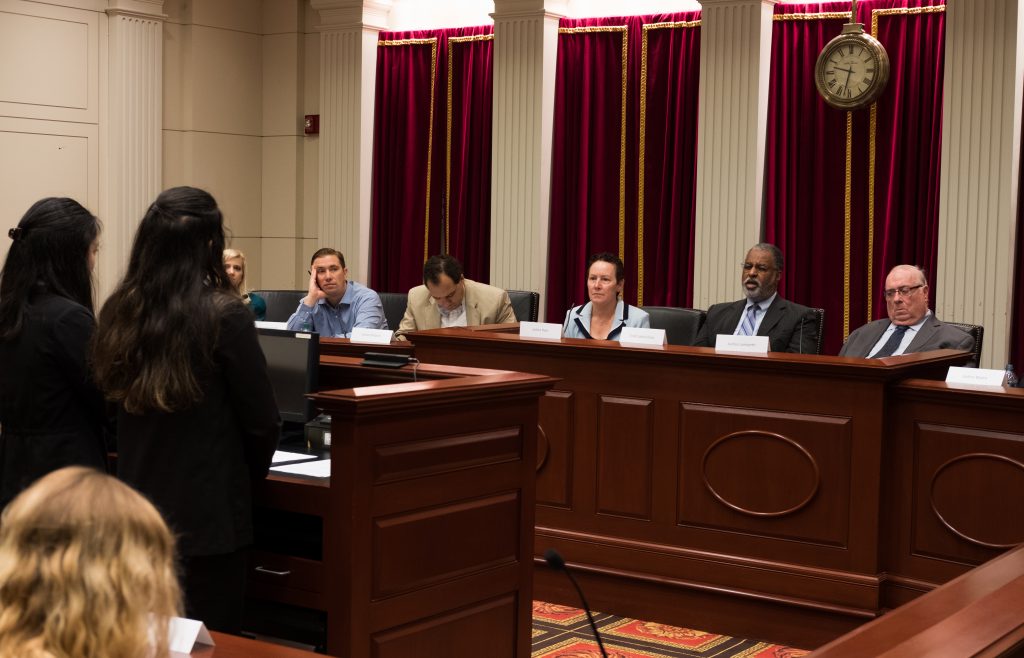
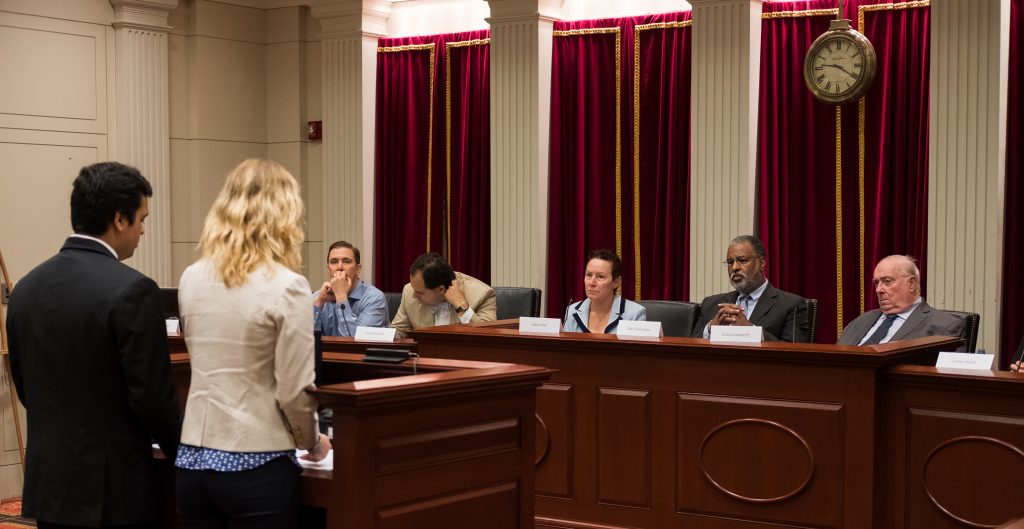
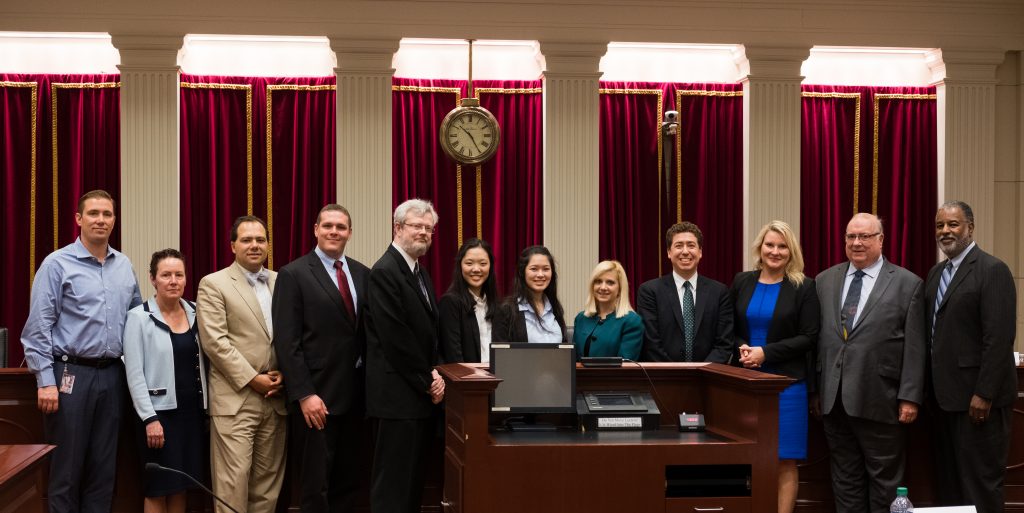
On May 18, 2017, The Harlan Institute and The Constitutional Sources Project (ConSource) hosted the championship round of the fifth annual National Virtual Supreme Court Competition for high school students. The competition was hosted in the Supreme Court Institute Moot Court Room at Georgetown University Law Center, where two teams of talented high school students argued the case of Trinity Lutheran Church v. Comer in front of a panel of nine judges in a small-scale replica of the courtroom at the United States Supreme Court.
Lucy Mini and Arjun Ahuja from Greenwich High School in Greenwich, Connecticut, argued on behalf of the petitioners, and Jacklin Chang and Emma Austin from Lake Oswego High School in Lake Oswego, Oregon argued on behalf of the respondents. To reach the championship round, these outstanding students had to compete against dozens of teams from all corners of the continental United States. Ahuha and Mini and Chang and Austin not only submitted the best-written appellate briefs, but also proved to be the most able oral advocates in the preliminary oral argument rounds.
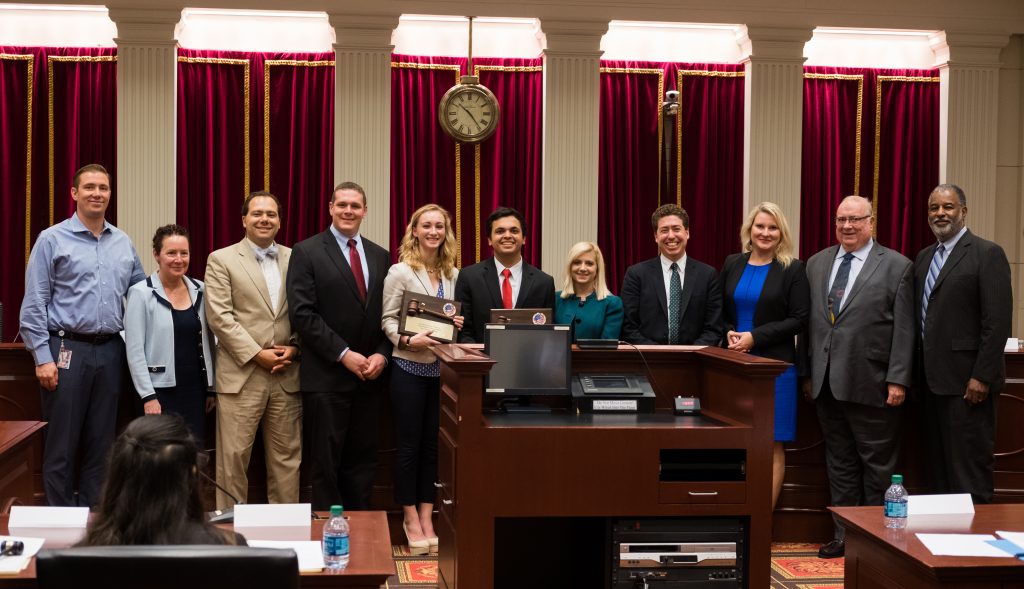
Their skills were put to the test during the championship round where, during oral argument in front of a lively panel of nine distinguished judges, the students had to respond to rapid fire and complex legal questions. The competition was judged by Honorable Andre Davis, United States Court of Appeals for the Fourth Circuit; Honorable Meg Ryan, United States Court of Appeals for the Armed Forces; Honorable Royce Lamberth, United States District Court for the District of Columbia​; Ilya Shapiro, Senior Fellow in Constitutional Studies at the Cato Institute; Elizabeth Wydra, President of the Constitutional Accountability Center​; Shon Hopwood, Georgetown University Law Center; Gregory Lipper, Clinton Brook & Peed​; Josh Blackman, President of the Harlan Institute; and Julie Silverbrook, Executive Director of The Constitutional Sources Project.
​The competition was fierce, but Lucy Mini and Arjun Ahuja from Greenwich High School prevailed in the end and were named the champions of the Virtual Supreme Court Competition.
Their coach, Aaron Hull, a model civic educator, shared how his students prepared for the competition: “Lucy prepared for the competition in the middle of AP Exams, and Arjun had graduated, moved on to Senior Internship, and could have mailed it in. Instead, both dug deep to develop Petitioners’ argument at a substantive and nuanced level, attempting, as we often strive to find in our Republic, a balance between the safety of all of our citizens and excessive governmental entanglement in the religious beliefs of a sect of them. After we arrived in DC, settled in, had our dinner, and toured the monuments, they then continued to work into the night to deepen their understanding of the facts of the case. What a pair of citizen scholars.”
Arjun Ahuja said of the Virtual Supreme Court Competition: “There are few time periods in US history where it would be more important to be constitutionally literate than right now. I find the law and the legal field to be interesting so it’s easy, but things like the Virtual Supreme Court keep the flame alive. I hope to continue with events like this to help advance the ideals that the Constitution represents.”

His teammate, Lucy Mini, added: “The Constitution is no where near as black and white as it may seem in a traditional classroom setting. Taking a stand on what those broad words mean, and then being battered by judges looking for any cracks in your argument, that is what the Founders intended when they wrote the Constitution, which is exactly what this competition provides for.”

Ilya Shapiro, one of this year’s judges, said of the competition: “Constitutional education is so important and it’s heartening to see such a high level of constitutional facility from high schoolers. I would love to see this program become a standard part of social-science classes nationwide.”

Julie Silverbrook, Executive Director of ConSource, said of the student competitors: “These students represent the very best of America. They are a testament to what can be achieved when thought leaders, public officials, schools, teachers, and parents invest in the civic education of our young people!”

Reflecting on how the competition has grown over the last five years, Harlan Institute President, Josh Blackman, shared: “The top two teams were absolutely amazing. They fielded difficult and probing questions from a panel of nine judges with poise and sophistication. Watching these students’ impressive performance gives me faith for the future of the Republic. In less than five years, the Harlan Institute-ConSource Virtual Supreme Court grew from an idea Julie and I hatched to, what I hope, will remain as a venerable institution for many years to come. I am grateful for everyone involved, and can’t wait to see how the tournament flourishes next year.”
Coach Aaron Hull expressed his appreciation for the Virtual Supreme Court Competition: “What [The Harlan Institute and ConSource] have achieved has motivated my students [by] placing a rigorous, demanding, achievable, and open-ended goal in front of [them] that will propel them to find their excellence, within themselves. Thank you for motivating and inspiring- its the core of education more broadly, and the key to inspiring the civic engagement our Constitutional Republic so desperately needs. My students will pay it forward, I can assure you.”
Gerrit Koepping, who coached second place finalists Jacklin Chang and Emma Austin, and has participated in the Virtual Supreme Court Competition for three years, added “This competition provides students with meaningful insight into how the courts work and how our constitution is interpreted. It is hard not to be inspired by the work and dedication of these students.”

If you are interested in registering your students for next year’s competition, please email [email protected] or [email protected] to get on the mailing list for next year’s competition, which will be announced in the fall.

Immigration Law and the Power to “define and punish . . . Offenses against the Law of Nations.”

May 19th, 2017

Ilya Somin has written that the “detailed list of congressional powers in Article I of the Constitution does not include any general power to restrict migration.” Specifically, he contends, this authority cannot be derived from the Naturalization Clause, the Commerce Clause, the Migration or Importation Clause, or any sort of inherent aspect of sovereignty (as John Eastman counters).

Robert Natelson writes in The Hill of another provision in Article I that supports federal immigration laws: the Power to “define and punish . . . Offenses against the Law of Nations.” Natelson, and his co-author, Dave Kopel first wrote about this clause nearly seven years ago in a response to Jack Balkin’s claim that immigration laws can be supported by the Commerce power. They explained in the Michigan Law Review Online:

One example was governance over the immigration and emigration of free persons, which Balkin several times erroneously attributes exclusively to the commerce power, but which the Constitution granted to Congress as part of its authority to “define and punish . . . Offenses against the Law of Nations.”16

16 See EMER DE VATTEL, THE LAW OF NATIONS 220–27 (Knud Haakonssen, ed. 2008) (originally published 1758) (discussing emigration and immigration as a division of international law). Vattel’s work was the most important book on international law during the Founding Era.

Natelson elaborates at length in The Hill:

“The law of nations” was the usual 18th-century term for international law. It included standards of conduct among nations. But it also encompassed some rules within national boundaries. A power to “define and punish” an “offense against the law of nations” included protecting foreign ambassadors against interference, protecting safe-conduct passes — and restricting immigration.

Why have so many writers — including some constitutional law professors — missed this? One reason is that 18th-century legal terms and categories were different from those we use today. For example, a modern law book might feature a heading for “immigration law.” But in William Blackstone’s “Commentaries,” the English book that served as America’s most popular legal treatise, there was no such heading.

Instead, Blackstone addressed the topic in his chapter on the British king’s prerogative powers. When discussing safe-conduct passes, Blackstone observed that without them “by the law of nations no member of one society has a right to intrude into another … [I]t is left in the power of all states, to take such measures about the admission of strangers, as they deem convenient.”

Blackstone relied partly on the writings of Samuel Von Puffendorf, a German international law scholar. Puffendorf’s writings were familiar to Americans. Even more popular were the writings of the Swiss lawyer, Emer de Vattel. His famous book on international law did not have a topic entitled “immigration.” But it did discuss both immigration and emigration as part of the law of nations. For example, Vattel wrote that in “Switzerland and the neighboring countries … the law of nations … did not permit a state to receive the subjects of another state into the number of its citizens.”

This should teach us two civic lessons. First, the Constitution did grant the federal government authority over immigration. Second, to understand the Constitution you have to do more than read the document. Because it was written mostly by lawyers for an 18th-century public well educated in legal matters, to fully understand the Constitution we have to know some fundamentals of 18th-century law.

Natelson makes a compelling case that I have not seen addressed elsewhere.


Guest on France 24 to Discuss Standards for Impeachment

May 18th, 2017

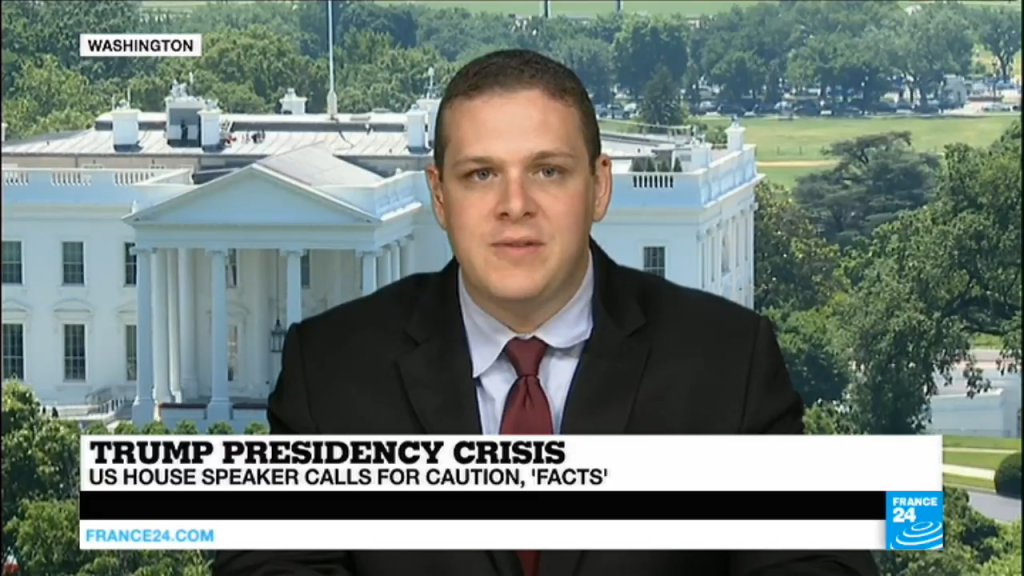
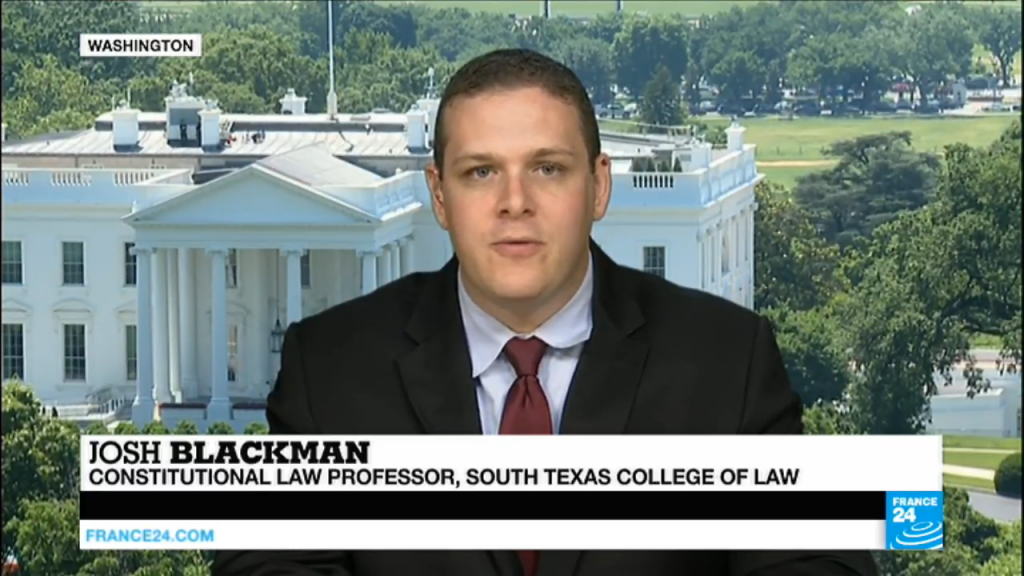
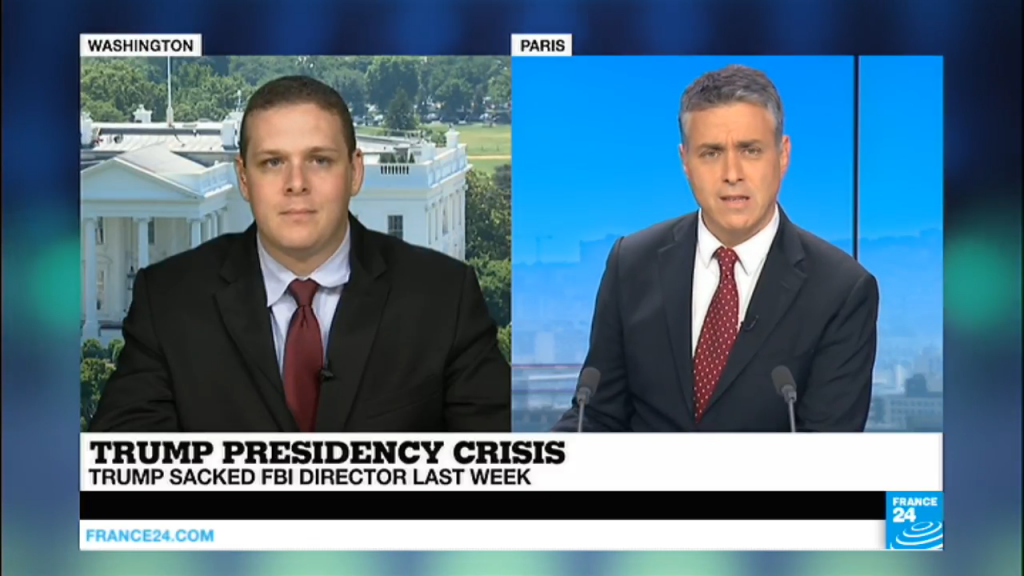
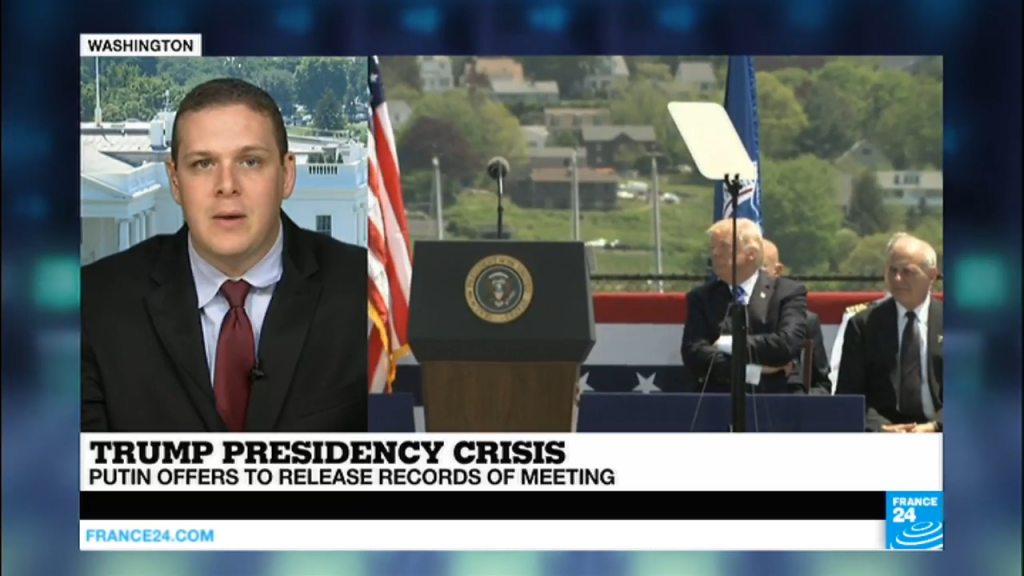
Yesterday, I was a guest on France 24, an English-language cable news network in France, to discuss the standards for impeachment under our Constitution. For those curious, I recorded this in front of a green screen. I was not overlooking the White House.

Consistency Between U.S. v. Texas and Hawaii v. Trump

May 17th, 2017

During oral arguments in Hawaii v. Trump, Judge Hawkins asked Neal Katyal about the brief he filed in U.S. v. Texas on behalf of Former Commissioners of the United States Immigration and Naturalization Service. Here is the transcript, via CNN:

HAWKINS: You’ve argued in the past to give deference to the executive in immigration matters, haven’t you?

KATYAL: Sure.

HAWKINS: And the United States against Texas, I think you wrote an amicus brief in which you said, “the particular demands of the immigration system, in fact, require the executive to wield broad discretion. The executive prioritize enforcement resources in a way that makes the immigration system function effectively, while balancing the range of foreign policy, national security, economic and humanitarian concerns.” That’s your language, isn’t it?

KATYAL: Absolutely. And we don’t disagree with any part of that, Judge Hawkins. Rather what we are saying is that the president has to implement, you know, Congress’ will. But it can’t be an unbounded delegation . . . .

In United States v. Texas, the government cited two statutes to identify President Obama’s statutory authority to implement DAPA. First,  U.S.C. § 202(5) provides “The Secretary shall be responsible for . . . Establishing national immigration enforcement policies and priorities.” Second, 8 U.S.C § 1103(a) affords the Secretary the authority to “perform such other acts as he deems necessary for carrying out his authority under the provisions of this chapter.” In the brief I prepared on behalf of the Cato Institute, I argued that these two statutes cannot be read to provide the expansive authority to justify DAPA.

The Court should hesitate before reading these provisions as granting the government the unbounded authority it claims here. Such a construction would render much of the INA superfluous. Congress “does not alter the fundamental details of a regulatory scheme in vague terms or ancillary provisions,” Whitman v. Am. Trucking Ass’ns, Inc., 531 U.S. 457, 468 (2001). The source of the government’s purported statutory authority could not hide an elephant, let alone the Leviathan that is DAPA. To avoid constitutional doubts, these provisions should be read as they are written—to permit only authority within “the provisions of this chapter.” 8 U.S.C. § 1103(a)(3) (2015); see Nw. Austin Mun. Util. Dist. No. One v. Holder, 557 U.S. 193, 205 (2009).

In his brief on behalf of the former Insurance Commissioners, Katyal wrote that these two statutes did provide sufficient authority.

The authority to grant deferred action and work authorization are broad powers, but they are within the scope of the Secretary’s wide grant of statutory authority to create “national immigration enforcement policies and priorities,” and to “issue such instructions; and perform such other acts as he deems necessary for carrying out his authority” to “administ[er] and enforce[]” immigration laws. 6 U.S.C. § 202(5); 8 U.S.C. § 1103(a)(1) and (3). The vast and complex system of immigration law requires the Executive not only to make decisions about how to prioritize enforcement resources, but also how to do so in a way that makes the system function effectively, while balancing a range of foreign policy, national security, economic, and humanitarian concerns.

Let’s contrast these two statutes, with the statute at issue in the travel ban case, 8 U.S.C. 1182(f).

Whenever the President finds that the entry of any aliens or of any class of aliens into the United States would be detrimental to the interests of the United States, he may by proclamation, and for such period as he shall deem necessary, suspend the entry of all aliens or any class of aliens as immigrants or nonimmigrants, or impose on the entry of aliens any restrictions he may deem to be appropriate. Whenever the Attorney General finds that a commercial airline has failed to comply with regulations of the Attorney General relating to requirements of airlines for the detection of fraudulent documents used by passengers traveling to the United States (including the training of personnel in such detection), the Attorney General may suspend the entry of some or all aliens transported to the United States by such airline.

Sections 202(5) and 1103(a) are fairly generic delegations without any specific phrases for domestic matters, an area where Article I is paramount. Section 1182(f) is an extremely specific delegation, that affords the President an expansive authority to protect national security, an area where Article II is at its zenith. It is remarkable that attorneys who can see in 202(5) and 1103(a) such an expansive discretion, parse 1182(f) in such a formalistic and minimalistic manner.

Beyond this statutory incongruity, Judge Hawkins’s question raises a collateral issue about to what extent attorneys are estopped based on arguments they made in previous cases. This issue is especially poignant after so many parties switched sides after November 8. As I noted earlier this year, to support its nationwide injunction, the Washington AG expressly relied on arguments it opposed the year before in the Texas litigation. I don’t think the Attorney General, or Katyal for that matter, is bound. Litigators do not have a duty of consistency. Scholars, on the other hand, do.

All Things Considered on the Presumption of Regularity

May 16th, 2017

Following oral arguments in IRAP v. Trump, I wrote at length about the “presumption of regularity.” Following my post, numerous commentators addressed this topic, arguing that Trump has rebutted this presumption. Today I spoke with Carrie Johnson of NPR for a feature on All Things Considered about the “presumption of regularity.” I explain that this is a political crisis, and not a constitutional crisis. Our separation of power demands that Congress, and not judges, deal with our unpresidented president.

You can listen to me, Jack Goldsmith, and Christina Rodriguez here:

Update: Here is the transcript:

ARI SHAPIRO, HOST:

In a moment, we’re going to get reaction from a Republican congressman to the allegations that President Trump shared sensitive information with Russia. First, a step back, a look at how courts and legal scholars are wrestling with how to evaluate this president. He has not been shy about flexing the muscles of his executive power, from enacting a travel ban after a week in office to the firing of the FBI director and now this latest situation with Russia. NPR’s Carrie Johnson reports.

CARRIE JOHNSON, BYLINE: Congress has handed the White House enormous authority when it comes to immigration and national security. There’s a phrase for this – the presumption of regularity. Law professor Josh Blackman explains.

JOSH BLACKMAN: Trump was elected. He had a majority of the Electoral College, and with that goes certain powers, including this presumption of regularity that he acts in a lawful manner.

JOHNSON: In normal times, that presumption that an official in political office is acting properly and legally carries a lot of weight. Problem is, some lawyers argue these are not normal times. Harvard Law School’s Jack Goldsmith.

JACK GOLDSMITH: The broad delegation to the president assumes a minimally competent, minimally truth-telling, minimally steady president. We’ve never seen the president this much outside the lines, someone who is defying the norms of the presidency every day, someone who attacks the intelligence community, someone who is impetuous in his decisions.

JOHNSON: In the past two weeks, Trump has fired the FBI director, he called on the intelligence community to hunt for leakers and now accusations that he shared sensitive classified information about ISIS with Russia. Cristina Rodriguez teaches at Yale Law School. She says courts are uncomfortable.

CRISTINA RODRIGUEZ: I think it’s definitely the case that both the Constitution and especially Congress have delegated a lot of authority to the president. But I think what you’re seeing now are some of the institutional limits on that power and especially the capacity and willingness of the courts to question some of the judgments that are underlying the current president’s immigration policies.

JOHNSON: These policies are playing out across the country as judges hear challenges to President Trump’s travel ban. This month, two different appeals courts have been considering whether remarks by Trump and his advisers about banning Muslims from the country outweigh a president’s strong prerogative on national security. The ACLU and the state of Hawaii recently argued the statements are fair game and evidence of improper religious discrimination. Here’s Judge Henry Floyd asking acting Solicitor General Jeffrey Wall about the remarks.

(SOUNDBITE OF ARCHIVED RECORDING)

HENRY FLOYD: Is there anything other than willful blindness that would prevent us from getting behind those statements?

JEFFREY WALL: Yes, Judge Floyd, respect for the head of a coordinate branch and the presumption that officials act legally, which is to say the presumption of regularity.

JOHNSON: To hear Cristina Rodriguez tell it, Trump has only himself to blame for his skeptical reception in court.

RODRIGUEZ: The fact that the courts are willing to consider these other motives does feel like a step beyond what courts ordinarily do, but that is the result of, in my view, an undisciplined administration.

JOHNSON: Josh Blackman of the South Texas College of Law could not disagree more.

BLACKMAN: He’s the president, and I don’t think courts should be in the business of flipping on or off various switches of the rule of law depending on who the president is.

JOHNSON: The judicial branch isn’t the place to make those sensitive political determinations, he says. But there is a third way, Blackman adds.

BLACKMAN: Congress will be far more effective at hobbling Donald Trump’s presidency than a bunch of judges ever could. And I think that is how our separation of powers was designed to deal with this issue. We are not in a constitutional crisis. This is a political crisis.

JOHNSON: For now, there’s no sign that Republicans in Congress intend to yank back power from a president from the same political party. Carrie Johnson, NPR News, Washington.