Blog

Between 2009 and 2020, Josh published more than 10,000 blog posts. Here, you can access his blog archives.

2020
2019
2018
2017
2016
2015
2014
2013
2012
2011
2010
2009

Visualizing the Breyer Pages

April 11th, 2014

Here are the oral arguments in Koontz visualized. See how long Breyer talks uninterrupted.


H/T Patrick Ellis

No Justice Stevens, “High-Powered Automatic Weapons” were not used in Newtown

April 11th, 2014

Justice Stevens has a new Op-Ed promoting his new book about Six Amendments to add to the Constitution (I listed them here). There is a glaring error in the first sentence.

Following the massacre of grammar-school children in Newtown, Conn., in December 2012, high-powered automatic weapons have been used to kill innocent victims in more senseless public incidents.

No. There were no “high-powered automatic weapons.” A semi-automatic rifle was used. Automatic weapons are illegal under federal law. Semi-automatic rifles are legal. And those rulings predate Heller. I appreciate that he does not agree with Scalia about the nature of the Second Amendment, but at least get your facts right.

Same for Virginia, Colorado, and Arizona, semi-automatic weapons were used, not automatic weapons.

Thus, even as generously construed in Heller, the Second Amendment provides no obstacle to regulations prohibiting the ownership or use of the sorts of automatic weapons used in the tragic multiple killings in Virginia, Colorado and Arizona in recent years.

Though, he is right in his second and third sentences.

Those killings, however, are only a fragment of the total harm caused by the misuse of firearms. Each year, more than 30,000 people die in the United States in firearm-related incidents. Many of those deaths involve handguns.

Deaths by mass shootings are a tiny, tiny fraction of gun deaths, as I discuss in The Shooting Cycle. The overwhelming majority of gundeaths are from the handgun–the very gun that was protected in Heller.

By the way, Stevens’s amendment to the Second Amendment doesn’t even make sense.

 A well regulated Militia, being necessary to the security of a free State, the right of the people to keep and bear arms when serving in the Militia shall not be infringed.

Why would there be an individual right to keep and bear arms in the militia? Could a commanding officer not take away a militiaman’s rifle because of the Second Amendment? Almost certainly the right in the militia would have to be collective.

Taking Stevens’s dissent in Heller seriously would require more than adding five words. How bout this:

 A well regulated Militia, being necessary to the security of a free State, the right of the states to maintain militias shall not be infringed.

It would make no mention of keeping and bearing arms.

I’ve resisted the urge to review Stevens’s book, which I have a copy of. I have too many other projects to pursue.


Ima letchu finish Justice Blackmun, but Judge Kavanaugh had the best judicial homage to sports

April 11th, 2014

Forget Justice Blackmun’s rambling missive about baseball greats in Flood v. Kuhn. Judge Kavanaugh’s dissenting opinion in the Sea World killer whale case (who’da thunk killer whales were dangerous!?) offers a great homage to sports, with a special shot-out to the Captain, Derek Jeter.

Many sports events and entertainment shows can be extremely dangerous for the participants. Football. Ice hockey. Downhill skiing. Air shows. The circus. Horse racing. Tiger taming. Standing in the batter’s box against a 95 mile per hour fastball. Bull riding at the rodeo. Skydiving into the stadium before a football game. Daredevil motorcycle jumps. Stock car racing. Cheerleading vaults. Boxing. The balance beam. The ironman triathlon. Animal trainer shows. Movie stunts. The list goes on.

But the participants in those activities want to take part, sometimes even to make a career of it, despite and occasionally because of the known risk of serious injury. To be fearless, courageous, tough – to perform a sport or activity at the highest levels of human capacity, even in the face of known physical risk – is among the greatest forms of personal achievement for many who take part in these activities. American spectators enjoy watching these amazing feats of competition and daring, and they pay a lot to do so. Americans like to witness the thrill of victory, to cheer the linebacker who hammers the running back at the goal line, to yell with admiration as Derek Jeter flies into the stands down the left-field line to make a catch, to applaud the gymnast who nails the back flip off the balance beam, to hold their collective breath as Jack Hanna plays with pythons, to root on the marathoner who is near collapse at the finish line, to scream “Foreman” when the announcer says “Down goes Frazier.” And American spectators also commiserate during the “agony of defeat,” as immortalized in the Wide World of Sports video of a ski jumper flying horribly off course.

The broad question implicated by this case is this: When should we as a society paternalistically decide that the participants in these sports and entertainment activities must be protected from themselves – that the risk of significant physical injury is simply too great even for eager and willing participants? And most importantly for this case, who decides that the risk to participants is too high?

Obviously, the answer is the government, not the athletes or the sportsmen themselves.

To the extent sports or entertainment activities raise concern about the risk of injury to the participants, several

extant legal bodies possess significant authority to clamp down on unreasonable dangers: Congress, state legislatures, state regulators, courts applying state tort law. I take no position here on whether SeaWorld – or for that matter the NFL or NASCAR – should be subject to more stringent government regulation or liability, or otherwise should voluntarily make its activities safer. That policy question is not before us. My legal disagreement with the majority opinion boils down to one basic question: Who decides? Under current law, it is not the Department of Labor. I respectfully dissent.

And, totally relevant, I paraphrase Judge Livington’s dissenting opinion from Pierson v. Post:

This is a knotty point, and should have been submitted to the arbitration of sportsmen, without poring over [OSHA]; they would have had no difficulty in coming to a prompt and correct conclusion.

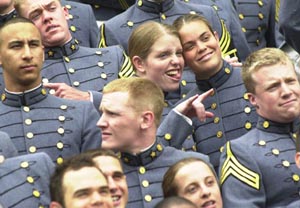
Constitutional Places: United States v. Virginia

April 11th, 2014

This is the Virginia Military Institute.

cadets

VMI

Here are some of the first cadets that graduated from VMI.

first-female-cadets-VMI

Would Single-Payer Healthcare Have Been Free of Constitutional Challenges?

April 11th, 2014

Neil Buchanan comments on whether conservatives would have challenged Obamacare had POTUS gone all in, and backed single-payer healthcare:

Honestly, however, it is hard to imagine that the people who have been pushing these anti-ACA lawsuits would have said, “Oh well, I guess there’s nothing we can do about single-payer.  Medicare is bulletproof.”  I mean, consider just how absurd the activity/inactivity distinction was — not just to liberals, but to conservative legal scholars as well — when it was first raised in NFIB.

If these people could imagine getting five justices to sign onto that incoherent mess, why would they not imagine that other legal doctrines could be invented to declare that, say, Medicare is a violation of property rights, or that payroll taxes are theft?  There is already a strong contingent of people, some of whom were put on the federal bench by George W. Bush, who want to revive the Lochner era’s expansive version of freedom of contract.  Why would they not use expanded Medicare as the wedge to push that agenda?

So, even though the economic costs of the ACA, relative to single-payer, are unbelievably high, I no longer think that the parade of bad constitutional challenges was an additional cost of adopting the go-it-slow strategy.  Motivated, well-funded people with friends on high courts will always try to use whatever raw material is available.

I address this issue in the epilogue to Unprecedented. I’m fairly convinced (moreso today than when I wrote it) that Obamacare’s imminent collapse will hasten the onset of some form of universal healthcare. Will there be constitutional challenges to Medicaid for all?

If the ACA continues to result in higher premiums and the con- sequent price controls aimed at controlling these rates nudge insurers to exit the market (insurers are already opting out of California’s exchanges), the mandate may serve as a mere pit stop on the road to single-payer health care (what progressives wanted but did not get in 2009). If that turns out to be the case, constitutional conservatives will be placed in a political pickle. In arguing that the individual mandate was unconstitutional, many prominent conservative and libertarian scholars conceded that single-payer health care would be constitutional. For example, in a February 17, 2011, letter to the New York Times, Randy Barnett wrote, “although I would oppose such a program, existing doctrine would allow Congress to impose a ‘single payer’ tax-and-spending scheme like Medicare on everyone.”

Note how Randy said “existing doctrine.”