Blog

Between 2009 and 2020, Josh published more than 10,000 blog posts. Here, you can access his blog archives.

2020
2019
2018
2017
2016
2015
2014
2013
2012
2011
2010
2009

Obama Signs Into Law Non-Bill-Of-Attainder But Issues Signing Statement Saying He Won’t Enforce It

April 19th, 2014

I blogged last week that a bill, proposed by Ted Cruz, and passed unanimously in both houses, that would have denied a diplomatic visa to anyone who engaged in terroristic activity against the United States, would not be a bill of attainder, even though it was clearly directed at the newly-appointed Iranian ambassador who took part in the Iranian hostage crisis. The President signed that bill into law, but issued a (gasp!) signing statement saying he would not follow it. And he cited the practices of President George H.W. Bush. It’s only “advisory.”

Today I have signed into law S. 2195, an Act concerning visa limitations for certain representatives to the United Nations.  S. 2195 amends section 407 of the Foreign Relations Authorization Act, Fiscal Years 1990 and 1991, to provide that no individual may be admitted to the United States as a representative to the United Nations, if that individual has been found to have been engaged in espionage or terrorist activity directed against the United States or its allies, and if that individual may pose a threat to United States national security interests.  As President Bush observed in signing the Foreign Relations Authorization Act, Fiscal Years 1990 and 1991, this provision “could constrain the exercise of my exclusive constitutional authority to receive within the United States certain foreign ambassadors to the United Nations.” (Public Papers of the President, George Bush, Vol. I, 1990, page 240).  Acts of espionage and terrorism against the United States and our allies are unquestionably problems of the utmost gravity, and I share the Congress’s concern that individuals who have engaged in such activity may use the cover of diplomacy to gain access to our Nation.  Nevertheless, as President Bush also observed, “curtailing by statute my constitutional discretion to receive or reject ambassadors is neither a permissible nor a practical solution.”  I shall therefore continue to treat section 407, as originally enacted and as amended by S. 2195, as advisory in circumstances in which it would interfere with the exercise of this discretion.

Imagine that. A President referring to an Act of Congress, passed overwhelmingly across Party lines, as “advisory.”

I will wait for the ABA to condemn President Obama for issuing a signing statement. Never mind.

Hey, at least the President signed into law a bipartisan piece of legislation. That hasn’t happened too many times of late.

Update: If the President truly believed this law unconstitutionally infringed on his Article II powers over foreign affairs–and I think he and Bush 41 are right here–he should have vetoed it. The rationales for a signing statement are weak when the bill is a single issue. Perhaps if there are many parts of a bill the President likes, but one objectionable part, a signing statement may make sense (that is not what the ABA found in their report). But here, the Cruz bill only had one provision, which the President thought unconstitutional. This should have been an *easy* case to veto. But instead he signed it into law, only to promptly disregard it. I will wait for the ABA to condemn this lawlessness.
Talk About Citing Facts Outside The Record! Justice Breyer Cites Unpublished Book in McCutcheon Dissent

April 19th, 2014

It has long been a pet peeve of mine when appellate judges cite sources outside the record, and in particular cite sources that came to light following oral arguments. There is no way the advocates can be aware of these sources, and perhaps rebut them. Justice Breyer just one-upped this. In his McCutcheon dissent, he cited Robert Post’s forthcoming book, that will be officially published in June.

That is also why the Court has used the phrase “subversion of the political process” to describe circumstances in which “[e]lected officials are influenced to act contrary to their obligations of office by the prospect of financial gain to themselves or infusions of money into their campaigns.” NCPAC, 470 U.S., at 497, 105 S.Ct. 1459. See also Federal Election Comm’n v. National Right to Work Comm., 459 U.S. 197, 208, 103 S.Ct. 552, 74 L.Ed.2d 364 (1982) (the Government’s interests in preventing corruption “directly implicate the integrity of our electoral process” (internal quotation marks and citation omitted)). See generally R. Post, Citizens Divided: Campaign Finance Reform and the Constitution 7–16, 80–94 (forthcoming 2014) (arguing that the efficacy of American democracy depends on “electoral integrity” and the responsiveness of public officials to public opinion).

No one, other than those with access to the author or publisher, could see it.

Derek Muller was the first to notice.

Yeah, wouldn’t it be nice. Rick Hasen adds some comments:

Have there been any other occasions where Justices have cited scholarship not available in the public record?  Justice Scalia cited a forthcoming piece posted on SSRN in Heller (“And if one looks beyond legal sources, “bear arms” was frequently used in nonmilitary contexts. See Cramer & Olson, What Did “Bear Arms” Mean in the Second Amendment?, 6 Georgetown J.L. & Pub. Pol’y (forthcoming Sept. 2008), online at https://papers. ssrn.com/abstract=1086176 (as visited June 24, 2008, and available in Clerk of Court’s case file) (identifying numerous nonmilitary uses of “bear arms” from the founding period).”). Justice Kennedy did in Boumediene (“. Thus the writ, while it would become part of the foundation of liberty for the King’s subjects, was in its earliest use a mechanism for securing compliance with the King’s laws. See Halliday & White, The **2245Suspension Clause: English Text, Imperial Contexts, and American Implications, 94 Va. L.Rev. 575, 585 (2008) (hereinafter Halliday & White) (manuscript, at 11, online at https://papers.ssrn.com/sol 3 /papers.cfm?abstract_id =1008252 (all Internet materials as visited June 9, 2008, and available in Clerk of Court’s case file) (noting that “conceptually the writ arose from a theory of power rather than a theory of liberty”)”.)

But Justice Breyer cited to something which is not available on SSRN nor is there any notation that a copy is in the Clerk of Court’s file.

Bad form from Justice Breyer.

As an aside, Post’s book addresses some of the themes I’ve been thinking about with Collective Liberty. I’ll be sure to read it when it comes out.

Post interprets constitutional conflict over campaign finance reform as an argument between those who believe self-government requires democratic participation in the formation of public opinion and those who believe that self-government requires a functioning system of representation. The former emphasize the value of free speech, while the latter emphasize the integrity of the electoral process. Each position has deep roots in American constitutional history. Post argues that both positions aim to nurture self-government, which in contemporary life can flourish only if elections are structured to create public confidence that elected officials are attentive to public opinion. Post spells out the many implications of this simple but profound insight. Critiquing the First Amendment reasoning of the Court in Citizens United, he also shows that the Court did not clearly grasp the constitutional dimensions of corporate speech.

Update: Two of Breyer’s clerks this year–Thomas P. Schmidt (Garland) and Sara A. Solow (Baylson, E.D.Pa) graduated from Yale Law School.

Brandeis Brief: “women are fundamentally weaker than men in all that makes for endurance”

April 18th, 2014

Louis Brandeis is often celebrated for his advocacy in Muller v. Oregon, and the so-called Brandeis Brief. As David Bernstein has pointed out, most of the brief was junk social science. In case you were wondering, here is the opening paragraphs of his lead argument section about the dangers of long hours for working women.

I. The Dangers of Long Hours

A. Causes

(1) Physical Differences Between Men and Women

The dangers of long hours for women arise from their special physical organization taken in connection with the strain incident to factory and similar work.

Long hours of labor are dangerous for women primarily because of their special physical organization. In structure and function women are differentiated from men. Besides these anatomical and physiological differences, physicians are agreed that women are fundamentally weaker than men in all that makes for endurance: in muscular strength, in nervous energy, in the powers of persistent attention and application. Overwork, therefore, which strains endurance to the utmost, is more disastrous to the health of women than of men, and entails upon them more lasting injury ….

Compare this with Justice Sutherland’s opinion in Adkins v. Children Hospital:

In the Muller case, the validity of an Oregon statute, forbidding the employment of any female in certain industries more than ten hours during anyone day was upheld. The decision proceeded upon the theory that the difference between the sexes may justify a different rule respecting hours of labor in the case of women than in the case of men. It is pointed out that these consist in differences of physical structure, especially in respect[p553] of the maternal functions, and also in the fact that, historically, woman has always been dependent upon man, who has established his control by superior physical strength. The cases of Riley, Miller, and Bosley follow in this respect the Muller case. But the ancient inequality of the sexes, otherwise than physical, as suggested in the Muller case (p. 421) has continued “with diminishing intensity.” In view of the great — not to say revolutionary — changes which have taken place since that utterance, in the contractual, political and civil status of women, culminating in the Nineteenth Amendment, it is not unreasonable to say that these differences have now come almost, if not quite, to the vanishing point. In this aspect of the matter, while the physical differences must be recognized in appropriate cases, and legislation fixing hours or conditions of work may properly take them into account, we cannot accept the doctrine that women of mature age, sui juris, require or may be subjected to restrictions upon their liberty of contract which could not lawfully be imposed in the case of men under similar circumstances. To do so would be to ignore all the implications to be drawn from the present day trend of legislation, as well as that of common thought and usage, by which woman is accorded emancipation from the old doctrine that she must be given special protection or be subjected to special restraint in her contractual and civil relationships. In passing, it may be noted that the instant statute applies in the case of a woman employer contracting with a woman employee as it does when the former is a man.

And for reasons I cannot recall, Justice Brandeis recused in Adkins.

Years ago, I saw Justice Ginsburg preside over a reenactment of Muller v. Oregon. It was awesome to see RBG favorably cite Lochner, and note how the arguments in Muller deemed women inferior.

Bagley on the Legality of Delaying the ACA

April 18th, 2014

Nick Bagley, who kindly  commented on my book talk at UMichigan, has a piece in the New England Journal of Medicine explaining in a concise manner the legality of the myriad delays to Obamacare:

For several reasons, however, the recent delays of ACA provisions appear to exceed the scope of the executive’s traditional enforcement discretion. To begin with, the delays are not “discretionary judgment[s] concerning the allocation of enforcement resources” that, per Heckler, are at the core of the executive branch’s power to decline to enforce laws.2 Instead, they reflect the administration’s policy-based anxiety over the pace at which the ACA was supposed to go into effect. The mandate delays, for example, were designed to “give employers more time to comply with the new rules.”3 Similarly, the postponement of the insurance requirements aims to honor the President’s promise that “if you like your health care plan, you can keep it.”

To sharpen the point: even if the administration lacked the capacity or desire to take action against those who failed to comply with the ACA, it could have remained silent about its enforcement plans. Most employers and insurers would still have felt obliged to adhere to the law. Because the administration wanted to relieve them of an unwanted burden, however, it publicly committed itself to nonenforcement, thereby licensing employers and insurers to disregard the ACA’s terms.

Encouraging a large portion of the regulated population to violate a statute in the service of broader policy goals — however salutary those goals may be — probably exceeds the limits of the executive’s enforcement discretion.4 The U.S. Court of Appeals for the D.C. Circuit has said that “an agency’s pronouncement of a broad policy against enforcement poses special risks that it has consciously and expressly adopted a general policy that is so extreme as to amount to an abdication of its statutory responsibilities.”5 The ACA delays appear to be just such broad — and worrisome — policies.

The administration’s legal claim is strongest in defending the employer-mandate delays. The Internal Revenue Service (IRS) has an established practice, stretching back at least three presidential administrations, of affording “transition relief” to taxpayers who might otherwise struggle to comply with a change in the tax code. In the administration’s view, that practice confirms that the IRS’s general authority, per the Internal Revenue Code, to “prescribe all needful rules and regulations” to run the tax system includes the specific power to delay the effective date of new tax laws.

This is a plausible argument. The persistence of the IRS practice is some evidence that Congress has, by declining to rebuke the agency, acquiesced to its view that it can properly use its enforcement discretion to delay tax statutes. Extensions of transition relief, however, have typically been brief — usually just a few months — and covered taxes of marginal importance that affected few taxpayers. In 2007, for example, the IRS gave tax preparers an extra 6 months to plan for enhanced statutory penalties that would apply if they improperly filled out tax returns. Such examples provide slim support for a sweeping exemption that will relieve thousands of employers from a substantial tax for as long as 2 years.

Bagley closes with an important point–a future President unsympathetic to Obamacare can delay or postpone provisions as means to frustrate the law.

The delays nonetheless set a troubling precedent. They are unlikely to be challenged in court — no one has standing to sue over the employer-mandate delays, and no insurer has thought it worthwhile to challenge the “like it, keep it” fix. But a future administration that is less sympathetic to the ACA could invoke the delays as precedent for declining to enforce other provisions that it dislikes, including provisions that are essential to the proper functioning of the law. The delays could therefore undermine the very statute they were meant to protect — and perhaps imperil the ACA’s effort to extend coverage to tens of millions of people.

More generally, the Obama administration’s claim of enforcement discretion, if accepted, would limit Congress’s ability to specify when and under what circumstances its laws should take effect. That circumscription of legislative authority would mark a major shift of constitutional power away from Congress, which makes the laws, and toward the President, who is supposed to enforce them.

H/T Jon Adler

The Supreme Court’s Docket Books

April 18th, 2014

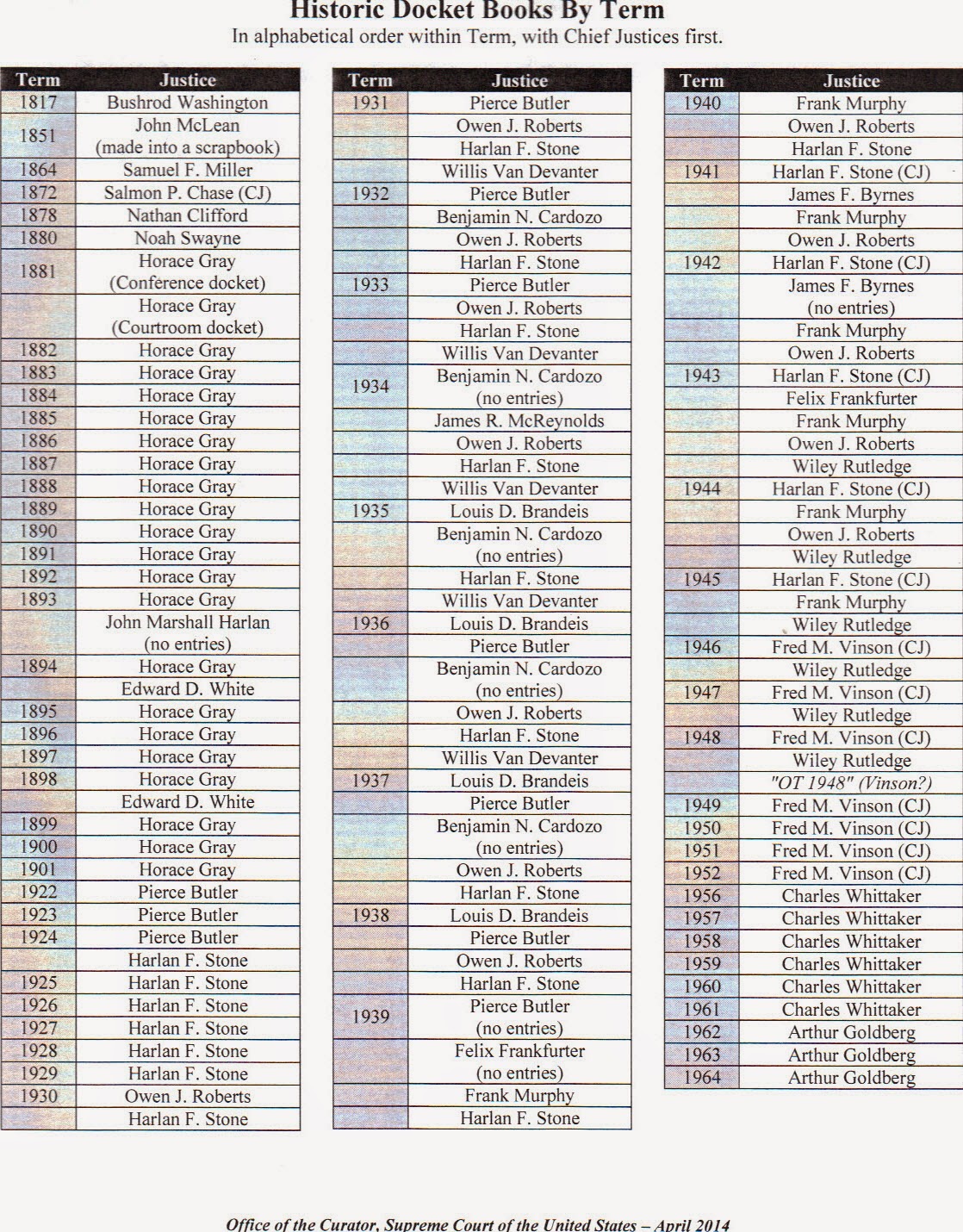
Ever wish you knew how the Justices voted for cases at conference? Well now you can. Kind of. For certain Justices, during certain terms, if they didn’t burn them. The Supreme Court’s curator office now offers very, very limited access to these treasures. Dan Ernst has a post discussing his experiences with the Docket Books. I love this account of Justice McReynolds:

When U.S. Supreme Justice James C. McReynolds pushed his docket book across his desk to John Knox, the legal secretary felt “almost as if Moses had unexpectedly handed me the Ten Commandments.”  Knox’s shock was understandable: the book was a large, red volume, locked with a clasp, in which McReynolds, like his brethren, recorded votes, and sometimes more, during the conferences in which they considered the week’s cases.  Knox recalled McReynolds saying rather sharply, ‘That book will not be preserved after this term of the Court!  Next June I shall take it downstairs myself and stand before the big furnace in this building and watch it burn up.  A book like this must be destroyed at the end of each term!”

McReynolds may well have destroyed his docket book for the 1936 Term, but, thanks to a list released yesterday by the Office of the Curator of the Supreme Court of the United States (right; click to enlarge), we now know that his docket book for 1934 survives, as do those of many other justices.

Alas, requesting these docket books is a pain. You need to be an a “post-graduate scholars, professors, and historians.” You will not be able to flip through all the books. You can only make requests for specific cases, in writing.

Here is the list of books available.

docket-book