Blog

Between 2009 and 2020, Josh published more than 10,000 blog posts. Here, you can access his blog archives.

2020
2019
2018
2017
2016
2015
2014
2013
2012
2011
2010
2009

Schuette and Fisher and Constitutionality of Affirmative Action

April 22nd, 2014

After Schuette was argued, I queried how, if at all, Fisher v. University of Texas, Austin would be cited. The answer? Not much.

Before the Court addresses the question presented, it is

important to note what this case is not about. It is not about the constitutionality, or the merits, of race-conscious admissions policies in higher education. The considera- tion of race in admissions presents complex questions, in part addressed last Term in Fisher v. University of Texas at Austin, 570 U. S. ––– (2013). In Fisher, the Court did not disturb the principle that the consideration of race in admissions is permissible, provided that certain conditions are met. In this case, as in Fisher, that principle is not challenged. The question here concerns not the permissi- bility of race-conscious admissions policies under the Constitution but whether, and in what manner, voters in the States may choose to prohibit the consideration of racial preferences in governmental decisions, in particular with respect to school admissions.

Read the bold sentence again. That seems to say that Fisher did not challenge the principle that “consideration of race in admissions is permissible, provided that certain conditions are met.” I suppose that is true in a narrow sense, but Fisher greatly limited the number of conditions that could justify the use of race.

Update: Justice Sotomayor cites Fisher much more broadly in her dissent:

hese statistics may not influence the views of some of my colleagues, as they question the wisdom of adopting race-sensitive admissions policies and would prefer if our Nation’s colleges and universities were to discard those policies altogether. See ante, at 2 (ROBERTS, C. J., concur- ring) (suggesting that race-sensitive admissions policies might “do more harm than good”); ante, at 9, n. 6 (SCALIA, J., concurring in judgment); Grutter, 539 U. S., at 371–373 (THOMAS, J., concurring in part and dissenting in part); id., at 347–348 (SCALIA, J., concurring in part and dissent- ing in part). That view is at odds with our recognition in Grutter, and more recently in Fisher v. University of Texas at Austin, 570 U. S. ___ (2013), that race-sensitive admis- sions policies are necessary to achieve a diverse student body when race-neutral alternatives have failed. More fundamentally, it ignores the importance of diversity in institutions of higher education and reveals how little my colleagues understand about the reality of race in America.
SCOTUS on Schuette in the Sixth Circuit

April 22nd, 2014

Oh, woe is my former home, the Sixth Circuit.

A panel of the United States Court of Appeals for the Sixth Circuit reversed the grant of summary judgment. 652 F. 3d 607 (2011). Judge Gibbons dissented from that holding. Id., at 633–646. The panel majority held that Proposal 2 had violated the prin- ciples elaborated by this Court in Washington v. Seattle School Dist. No. 1, 458 U. S. 457 (1982), and in the cases that Seattle relied upon. The Court of Appeals, sitting en banc, agreed with the panel decision. 701 F. 3d 466 (CA6 2012). The majority opinion determined that Seattle “mirrors the [case] before us.” Id., at 475. Seven judges dissented in a number of opinions.

Even when the Court agrees with the dissenters, they look bad.

I should note I clerked while Schuette was argued en banc, but I was long gone by the time the opinion was issued.

Update: The Court also smacks down the 6th Circuit’s reasoning:

The broad rationale that the Court of Appeals adopted goes beyond the necessary holding and the meaning of the precedents said to support it; and in the instant case neither the formulation of the general rule just set forth nor the precedents cited to authenticate it suffice to inval- idate Proposal 2. The expansive reading of Seattle has no principled limitation and raises serious questions of com- patibility with the Court’s settled equal protection juris- prudence. To the extent Seattle is read to require the Court to determine and declare which political policies serve the “interest” of a group defined in racial terms, that rationale was unnecessary to the decision in Seattle; it has no support in precedent; and it raises serious constitu- tional concerns. That expansive language does not provide a proper guide for decisions and should not be deemed authoritative or controlling. The rule that the Court of Appeals elaborated and respondents seek to establish here would contradict central equal protection principles.

Update 2: Even the California Supreme Court AND the Ninth Circuit got this right!

It should also be noted that the judgment of the Court of Appeals in this case of necessity calls into question other long-settled rulings on similar state policies. The Califor- nia Supreme Court has held that a California constitu- tional amendment prohibiting racial preferences in public contracting does not violate the rule set down by Seattle. Coral Constr., Inc. v. City and County of San Francisco, 50 Cal. 4th 315, 235 P. 3d 947 (2010). The Court of Appeals for the Ninth Circuit has held that the same amendment, which also barred racial preferences in public education, does not violate the Equal Protection Clause. Wilson, 122 F. 3d 692 (1997). If the Court were to affirm the essential rationale of the Court of Appeals in the instant case, those holdings would be invalidated, or at least would be put in serious question. The Court, by affirming the judgment now before it, in essence would announce a finding that the past 15 years of state public debate on this issue have been improper.

Quick Thoughts on Schuette

April 22nd, 2014

I’ve had a number of calls all morning, so I’ve only been able to skim, quickly, the 108-page in opinion. Here are a few quick meta thoughts. I will go into detail soon.

First, the vote in this case is not much of a surprise. With Kagan recused, I expected that only Justice Sotomayor would dissent. Breyer did not at all seem enthused with this argument, which directly frustrates his beloved democratic process. In the end, RBG dissented.

Second, this case displays two wildly differing views on race. The majority sticks to the view that the way to end racial discrimination is to end racial discrimination. Justice Sotomayor seems to strongly suggest that race-sensitive admission policies (don’t call it affirmative action) is the way to end racial discrimination. The Justices snipe at each other back and forth over this fundamental disagreement. This is not a collegial opinion. There is some anger here over accusations of racism and discrimination. The Chief’s concurring opinion reminds me of his opinion in Perry that people who oppose same-sex marriage are not bigots. Imputing animus for opposing policies is a sore point of division.

Third, Justice Scalia, joined by Justice Thomas, went ahead and would overrule the political process decisions from the 1980s. As I noted in this piece, these cases have fallen into desuetude. The plurality kept them alive, but severely limited them. Nino took it one step further and cast doubt on Footnote 4, calling it dictum. He makes a very similar point to something I recently wrote, building on the work of Bruce Ackerman, that discrete and insular minorities due to lower transaction costs, are most easily able to mobilize for change.

I have a whole host of other things that I will be posting throughout the day. Stay tuned.

Judge To Rule in Ongoing Ashby High-Rise Case

April 22nd, 2014

In the never-ending saga that is the Houston property dispute of Ashby, a judge is poised to rule on whether he will issue a permanent injunction barring construction. The jury determined that the designs for the Ashby high-rise, as submitted were a nuisance. At a hearing yesterday, the judge (in something of a surprise to me) suggested that something less than a permanent injunction may issue. In short, he suggested that if the developer submitted a modified design, that would not be a nuisance (whatever that means in this bizarre case), a partial injunction shall issue. That would, in my mind, disregard the jury’s verdict (which I think was an incorrect verdict). It would seem that a new design would require a new trial with experts and everything. This case should get reversed on appeal in any event due to the incorrect instructions about the nature of what constitutes a nuisance.

Erin Mulvaney has a writeup:

State District Judge Randy Wilson said he was struggling with what would happen next if he rules against developers and permanently blocks the 21-story residential tower. He told attorneys in a Harris County courtroom packed with onlookers that the Ashby case is not as clear-cut as previous nuisance cases, such as a slaughterhouse or tanning facility planned alongside private homes. …

“We know a Maryland Manor is fine, but 21 stories is not fine,” Wilson said after hearing the last of the legal arguments in the case. “But what is? That’s a horse of a different color.”

The judge asked for a final set of documents from attorneys on both sides and promised to make a decision promptly.

“This case has intense public interest and has stretched for some time,” Wilson told the courtroom. “Because of this, I will rule quickly.”

Update: Here is a copy of the City’s letter. Letter to Judge Wilson

Constitutional Faces: Griswold v. Connecticut

April 22nd, 2014

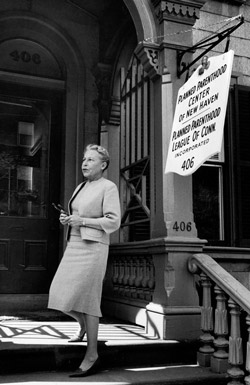
Here is Estelle Griswold, the lead plaintiff at the Planned Parenthood Center of New Haven, Connecticut.

ok


Estelle-Griswold

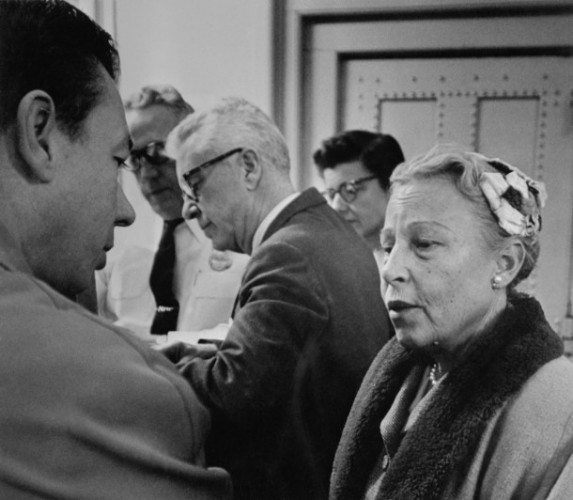
Here is a photograph of Dr. C. Lee Buxton and Estelle Griswold after their arrest.

Dr Lee Buxton and Estelle Griswold

Estelle Griswold Cornelia Jahncke Planned Parenthood League CT