Blog

Between 2009 and 2020, Josh published more than 10,000 blog posts. Here, you can access his blog archives.

2020
2019
2018
2017
2016
2015
2014
2013
2012
2011
2010
2009

Breaking: Justice Ginsburg “Neck Doily” Watch – RBG Swaps Jabot for Bling!

November 26th, 2012

Earth-shattering news from the Supreme Court, courtesy of Robert Barnes:

I hope someone got a sketch of that! For more on the Jabot (or as I call it the neck doily) see these posts.

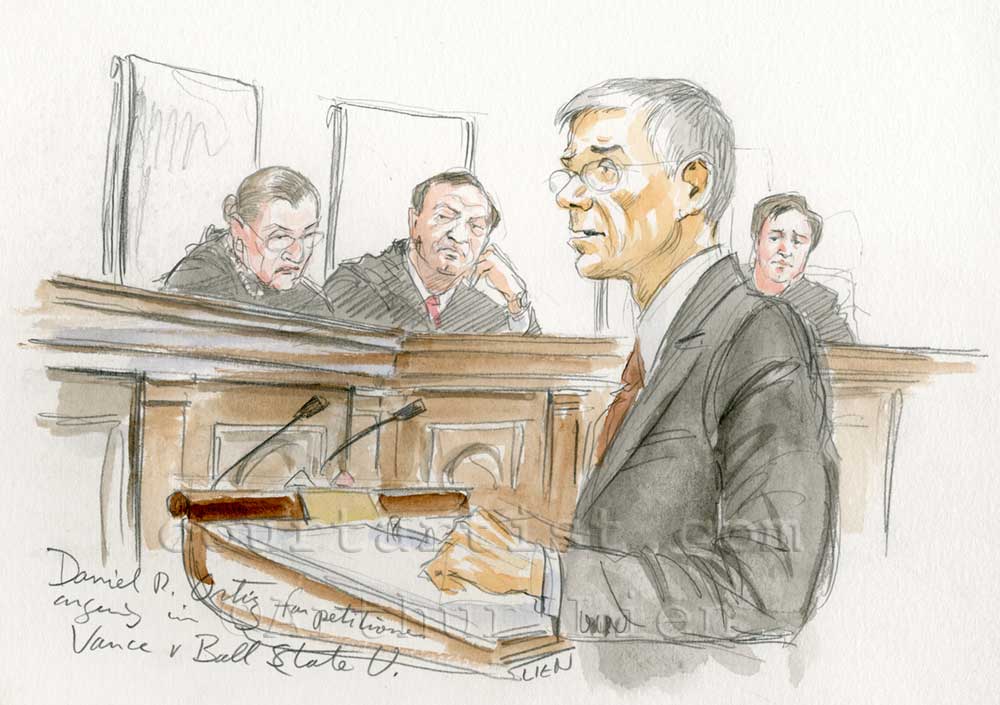
Update: Thanks to the inestimable Art Lien, we now have a sketch of Justice Ginsburg “forgo[ing] the jabot.”

Here are Art’s comments:

One thing a sketch artist at the Supreme Court needs to look for is whether Justice Ginsburg is wearing a jabot or one of her increasingly large doilies around her neck. Today, for the first time I can recall, she wore neither. She appeared to be wearing a sparkly necklace of dark crystals. I couldn’t quite make it out.

Bling Bling!

Update: WaPo Reliable Sources has the scoop on RBG’s new bling.

Time to bust out your holiday-season bling — and that goes for you Supreme Court justices, too!Ruth Bader Ginsburg turned some heads Monday when she showed up in court wearing a big shiny necklace with her robe instead of her usual frilly white jabot. We’re told that the bib-style sparkler (glass beads on a black scalloped base) was a Banana Republic offering that came in the VIP gift bag at Glamour magazine’s “Women of the Year”gala in New York this month, where Ginsburg was among the honorees. (Sorry, no photo: Cameras aren’t allowed in the court.)

Swanky. Here is a pic from Banana Republic’s web site:

H/T DC Dicta

Kagan’s Not Crazy for the Insanity Defense

November 26th, 2012

Today, the Supreme Court denied cert in Delling v. Idaho, a case that considered whether Idaho’s modification of the insanity defense violated the Due Process Clause. Justice Breyer, joined by Justices Ginsburg dissented from the denial of cert (dissental if you will). But, Justice Kagan did not join? Hrm… Speculation…

Doug Berman comments here.

US Supreme Court Faults Oklahoma Supreme Court’s Application of “generalia specialibus non derogant”

November 26th, 2012

Of course,  generalia specialibus non derogant  means “the general does not detract from the specific.”

I am willing to bet money that Justice Scalia, author of the canonical book on statutory canons, had something to do with this discussion in  Nitro-Lift Technologies, L. L. C. v. Howard.

The state court reasoned that Oklahoma’s statute “ad­ dressing the validity of covenants not to compete, must govern over the more general statute favoring arbitration.” 273 P. 3d, at 26, n. 21. But the ancient interpretive principle that the specific governs the general (generalia specialibus non derogant) applies only to conflict between laws of equivalent dignity. Where a specific statute, for example, conflicts with a general constitutional provision, the latter governs. And the same is true where a specific state statute conflicts with a general federal statute. There is no general-specific exception to the Supremacy Clause, U. S. Const. Art. VI, cl. 2. “‘[W]hen state law prohibits outright the arbitration of a particular type of claim, the analysis is straightforward: The conflicting rule is displaced by the FAA.’” Marmet Health Care Center, Inc. v. Brown, 565 U. S. ___, ___–___ (2012) (per curiam) (slip op., at 3–4) (quoting AT&T Mobility LLC, supra, at ___–___ (slip op., at 6–7)). Hence, it is for the arbitrator to decide in the first instance whether the covenants not to compete are valid as a matter of applicable state law. See Buckeye, 546 U. S., at 445–446.

I wonder if this case will be cited in the next edition of Reading Law. (Does anyone actually have a copy? What does it say about this canon? I refuse to buy a Kindle for $40!).

And the Court threw in a citation to a progressive bugaboo, AT&T v. Concepion:

The state court insisted that its “[own] jurisprudence controls this issue” and permits review of a “contract submitted to arbitration where one party assert[s] that the underlying agreement [is] void and unenforceable.” 273 P. 3d, at 26. But the Oklahoma Supreme Court must abide by the FAA, which is “the supreme Law of the Land,” U. S. Const., Art. VI, cl. 2, and by the opinions of this Court interpreting that law. “It is this Court’s responsibility to say what a statute means, and once the Court has spoken, it is the duty of other courts to respect that understanding of the governing rule of law.” Rivers v. Roadway Express, Inc., 511 U. S. 298, 312 (1994). Our cases hold that the FAA forecloses pre­ cisely this type of “judicial hostility towards arbitration.” AT&T Mobility LLC v. Concepcion, 563 U. S. ___, ___ (2011) (slip op., at 8).

In other words, we mean it state courts! Enforce the FAA!


And the Obamacare case goes on with a prayer

November 26th, 2012

While the 2012 election largely decided the fate of Obamacare (hint: it’s here to stay), this morning the Supreme Court allowed a religious liberty challenge to the ACA to continue.

LIBERTY UNIVERSITY, ET AL. V. GEITHNER, SEC. OF TREASURY The petition for rehearing is granted. The order entered June 29, 2012, denying the petition for a writ of certiorari is vacated. The petition for a writ of certiorari is granted. The judgment is vacated, and the case is remanded to the United States Court of Appeals for the Fourth Circuit for further consideration in light of National Federation of Independent Business v. Sebelius, 567 U.S. ___ (2012).

SCOTUS had been holding the Liberty University petition until NFIB v. Sebelius was decided. After the case on June 29, 2012, the Court denied Liberty’s petition for a writ of certiorari. Then, Liberty filed a petition for rehearing in light of NFIB. Today, the Court granted that hearing, and vacated the June 29, 2012 order denying the petition for a writ of cert. So now the case is GVR’d (grant, vacate, remand). In other words, the Court granted Liberty’s petition for cert on appeal from the 4th Circuit, vacated the 4th Circuit’s judgment, and remanded it to the 4th Circuit to reconsider in light of NFIB v. Sebelius.

So what is the 4th Circuit to reconsider? The individual and employer mandate as violations of rights of religious liberty. Lyle notes:

Liberty University has been pursuing a challenge to both mandates, based on claims that they violate rights to religious freedom or to legal equality under the Constitution.  The Fourth Circuit had not ruled on either of those claims, because it ruled that Liberty was barred by the Federal Anti-Injunction Act from suing to stop those mandates.  That is one of the issues the Circuit Court will have to reconsider when the case is returned there. The Court cleared the way for doing so by vacating and remanding the Circuit Court’s earlier decision.

There are several other challenges to the contraceptive mandate percolating through the lower courts. I don’t think that Liberty will be permitted to amend their complaint to consider these issues.

Update: Philip Klein has more details on the Liberty University suit.

“We’ll probably be back before the Supreme Court in fall of 2013, about a year from now,” Mathew Staver, the lawyer representing Liberty University, predicted in a phone interview with the Washington Examiner. . . .

Contrary to some news reports, Liberty University’s suit does not explicitly challenge the contraception mandate as it focuses on abortion. However, if successful, it would likely affect the contraception coverage requirement as well.

Staver said the Fourth Circuit panel rehearing the suit is likely the same as the one which heard the original suit, which would seem to cut against challengers to the law. That panel was comprised of two Obama-appointed judges and a Clinton-appointed judge.

“No matter which way this panel goes, this is a case that has had from the beginning Supreme Court written on it,” Staver insisted. “I think everybody realizes that the Court of Appeals is another stop in the way back to the U.S. Supreme Court.”

If the court were to strike down the employer mandate, Staver argued that the entire law should be struck down as well.

“If they struck the employer mandate, that essentially guts the law, because it cripples the law so much that it cannot continue to operate,” he said. “If we win on (free exercise or religion), that may not gut the law, but it puts a big hole in the bottom of the boat that ultimately does, I think, significant damage to the law that will impede its implementation.”

Ed Whelan is not so sanguine:

 But nothing in this routine order should be misread as signaling that the Court or any of its justices has a favorable view (or any view) of Liberty’s case. The order is simply a matter of proper housekeeping.

And Ian Millhiser urges us to keep calm and carry on–this isn’t a big deal.
Is Secession Constitutional In Spain?

November 25th, 2012

While my new home state aims to return to its status as an independent Republic, residents of Catalonia (a quasi-autonomous region in Spain) recently voted to on whether to move towards secession from Spain. It seems the Nationalists have may have enough votes to move forward. Though, there is an interesting constitutional issue–under the Spanish Constitution, secession is unconstitutional.

It is also not at all clear that separation is a real option. Apart from the questions about economic viability (everything from loss of investments to membership in the European Union), there are also serious doubts about how and whether Catalonia could legitimately establish itself as an independent state. “There’s no chance,” says Enrique Alvarez, professor of constitutional law at Madrid’s University of King Juan Carlos. “The Spanish constitution doesn’t permit secession. You’d have to reform the constitution, and both of the major parties have made it clear they aren’t willing to do that.” Even if they were, reforming the constitution is an onerous process that requires, among other things, a 2/3 majority in the national legislature, the dissolution of the sitting parliament, and new elections.

How can secession be unconstitutional? Isn’t the entire point of secession that people no longer want to be governed by others? Of course, this question raged throughout the Civil War, where the Union maintained that secession was unconstitutional. Lincoln maintained that the Rebel States were simply in a state of insurrection, and never seceded. Texas v. White confirmed this constitutional reading.  TexasSecede.com has a contrary reading of the law. Though, there is nothing in the text of our Constitution that precludes secession, unlike the Articles of Confederation, which referred to the Confederacy as a “perpetual union.”

In any event, once secession reaches a certain point, constitutions are mere parchment barriers.

Yet even that is tricky. In 2008, Basque leader Juan José Ibarretxe tried to call for a similar non-binding “consultation” in his region, only to have the proposal shot down by the Spanish government as unconstitutional. And already, deputy prime minister Soraya Sáenz de Santamaria has vowed that the government will use its “juridical and judicial instruments to stop” a Catalan attempt to do the same.

What exactly are those “juridicial and judicial instruments”? The real lingering matter is whether any other country will recognize the breakaway region as an autonomous country.

Some constitutional law experts think that Catalonia could pull it off by looking outside Spain. “You would have to do a good job of winning international support,” says Ferran Requejo, political scientist at Barcelona’s Pompeu Fabra university. “Secession is completely illegal in Spain, so you’d have to look for legitimacy outside.”

During the Civil War, many foreign powers (especially those dependent on southern textiles) recognized the Confederacy, and even funded their war effort–two weak American countries was better for Europe than one strong nation.

This NYT Op-Ed makes the case for secession, notwithstanding the Spanish Constitution.

Yet even that is tricky. In 2008, Basque leader Juan José Ibarretxe tried to call for a similar non-binding “consultation” in his region, only to have the proposal shot down by the Spanish government as unconstitutional. And already, deputy prime minister Soraya Sáenz de Santamaria has vowed that the government will use its “juridical and judicial instruments to stop” a Catalan attempt to do the same.

This is fascinating stuff.