Blog

Between 2009 and 2020, Josh published more than 10,000 blog posts. Here, you can access his blog archives.

2020
2019
2018
2017
2016
2015
2014
2013
2012
2011
2010
2009

New in WSJ: “Testing California’s ‘Sanctuary’ Laws”

March 13th, 2018

Ilya Shapiro and I published an Op-Ed in the Wall Street Journal on California v. Trump. Here is the introduction:

California lawmakers oppose President Trump’s pledge to step up deportations. They’ve enacted three so-called sanctuary measures designed to make it harder for immigration officials to perform their missions. There’s a long history of states resisting unpopular federal policies. Abolitionist states like Pennsylvania actively thwarted the Fugitive Slave Act by throwing slave catchers in jail, while South Carolina “nullified” federal tariffs to protect its agrarian economy. On immigration, too, states have attempted to frustrate federal policy from both sides. During the Obama administration, Arizona passed a series of measures stricter than federal law and policy.

But while states have broad police power within their own jurisdictions, they can’t interfere with federal law, which the Constitution proclaims is the “supreme law of the land.” California’s three sanctuary policies, which Attorney General Jeff Sessions challenged in a new federal lawsuit last week, fall on both sides of this constitutional line. As strong supporters of federalism, we see U.S. v. California as an opportunity to restore constitutional order and resolve simmering tensions between federal and state powers.

Due to space constraints, our discussion of 8 U.S.C. 1373–based on my blog post from last year–was cut. This excerpt explains it in some depth:

Attorney General Sessions counters that the California Values Act conflicts with a federal law, Section 1373, under which a state or local government may not prohibit the exchange of “information regarding” an individual’s immigration status. As a threshold matter, Section 1373 does not force, or commandeer, state agents to enforce federal immigration policies. Rather, Section 1373 places limits on the state’s ability to enact their desired laws. It is generally true that Congress can preempt, or disable states from legislating on areas of federal concern, like immigration. But Section 1373 goes too far, because it controls an aspect of state autonomy that is inherently local: how law enforcement agencies manage their resources and prioritize their missions. So long as the decision not to share information about an alien’s release date does not “interfere” with federal immigration enforcement—and it does not—then Congress lacks the power to regulate these local policies. There is no doubt that such a federal mandate is useful—or in constitutional terms, “necessary”—for the effective and safe enforcement of the immigration laws. It is not a “proper” exercise of federal power, however, because Congress cannot interfere with this aspect of California’s self-governance. The courts should uphold the California Values Act, and preserve this important sphere of state autonomy.

New York v. United States does not control this case, because Congress is not compelling the state to enact a new law (that is, to take title of radioactive waste). Neither does Printz v. United States, because there is no actual commandeering. Rather, the correct framework is the “proper” analysis from NFIB v. Sebelius. It is not a “proper” exercise of federal power to dictate how law enforcement agencies manage their resources and prioritize their missions

Ilya and I developed this theme in an amicus brief we filed concerning federal control of endangered species (attached at pp. 26-28). Here is the key excerpt:

The meaning of “proper” has been clarified in the recent Supreme Court cases of United States v. Comstock and NFIB v. Sebelius. Its main use in the courts has, to a degree, comported with its original purpose: protecting the states and the people from unprincipled and unbounded assertions of power.7 This is likely due to McCulloch’s warning that means employed pursuant to the Necessary and Proper Clause “may not be otherwise ‘prohibited’ and must be ‘consistent with the letter and spirit of the constitution.’” McCulloch, 17 U.S. at 421. This is a much more useful definition, and one more faithful to the original meaning.
As Justice Scalia’s concurrence in Raich put it, a law is not “proper for carrying into Execution the Commerce Clause [w]hen [it] violates [a constitutional] principle of state sovereignty.” 545 U.S. at 39 (quoting Printz, 521 U.S. at 923-24) (internal quotation marks omitted)….
In addition, whether a law is proper calls for an analysis of how it affects the separation of powers. In Printz the Court stressed that while the Commerce Clause “authorizes Congress to regulate interstate commerce directly; it does not authorize Congress to regulate state  governments’ regulation of interstate commerce.” Printz, 521 U.S. at 924 (citing New York v. United States, 505 U.S. 144, 166 (1992)). The Court expanded on this principle in Bond, explaining that “[n]o law that flattens the principle of state sovereignty, whether or not ‘necessary,’ can be said to be ‘proper.’” Bond v. United States, 134 S. Ct. 2077, 2101 (2014) (Scalia, J., concurring). The propriety of a law, as in Printz and Bond, must be judged with respect to background principles of the bounds of Congress’s powers.

To paraphrase the emphasized sentence from Printz, even though Congress can regulate immigration directly, Congress cannot regulate state governments regulation of immigration.
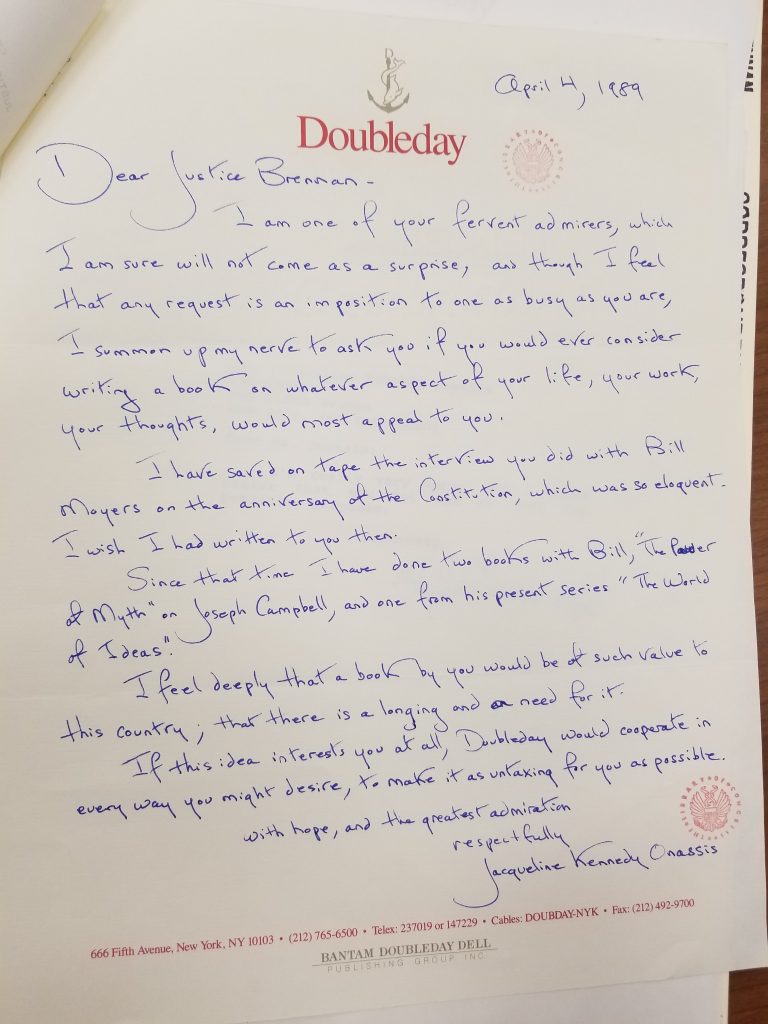
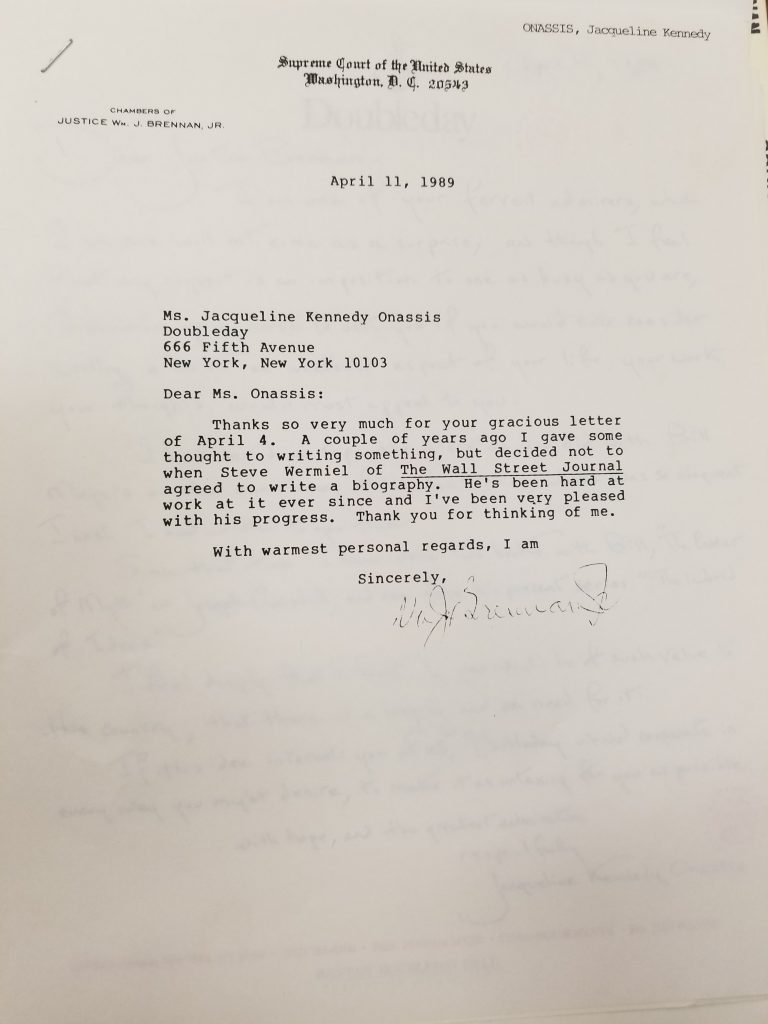
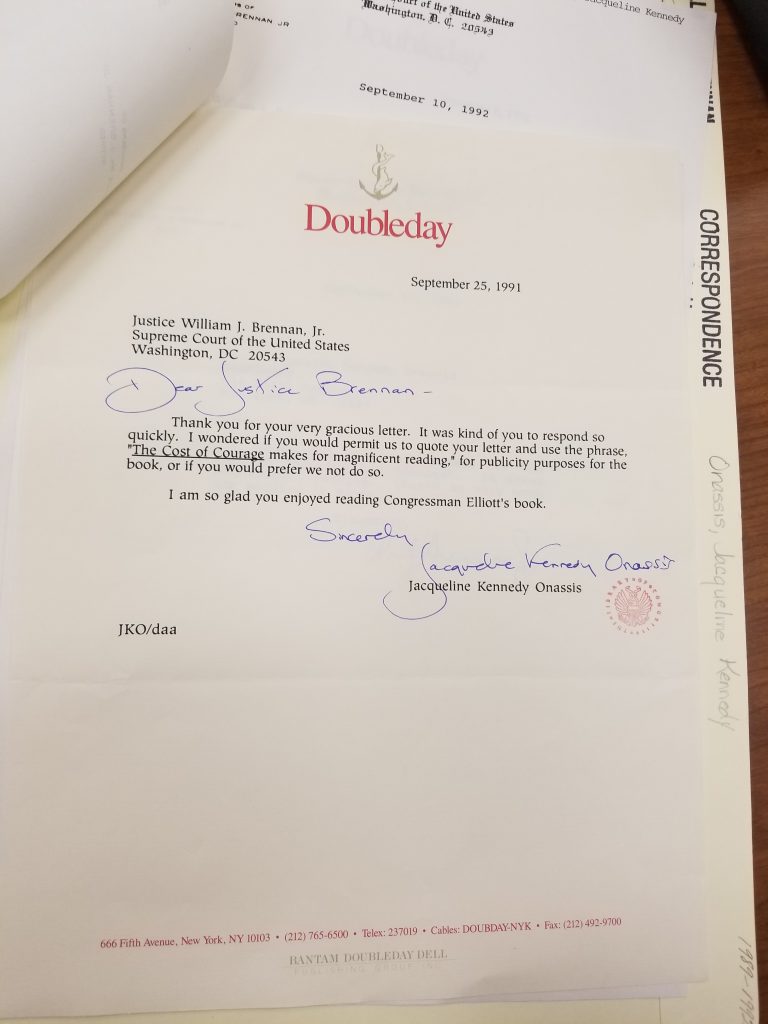
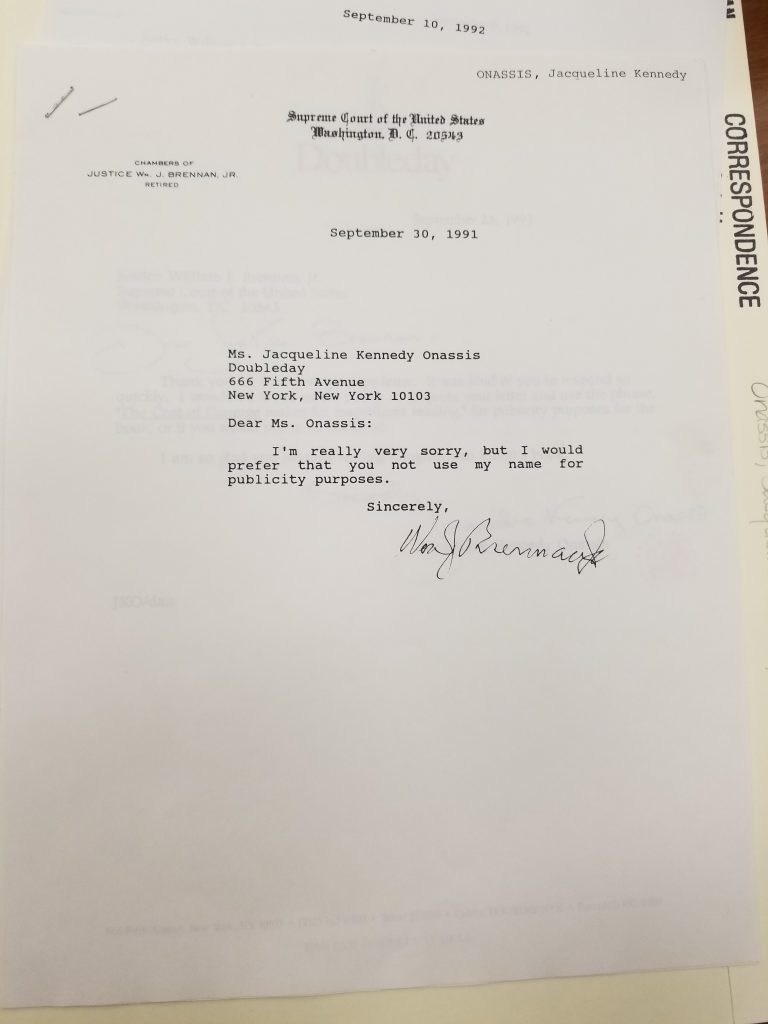
Justice Brennan’s Correspondences with Ms. Jacqueline Kennedy Onassis

March 13th, 2018

During the pendency of Judge Garland’s ill-fated Supreme Court nomination, I sought to discover whether he had any relevant communications with his former boss, Justice Brennan. Alas, Justice Brennan’s correspondences were sealed until June 2017. By that point, no one cared any more about Garland’s correspondences. Except for me.

Last week, during a trip to DC, I made good on a longstanding desire to view Brennan’s papers. At long last, were there any correspondences with a young Merrick Garland? None. Not a single letter that I could find. Nor were there any communications with another famous law clerk, Richard Posner. Perhaps Brennan didn’t file such letters? Who knows. But I did find other fascinating items, which I will blog seriatim.

In this first post, I will reproduce a number of communications between Justice Brennan and Ms. Jacqueline Kennedy Onassis. Methinks WJB had a thing for Jackie, though he would not let Doubleday publicize his praise of a book.


Highlights from the Congressional Research Service’s American Law Division

March 12th, 2018

During a recent trip to DC, I accepted a longstanding invitation to visit the Congressional Research Service’s American Law Division at the Library of Congress. I saw a number of cool Supreme Court documents, which I reproduce below.

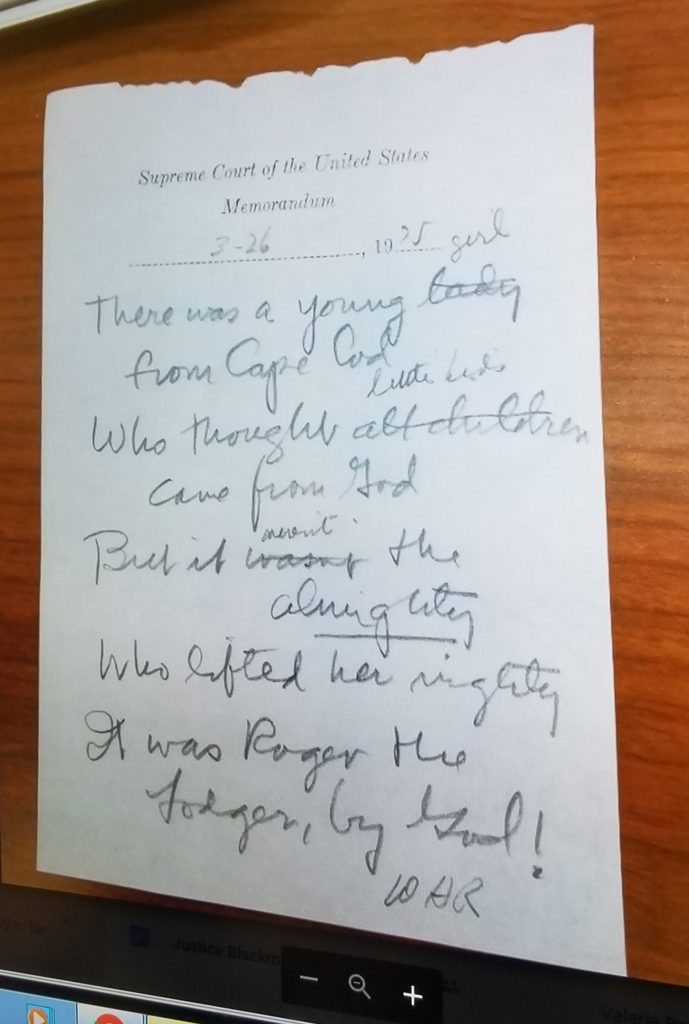
First, here is a limerick written by Justice Rehnquist in 1975:

There was a young girl from Cape Cod.

Who thought little babies came from God.

But if not the Almighty

Who lifted her Nighty

It was Roger the Dodger by God!

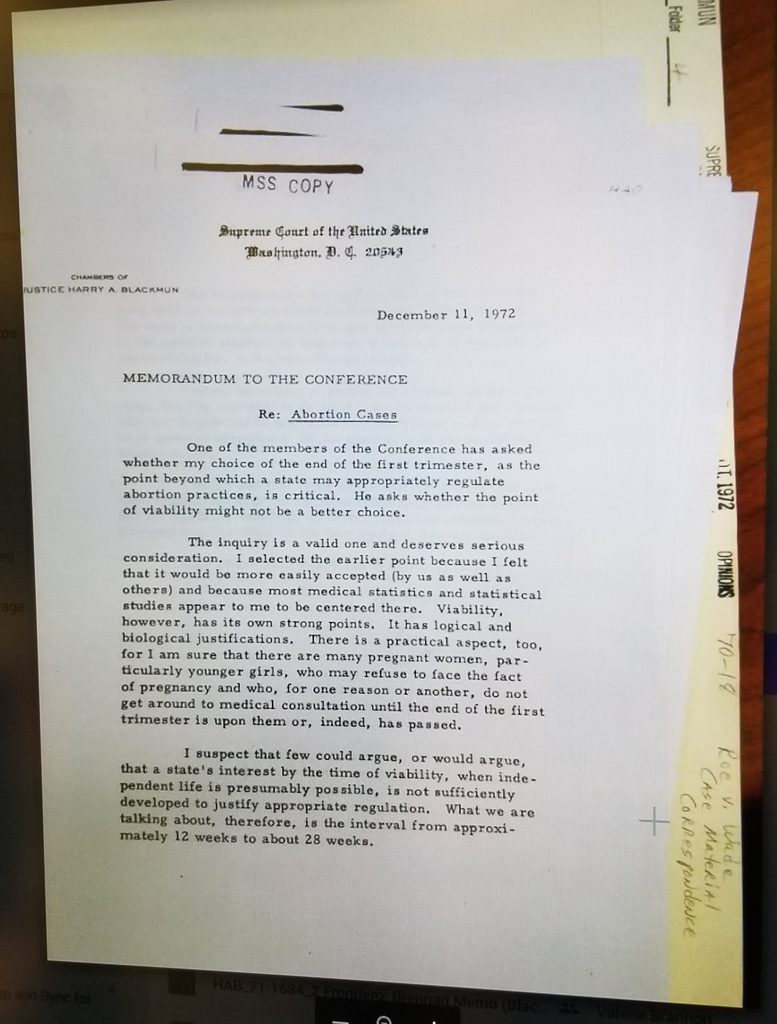
Second, here is a memo that Justice Blackmun wrote to the conference concerning Roe v. Wade. Specifically, he addressed whether the line should be addressed at viability, or at the first trimester. As history would reveal, the Court in Casey would drop Roe, and adopt viability as the relevant line.

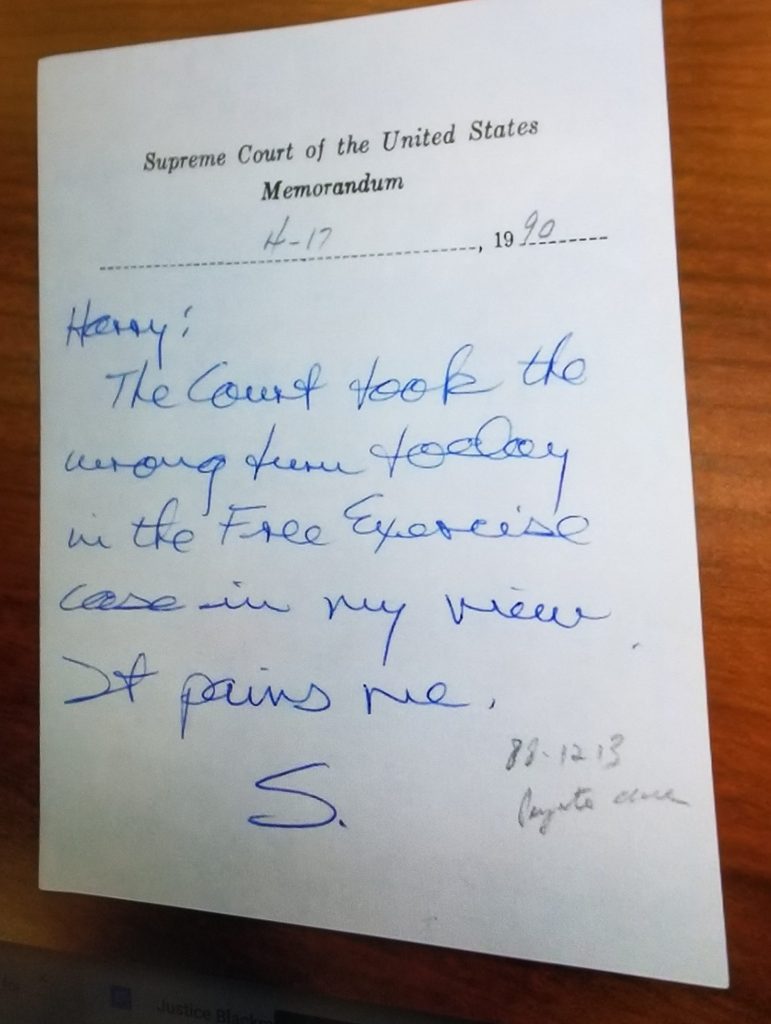
Third, here is a memorandum from Justice O’Connor to Justice Blackmun on 4/17/1990, the day the Court decided Employment Division v. Smith. She wrote:

Harry:

The Court took the wrong turn today in the Free Exercise case in my view. It pains me. S.

Someone scribbled in, “88-12-13 Peyote Case.”

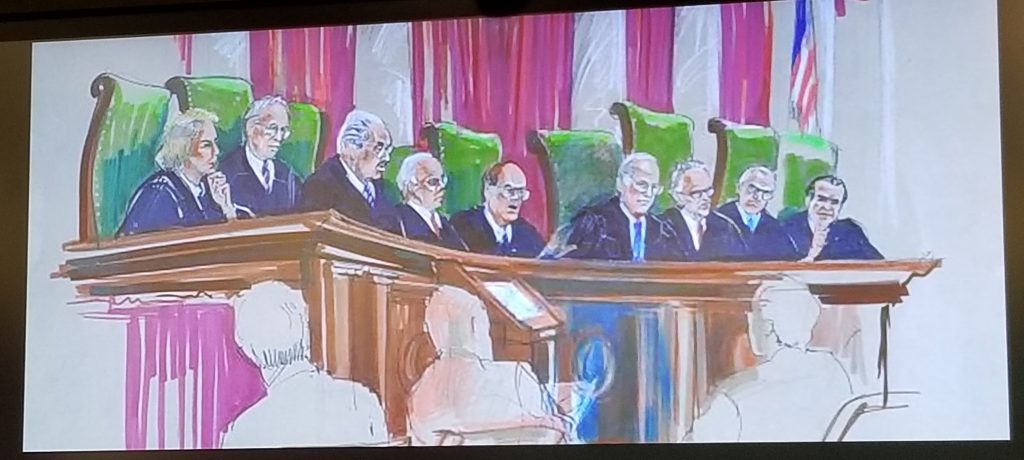
Fourth, here is a sketch of the Court from 1986 or 1987 when Justice Scalia was the junior justice. Were the chairs ever green?

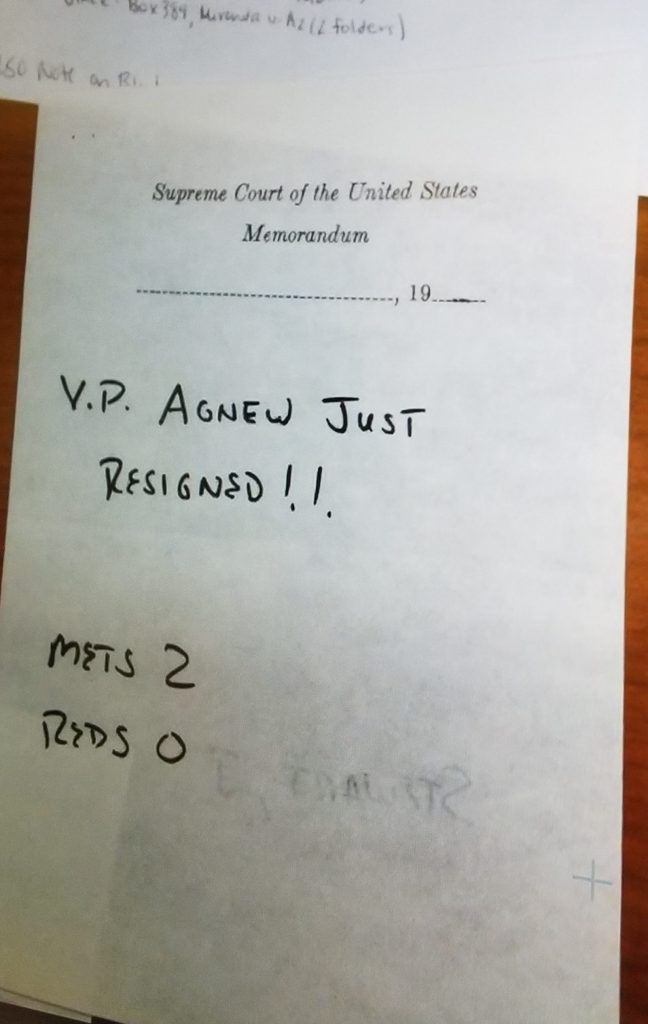
Fifth, Adam Liptak described the following memo this way:

In 1973, while the court heard arguments during the National League Championship Series, Justice Potter Stewart passed a note to Justice Harry A. Blackmun that exhibited a nice sense of proportion.

I will post many other fascinating documents I found in the coming days.

ConLaw Class 16 – The Scope of the 14 Amendment II – Congress’s Enforcement Powers and the Equal Protection Clause

March 8th, 2018

Class 16 – 10/5/17

The Scope of the 14th Amendment II – Congress’s Enforcement Powers and the Equal Protection Clause

The lecture notes are here.

The Civil Rights Cases

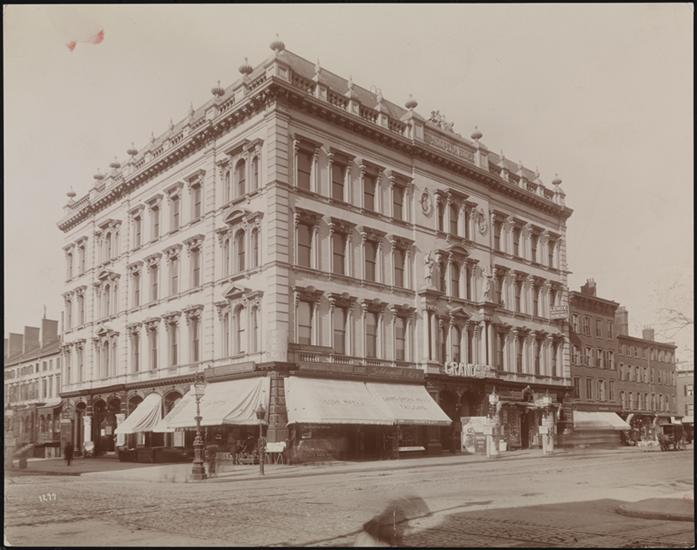
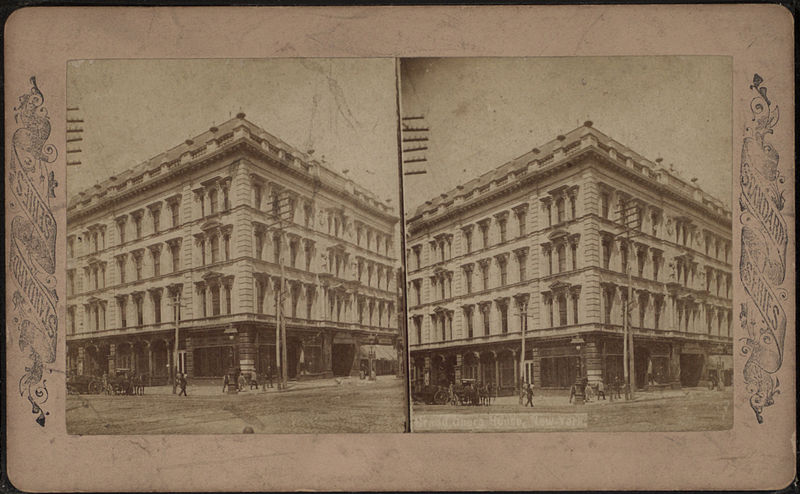
The Grand Opera House in New York City, formerly known as Pike’s Opera House, was located on the Northwestf Corner of 8th Avenue and 23rd Street, in Chelsea. It was was shut down in 1960.

grand-opera

800px-Grand_Opera_House,_New_York,_from_Robert_N._Dennis_collection_of_stereoscopic_views_2

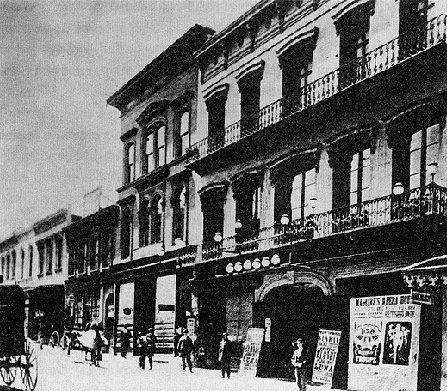
Maguire’s Opera House, formerly known as San Francisco Hall, was a three-story theater on Washington Street between Kearny and Montgomery in San Francisco.

maguires-opera-house

I was not able to find photographs of Nichol’s Inn in Jefferson City, MO, the Topeka Inn in Topeka, Kansas, or the Tennssee Parlor Car.

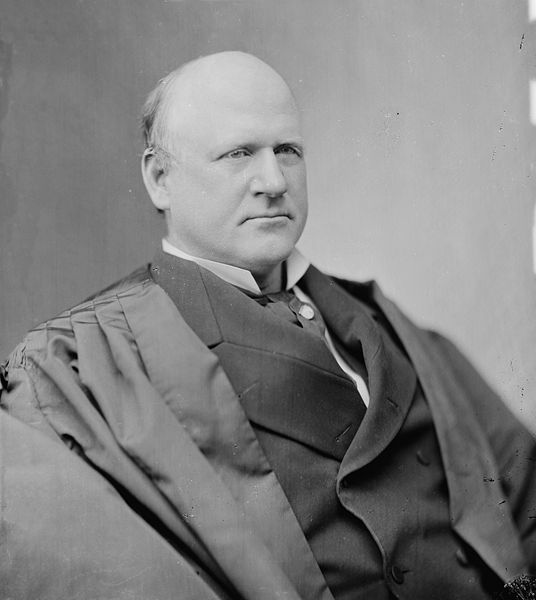
This is Justice John Marshall Harlan I, who authored the solo dissent in the Civil Rights Cases.

harlan

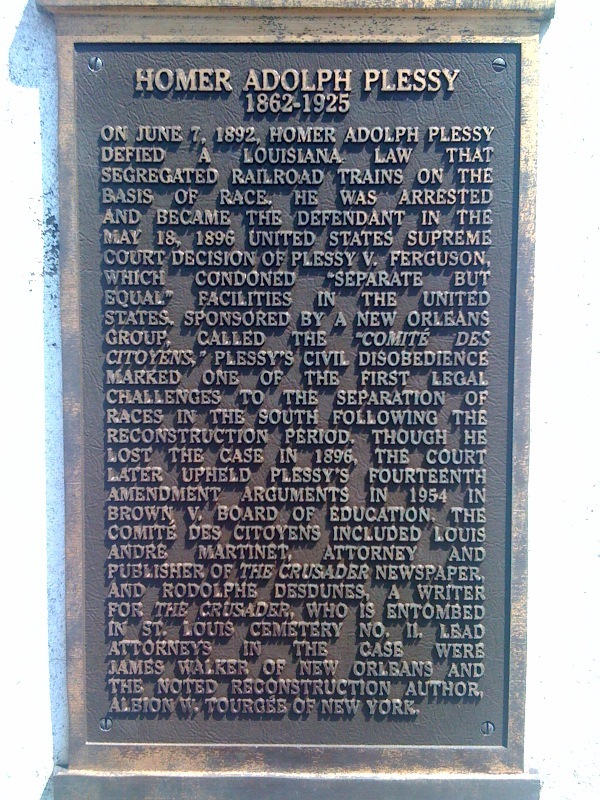
Plessy v. Ferguson

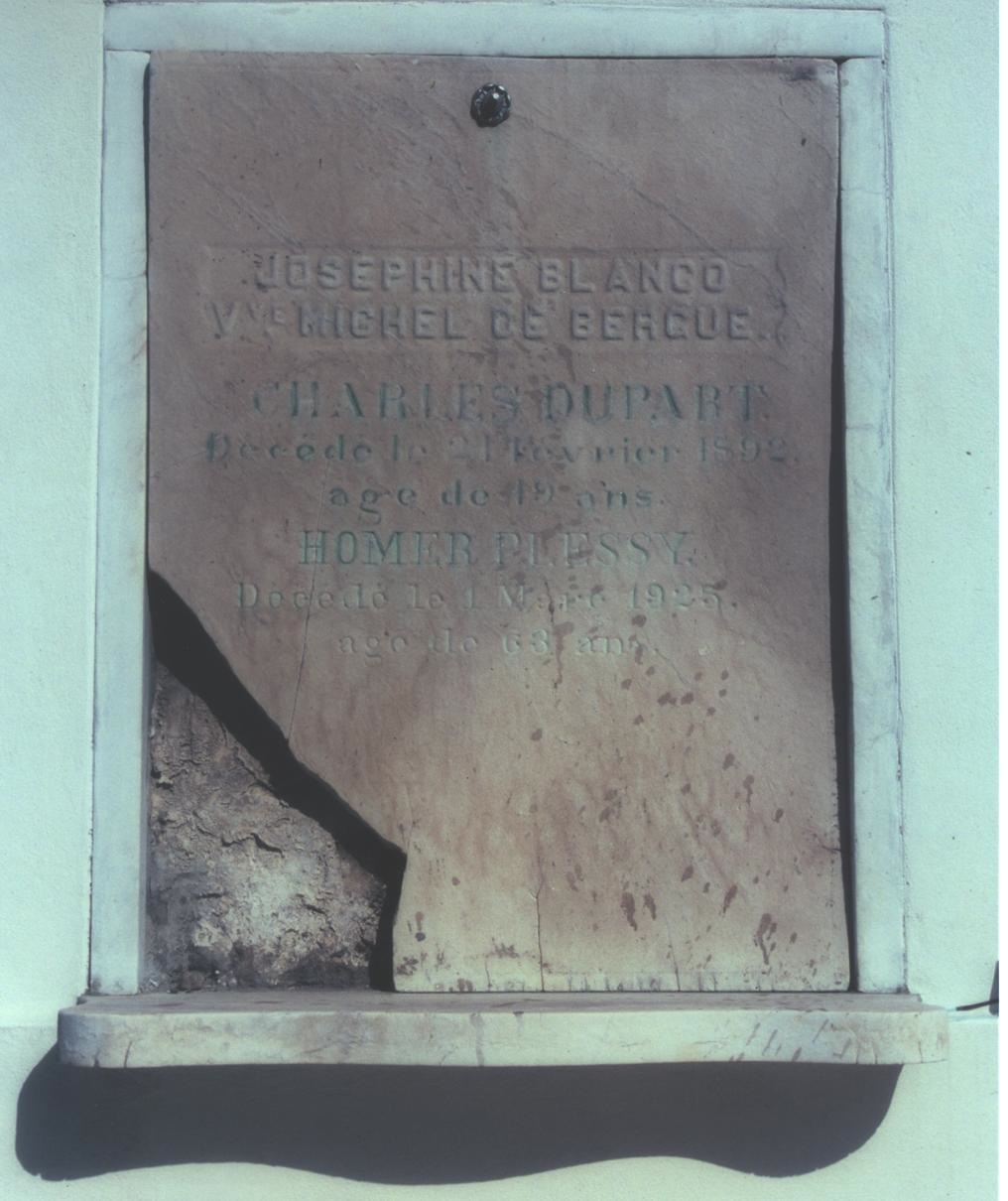
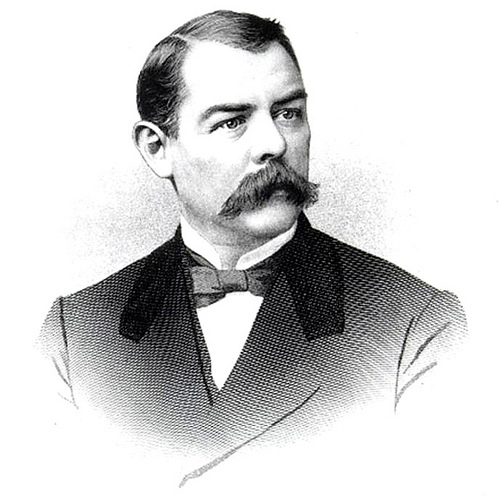
We actually do not have any confirmed photographs of Homer Plessy (there are some floating on the internet, but we aren’t sure if they are really him). Here is his grave.

Kunhardt Homer Plessy Grave

photo 2

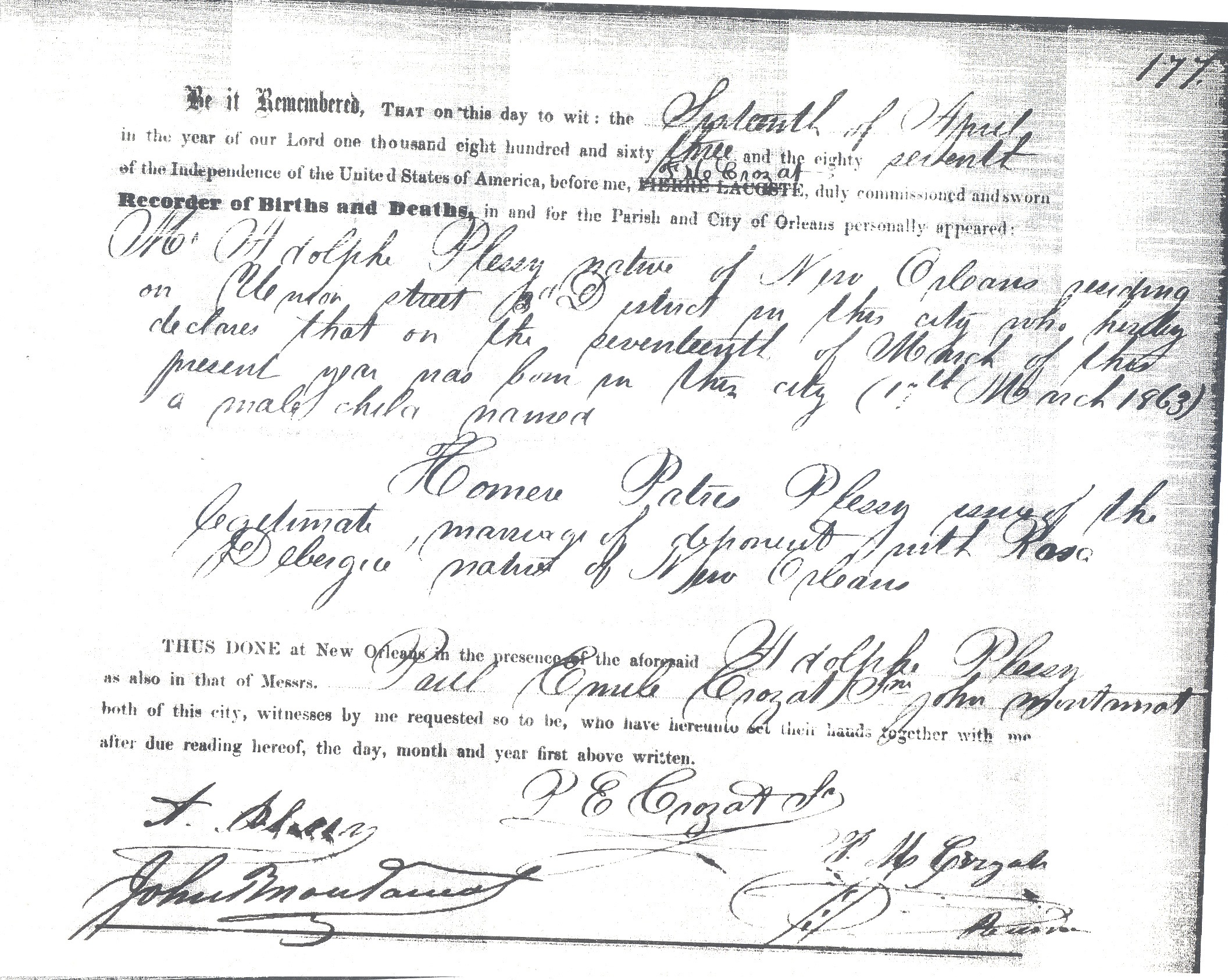
This is  Adolph Plessy’s Birth Certificate from Orleans Parish, from 1863.

Plessy Birth Certificate

plessy-sign

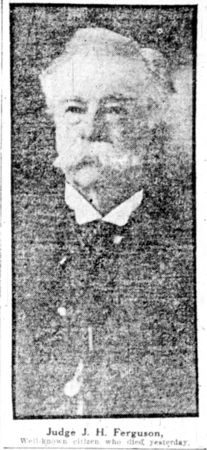
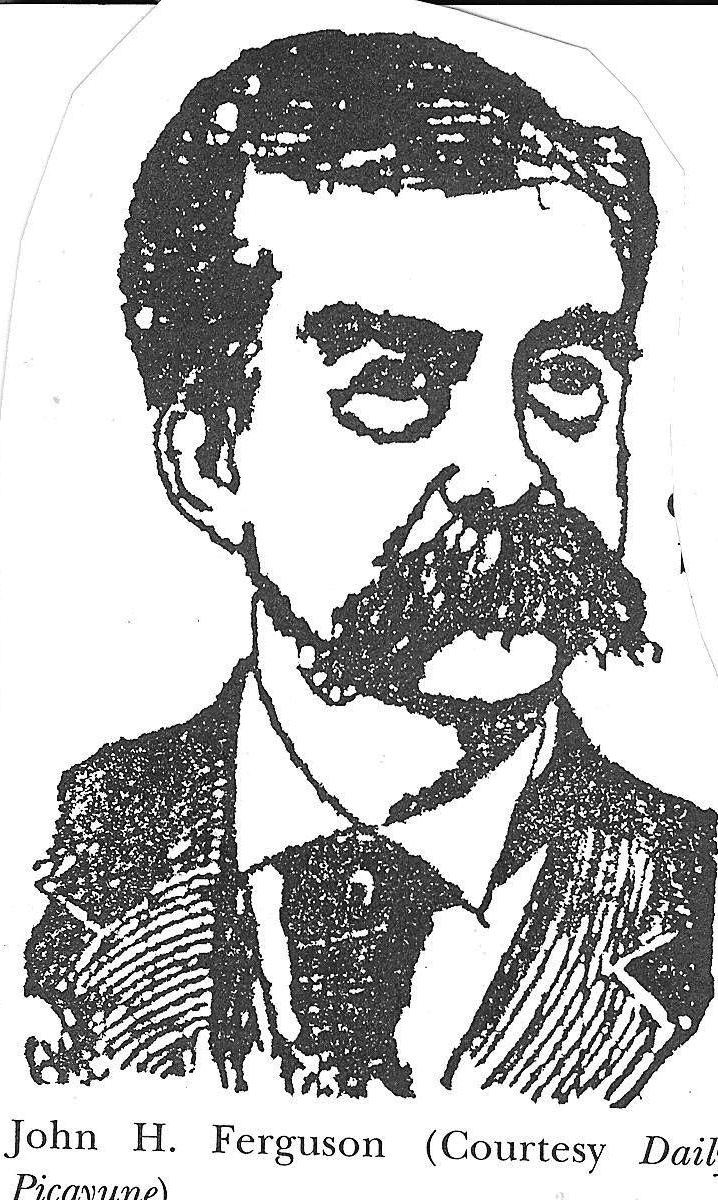
This is Judge John J. Ferguson.

ferguson

Little Rock Nine Visuals - Judge Ferguson

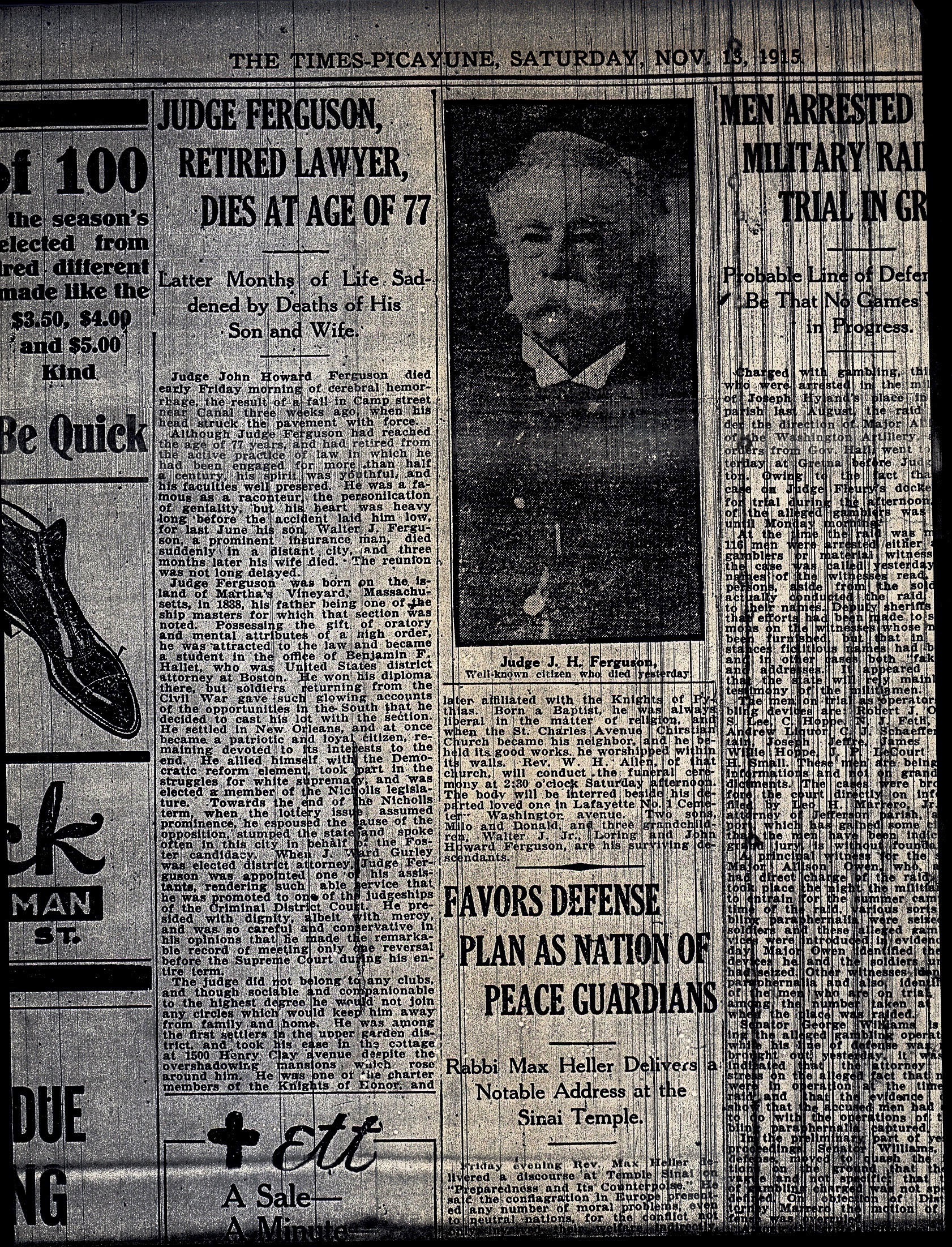
This is an obituary for Judge Ferguson. It makes no reference of his role in the case of Plessy v. Ferguson.

Ferguson - Obituary - Positive

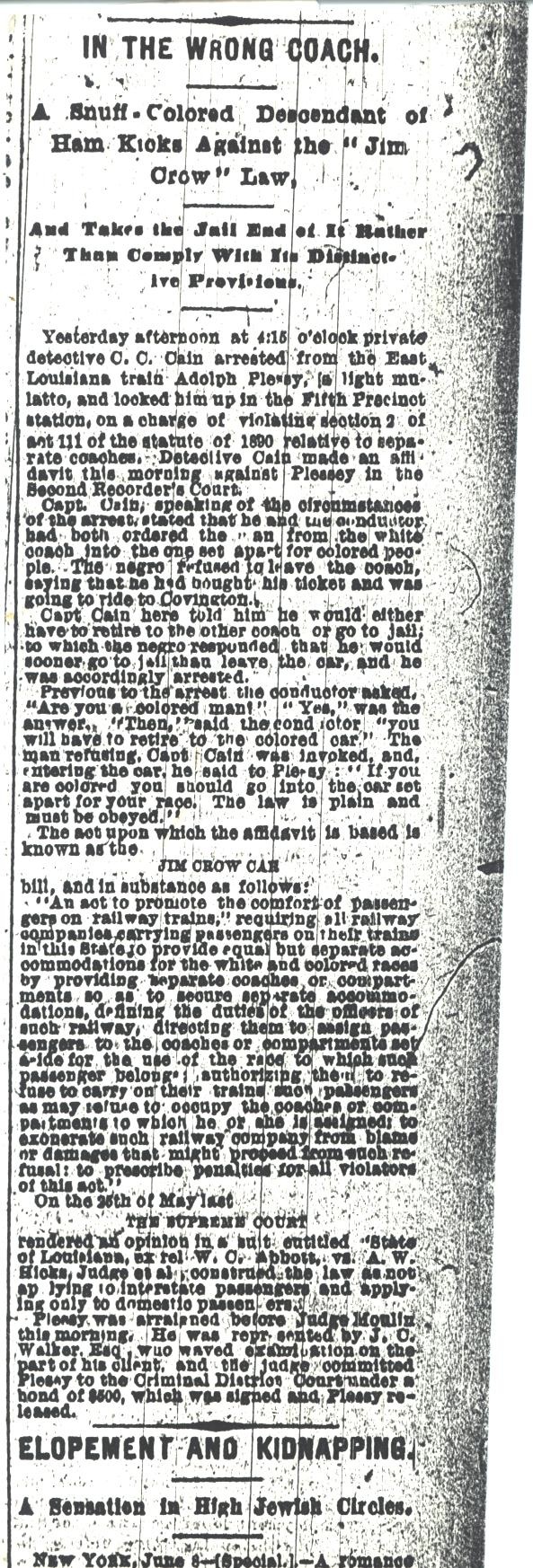
Here is a newspaper account from the Times Pacayune, June 9, 1892, with the headline, ” snuff-colored descendant of Ham kicks agains the ‘Jim Crow’ law.”

Yesterday afternoon at 4:15 o’clock private detecting C.C. Cain arrested from the East Louisiana [Homer] Adolph Plessy, a light mulatto, and locked him up in the Fifth Precinct station on a charge of violating section 2o of act 111 of the statute of 1890 relative to separate coaches. Detective Cain made an affidavit this morning against Plessey [sic] in the Second Recorder’s Court.

Capt. Cain, speaking of the circumstances of the arrest, stated that he and the conductor had ordered both the man from the white coach into the one set apart for colored people.  The negro refused to leave the coach, saying that he had bought his ticket and was going to ride to Covington.

Capt. Cain here told him he would either have to retire to the other coach or go to jail; to which the negro responded that he would sooner go to jail than leave the car, and he was accordingly arrested.

Previous to the arrest the conductor asked, “Are you are a colored man!”” “Yes,” was the answer. “Then,” said the conductor,” you will have to retire to the colored car.” The man refusing, Capt. Cain was invoked, and entering the car, he said to Plessy, “If you are colored you should go into the car set apart for your race. The law is plain and must be obeyed.”

The set upon which the affidavit is based is known as the “Jim Crow Car” bill, and in substance as follows.

“An act to promote the comfort of passengers on railway trains,” requiring all railway companies carrying passengers on their trains in this State to provide equal but separate accommodations for the white and colored races by providing separate coaches or compartments so as to secure separate accommodations, defining the duties of the offers of such railways, directing them to assign passengers to the coaches or compartments set aside for the use of the race to which such passengers belong, authorizing them to refuse to carry on their trains such passengers as may refuse to occupy the coaches or compartments to which he or she is assigned; to exonerate such railways company from blame or damage that might proceed from such refusal; to prescribe penalties for all violators of this act.”

On the 25th of May last, the Supreme Court rendered an opinion in a suit entitled “State of Louisiana Ex Rel W.C. Abbott v. A.W. Hicks, Judge et al, construed the law as not applying to interstate passengers and applying only to domestic passengers.

Plessy was arraigned before Judge Moulin this morning. He was represented by J.C. Walker, Esq. who waived examination on the part of his client, and the judge committed Plessy to the Criminal District Court under a bond of $500, which was signed and Plessy released.

Kunhardt Plessy In The Wrong Coach


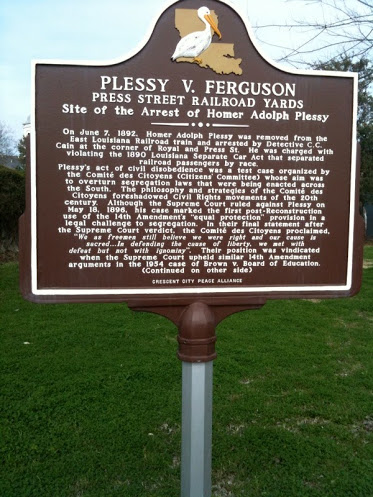
Plessy boarded the East Louisiana Railroad Co. train at Press and Royal streets.

East-Louisana

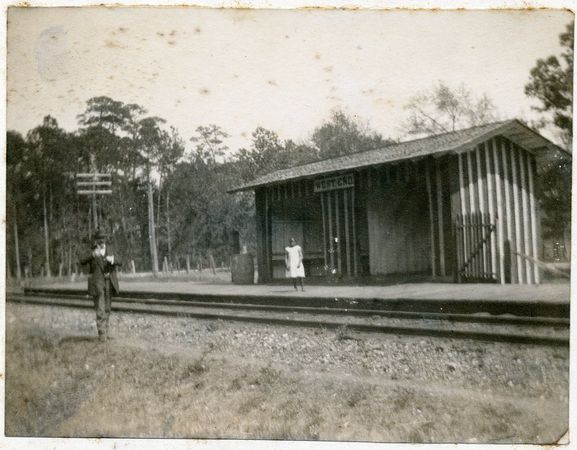
Here is a photograph of the nearby West End station.

west-end

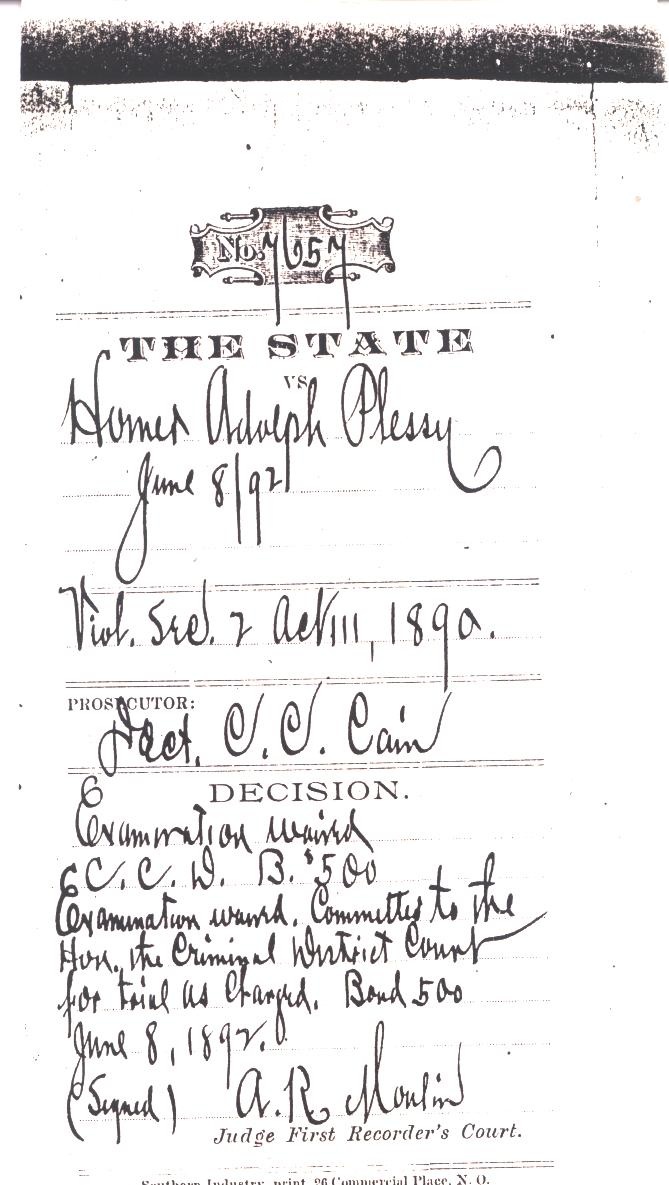
This is the order noting that Plessy’s counsel waved examination, and he was held on $500 bond. As the article suggests, Plessy posted bond, and was released.
Kunhardt Plessy Court Document 002

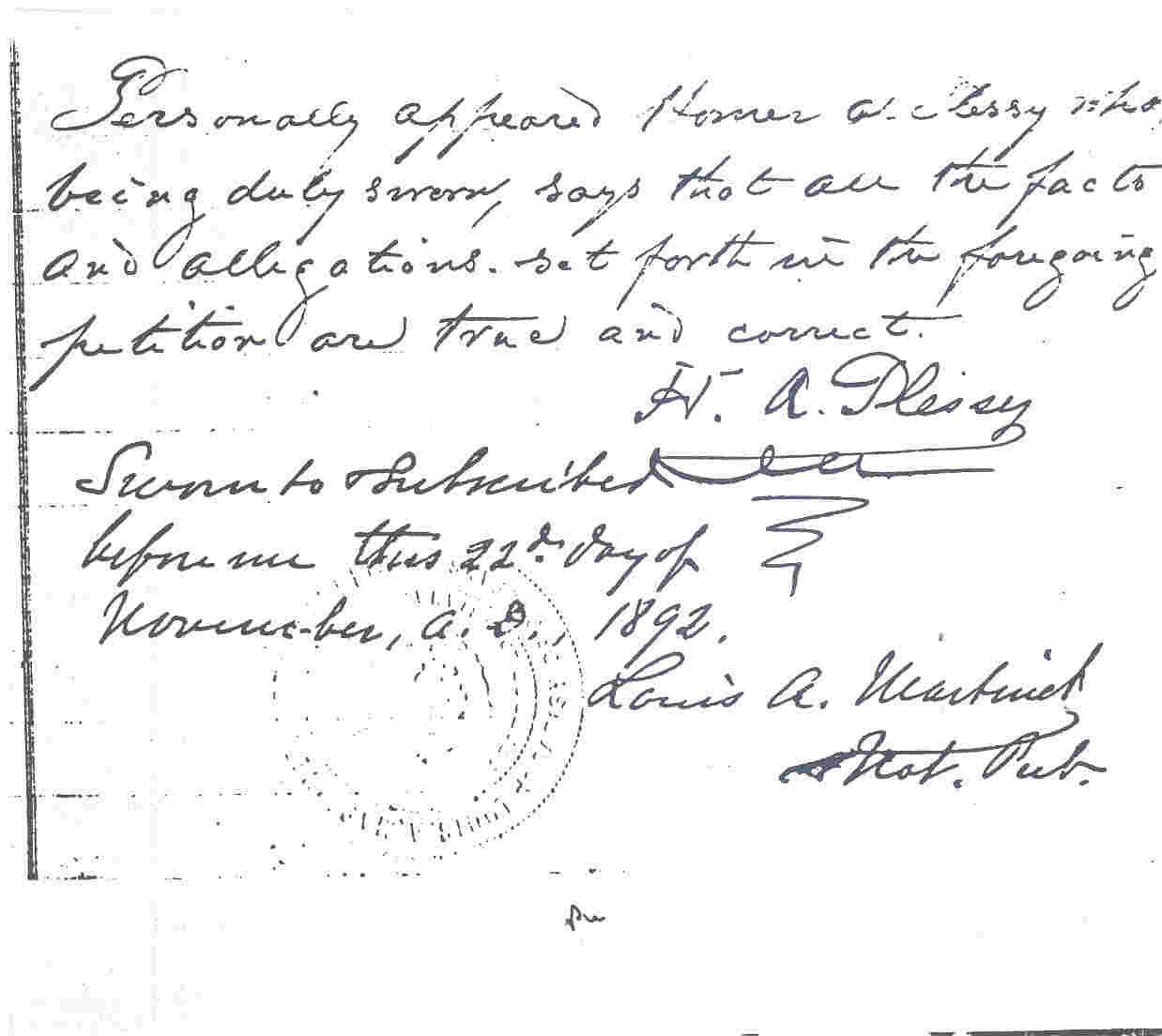
Here is an affidavit Plessy signed.

PVG-PlessyAffidavit

Judge Ferguson found that Louisiana could regulate railroad companies if they only operated in state boundaries. Plessy was ordered to pay a $300 fine.

Albion Tourgee´ represented Homer Plessy before the Supreme Court. He asked the Justices to imagine if they were black.

Tourgee

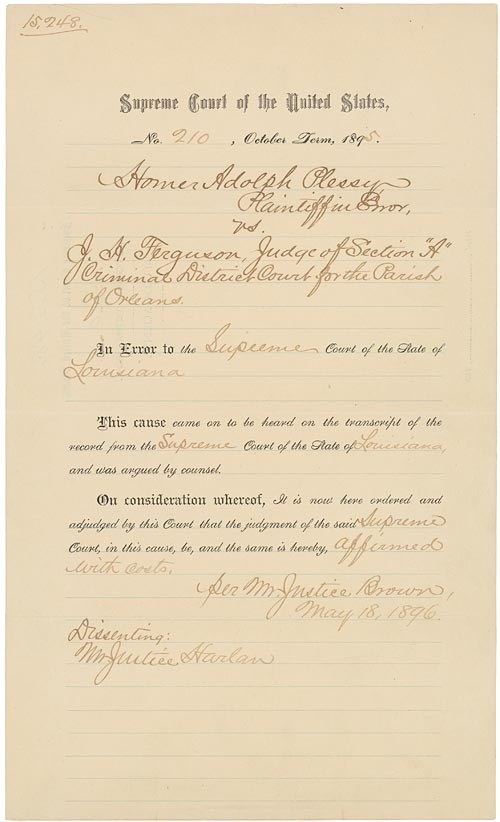
Here is the Supreme Court’s order affirming the decision of the Louisiana Supreme Court, noting the dissent of Justice Harlan.

plessy-scotus

And in a story almost too good to be true, descendants of Homer Plessy and John Ferguson have started a non-profit known as the Plessy and Ferguson Foundation. Here are Keith Plessy and Phoebe Ferguson. I’ve spoken on the phone to Keith Plessy.

Here is Plessy’s grand-nephew, Keith Plessy, standing at the site where his ancestor was arrested, Press and Royal streets.

plessy-standing


Class 16 – Future Interests III: Rule Against Perpetuities

March 8th, 2018

Class 16


The lecture notes are here.

Thankfully, Texas has abolished the Rule in Shelley’s case, the Doctrine of Worthier Title, and the Rule Forbidding a Remainder in the Grantor’s Heirs. This is the Texas Rule Against Perpetuities.

RULE AGAINST PERPETUITIES. The rule against perpetuities applies to trusts other than charitable trusts. Accordingly, an interest is not good unless it must vest, if at all, not later than 21 years after some life in being at the time of the creation of the interest, plus a period of gestation. Any interest in a trust may, however, be reformed or construed to the extent and as provided by Section 5.043.

In case you were wondering, the youngest mother on record is five-years old. And in a bizarre case, a man adopted his girlfriend to protect his assets.

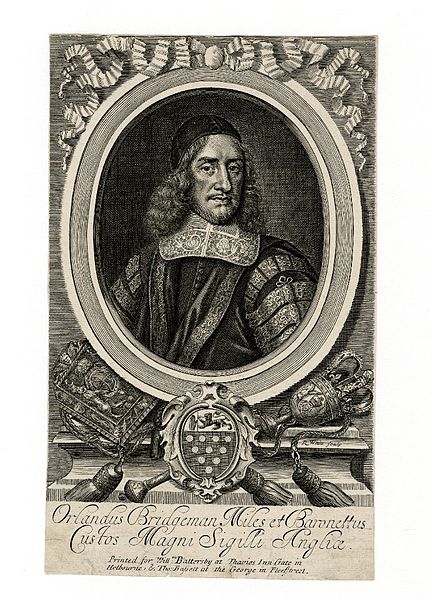
And, if you hate the Rule against Perpetuities, blame this guy. Orlando Bridgeman, whose crazy conveyances raised the possibility of perpetuity, which led to the creation of the Rule Against Perpetuities.bridgemanDon’t blame me. Blame Orlando. Note: The Rule Against Perpetuities will not be tested on the final examination. In other words, this is a wrap for RAP.