Blog

Between 2009 and 2020, Josh published more than 10,000 blog posts. Here, you can access his blog archives.

2020
2019
2018
2017
2016
2015
2014
2013
2012
2011
2010
2009

The “Presumption of Regularity” And James Comey

May 10th, 2017

In my post about IRAP v. Trump, I focused on the Solicitor General urging the court to apply a “presumption of regularity” to the travel ban. Taking the opposite perspective was professor Dawn Johnsen, who urged a room full of Seventh Circuit judges to “adapt their screens of deference” for the Trump administration, due, in part, to “Russian interference in our democracy.”

I responded:

I appreciate Johnsen’s candor, as she admits what the ACLU and other Attorneys General tap-dance around. She is openly asking courts to consider a litany of political grievances to determine that Trump is not entitled to the usual deference other Presidents have been afforded.

Today, after James Comey’s firing, Joshua Matz offered a similar message, urging the judges of the Fourth Circuit to consider the propriety of Trump’s admittedly lawful termination of James Comey when ruling on the travel ban:

The President has the raw power to fire the FBI Director.  But valid exercises of power can still create constitutional crises and threaten rule of law values, especially when our system depends heavily on norms and precedents rather than just a series of underlying formalisms.  Having fired the man in charge of significant national security and intelligence policies—and having done so while that man led a criminal investigation involving foreign influence at the highest levels of the U.S. government—Trump has unquestionably forfeited any claim to a presumption of “regularity” or “good faith.”

I expect that the judges of the Fourth Circuit Court of Appeals, and their law clerks, are paying close attention to these events. Norms of judicial rhetoric likely wouldn’t permit any mention of Comey in an opinion. But it’s inconceivable to me that the Comey firing won’t frame their reaction to Trump’s insistence that presumptions of deference compel them to uphold his Muslim Ban.

Like with Johnsen, I appreciate Matz’s candor. Since the inauguration, judges in Seattle, Hawaii, and Maryland have abandoned the presumption of regularity for Trump. It didn’t take the firing of Comey to do so. His dangerous attacks on Judge Curiel last year were more than enough.

With that being said, I am profoundly troubled that judges have an on/off switch for the usual rule of law based on how egregious they think the President’s actions are. Trump, like any party before the court, is entitled to equal justice under law. If anything, as the President of the United States, he occupies a unique place in our republic. It is not for judges to decide, from their cloistered chambers, to put a thumb on the scale.

This colloquy between Acting Solicitor Jeff Wall and judges of the Fourth Circuit works just as well for Comey’s firing, as it does for the travel ban:

In this clip, Judge Floyd asks “if there is anything other than willful blindness that would prevent us from getting behind those statements.” Wall responds, “Respect for the head of a coordinate branch, and a presumption that officials act legally, which is to say, the ‘presumption of regularity.’” Chief Judge Gregory interjects, and asks about whether that presumption prevents courts from assessing the constitutionality of actions. Wall replies that it does not, but that the “only thing” plaintiffs have is to “reach back” to “what was in the President’s head.” He admits there are “different ways to read those [political] statements,” but insists that “respect for a coordinate branch and a ‘presumption of regularity’ require reading them in a way that is not most hostile to the President, but would render the actions lawful.”

Judge Wynn says that, far from regularity, with respect to President Trump “we are in uncharted territories.” In response, Wall counters that the district court’s opinion was in fact “unprecedented.”

I’ll reiterate a point I made on Lawfare:

This sort of analysis will suffice for the inferior courts, but will have a short shelf life. I strongly doubt the Supreme Court will wade into such muddy waters. Can you imagine five Justices assessing the necessary level of “Russian interference in our democracy” before jettisoning the “presumption of regularity” as applied to President Trump’s executive actions?

And make no mistake about this campaign of delegitimization. It doesn’t stop at Trump, but goes to all aspects of his government–even to his judicial appointments. Professor Glenn Reynolds writes about an email bouncing around on a faculty list serve, calling on other professors to “quarantine” 5-4 decisions where Gorsuch casts the deciding vote because they are “illegitimate.”

This rabbit hole goes down very, very far. Think before you leap.

Senate and House investigations, special prosecutors, and political pressure, provide ample means to address purported misconduct. The courts do not need to do their part.
 

Bending the Arc to Justice

May 10th, 2017

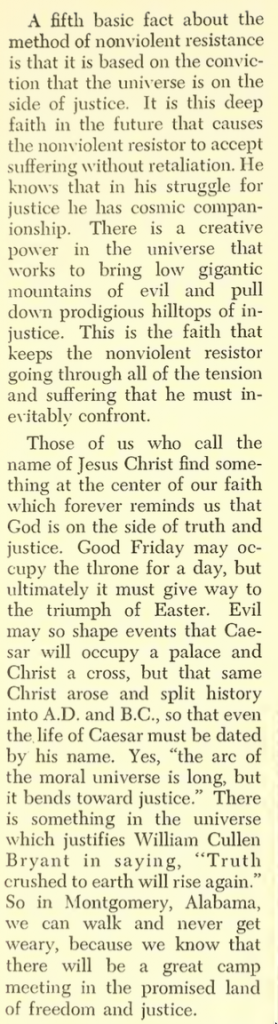
Throughout his career, President Obama has employed, with great rhetorical effect, a phrase often attributed to MLK: “the arc of the moral universe is long, but it bends toward justice.” On Sunday, while accepting the JFK Profiles in Courage aware, he tweaked it a bit, adding “It bends because we bend it. Because we put our hand on that arc & we move it in the direction of justice.”  For three reasons, I am not keen on this bromide.

First, the quotation is plucked entirely out of context. King did not come up with the expression, but instead quoted the 19th century clergyman and abolitionist Theodore Parker, in the February 8, 1958 edition of The Gospel Messenger (p. 14).

For both King and Parker, the quotation has a distinctly religious context. Michael Wear, who directed faith-based outreach for the Obama administration, explains:

 “It’s very clear that, apart from Jesus Christ, the idea of a moral arc of the universe was inconceivable to King. It only made sense within the context of a declarative faith statement.”

Matt Lewis added:

In this context, it is clear that bad people often prevail in this carnal world where Caesar still rules. That doesn’t mean that we shouldn’t engage in political activism, but it does mean that we shouldn’t assume some sort of magical force is inexorably leading us to some utopian progressive or liberal end of history.

Which leads me to my second objection. As it is used today, the phrase “justice” is synonymous with political liberalism. That is, all policies that serve progressive goals are just, and those that oppose progressive goals are unjust.  But what is justice? For that matter, what is liberty? Abraham Lincoln offered these wise words in 1864:

The world has never had a good definition of liberty, and the American people, just now, are much in need of one. We all declare for liberty; but in using the same word we do not all mean the same thing.

With some the word liberty may mean for each man to do as he pleases with himself, and the product of his labor; while with others the same word may mean for some men to do as they please with other men, and the product of other men’s labor. Here are two, not only different, but incompatible things, called by the same name — liberty. And it follows that each of the things is, by the respective parties, called by two different and incompatible names — liberty and tyranny.

The shepherd drives the wolf from the sheep’s throat, for which the sheep thanks the shepherd as a liberator, while the wolf denounces him for the same act as the destroyer of liberty, especially as the sheep was a black one. Plainly the sheep and the wolf are not agreed upon a definition of the word liberty; and precisely the same difference prevails today among us human creatures, even in the North, and all professing to love liberty. Hence we behold the processes by which thousands are daily passing from under the yoke of bondage, hailed by some as the advance of liberty, and bewailed by others as the destruction of all liberty.

Liberty is not self-defining. Nor is Justice. Do not presume that the end-game of our universe comports with your pre-conceived notions of morality. Such is the ultimate fatal conceit.

Finally, while on its face, the phrase is quite aspirational, as applied to modern-day political movements, it is quite divisive: those opposed to “justice” (as the speaker defines it) will be left behind by history. For example, Ohio governor John Kasich, who supported expanding Medicaid in his state, famously told an opponent, “When you die and get to the meeting with Saint Peter, he’s probably not going to ask you what you did about keeping government small. But he is going to ask you what you did for the poor. You better have a good answer.” This mode of argumentation is not much different than the Puritanical message: follow us or you will go to hell. Or, in the more modern sense, you’re either with us or against us. I would never presume that there is only one correct answer to every policy debate, but the arc of the universe question presumes exactly that. By itself, the phrase is conclusory, and uprightly dismisses arguments to the contrary.

Many progressive goals are laudable as a policy matter, but the conscriptions on seeking those goals that are imposed by the rule of law and a written Constitution are important as well. Justice, justice, we shall pursue.

Trump’s Firing of Comey was Constitutional

May 9th, 2017

Tonight, I was scheduled to go on Making Money with Charles Payne at 6:10 ET to talk about sanctuary cities. About 20 minutes beforehand, the news of James Comey’s firing blew up. I was convinced I would get bumped. Instead, the producers asked me to join the program to talk about Comey. I was in the chair for the full hour, offering some basic constitutional commentary about the President’s removal power. During commercial breaks, I managed to type out this statement for Politico Magazine, in response to the question of whether this is a “constitutional crisis.” In a word, no:

‘Trump’s actions were entirely constitutional’
Josh Blackman is a constitutional law professor at the South Texas College of Law in Houston, an adjunct scholar at the Cato Institute, and the author of Unraveled: Obamacare, Religious Liberty, and Executive Power.

Under the Constitution, the president has the absolute power to fire principal officers, such as Director Comey, at will. In that sense, Trump’s actions were entirely constitutional. Indeed, the termination was accompanied by a fairly elaborate set of reasons by the deputy attorney general.

As for whether there is a crisis, we must keep in mind that Comey’s replacement must be approved and confirmed by the Senate. Both Republicans and Democrats will have a say in who heads the agency going forward. At bottom, this is a political question, which ultimately the electorate can decide.

Further, for those drawing analogies to the Saturday Evening Massacre, recall that Nixon never actually fired anyone himself. Instead, he had to ask a subordinate to fire the special prosecutor for cause. Comey was fired by the President, directly, at will (though plenty of causes were given). I wrote about this issue after Yates was fired:

Let’s review the facts. In 1973, Attorney General Elliot Richardson appointed Archibald Cox as an independent special prosecutor to investigate the break-in at the Watergate Hotel. Cox, a former solicitor general, issued subpoenas to President Nixon for taped Oval Office conversations. Nixon refused. Under the law in effect at the time, the president could not fire the special prosecutor directly. Rather, the attorney general could fire Cox, but only “for cause,” which required some neglect of duty. In other words, the prosecutor could not be fired because his investigation came too close to the Watergate cover-up.

After ignoring the subpoena, on Saturday, Oct. 20, 1973, President Nixon ordered Attorney General Richardson to fire Cox. However, the prosecutor had not engaged in any malfeasance, and there was no “cause” to terminate him. Thus, the president’s order was against the law. Richardson refused to comply, and instead resigned. Shortly thereafter, Deputy Attorney General William Ruckelshaus assumed the position of acting attorney general. He too refused to fire Cox, and instead resigned. Third in line was Robert Bork. The solicitor general, now the acting attorney general, believed the president’s order was constitutional and appropriate. Bork complied, and fired the special prosecutor. It was a dramatic episode in constitutional history that gave rise to the independent counsel statute, and two decades later, President Bill Clinton’s impeachment.

As I noted on Fox Business, even if a special prosecutor is appointed, that prosecutor would still be subject to removal by Attorney General Jeff Sessions. But since Sessions has recused, the special prosecutor would be subject to removal by the Deputy Attorney General.


Audio: Bloomberg Law Radio: Travel Ban Faces Tough Review in Virginia Court

May 9th, 2017

Today I was a guest on Bloomberg Law Radio with host Greg Stohr, and Liza Goitein, co-director of the Liberty & National Security Program at the Brennan Center for Justice to discuss IRAP v. Trump.

You can listen here:

Op-Ed in NY Daily News: “The Wrong Way to Assess the Travel Ban.”

May 9th, 2017

Today’s New York Daily News ran my editorial, titled “The wrong way to assess the travel ban: Trump’s words in interviews and on the stump should not decide an appeals court’s ruling.”

On the campaign trail, candidate Donald Trump promised a complete Muslim ban. However, after listening to his lawyers, he announced that he would abandon that policy, and instead impose an “extreme vetting” policy for six terror-prone countries. Or did he?

Monday, 13 judges on the Fourth Circuit Court of Appeals in Virginia were sharply divided over what Trump really meant. A handful of jurists seemed willing to give the President the benefit to the doubt, out of respect for his critical position in our republic. Alas, the remainder of the bench looked at Trump’s campaign statements in roughly the same way Rachel Maddow scrutinized his tax returns.

At bottom, how judges view the travel ban amounts to a legal Rorschach Test: Will they treat Trump like any other President, or have they joined the resistance? The answer to this question, and not any neutral principle of law, will determine the fate of Trump’s signature immigration policy.

The travel ban, on its face, does not discriminate against Muslims. Rather, it severely restricts immigration from six nations — three of which are state sponsors of terror — that were each singled out for heightened scrutiny by the Obama administration. The world’s most populous Muslim nation are unaffected, as is the world’s most populist Arab country.

Had President Obama issued the exact same executive order, even the ACLU agreed that it would be constitutional. Where the policy goes awry, the challengers assert, is because of President Trump’s big mouth.

In December 2015, Trump called “for a total and complete shutdown of Muslims entering the United States until our country’s representatives can figure out what is going on.” Over the next few months, Trump shifted his position from the Muslim ban and moved toward “extreme vetting” of people seeking entry to the U.S. from certain “territories.”

But during a July 2016 interview on CBS’ “60 Minutes,” Trump told Lesley Stahl that she can still “call it whatever you want,” but “we’ll call it territories, OK?” Was that an actual repudiation, or a wink and a nod to the alt-right? However, a week later on “Meet the Press,” Trump seemed to clearly repudiate the old policy to Chuck Todd: “I’m talking territory instead of Muslim.”
What matters most is that all of these statements were made before Trump took the constitutional oath of office, assembled his cabinet and finalized the policy.

On Monday, the judges seemed most interesting in a single quip Trump made when he signed the executive order in January 2017. “We all know what that means,” he said.

The ACLU, challenging the travel ban, insists that “that” refers to his initial Muslim ban, and the executive order is but a mere cover for the true policy. The government counters that “that” refers to the President fulfilling his promise to protect the United States from countries that intend us harm.

Are we really going through this ridiculous exercise, attempting to figure out what a characteristically incoherent President meant in ambiguous off-the-cuff remarks?

President Clinton’s presidency nearly unraveled over the meaning of “is.” Now, Trump’s travel ban could hinge on the meaning of “that.”

Generally, in matters of national security, courts afford the President a dollop of deference, and are loathe to second-guess his policies. However, the majority of the judges on the court of appeals viewed Trump’s policy with s skepticism bordering on hostility.

One judge queried whether Trump thought allowing immigrants from these six nations “would” be harmful to the United States, or merely “may” be detrimental. Another judge announced that relying on statements made by the attorney general, and looking past Trump’s campaign statements, would amount to “willful blindness.”

A third judge, with refreshing candor, admitted that with Trump, we are in “uncharted territories.”

These questions are relevant for Sunday morning talk show hosts, but they shouldn’t be for judges. It shouldn’t matter whether Trump or Clinton or Sanders is President. The commander-in-chief has a central role in our three branches of government. With the advice of his cabinet, he is empowered to make decisions about our national security, without judges serving as back-seat drivers.

At the conclusion of his argument, Acting Solicitor General Jeffrey Wall reminded the court that “the precedents set by this case in reviewing” the President’s powers “will long transcend this debate and this constitutional moment.” He added that the court should “apply the usual rules,” and not join the widespread resistance to Trump.

That’s exactly right: Trump’s presidency will come to an end sooner or later. But the ruling set during this period will linger far, far longer. The judiciary should not abandon its traditional role simply because the President has abandoned his.

Blackman is a constitutional law professor at the South Texas College of Law in Houston, and the author of “Unraveled: Obamacare, Religious Liberty and Executive Power.”

This is a simplified form of my Lawfare post.