Blog

Between 2009 and 2020, Josh published more than 10,000 blog posts. Here, you can access his blog archives.

2020
2019
2018
2017
2016
2015
2014
2013
2012
2011
2010
2009

That Time Justice Breyer Certified A Question to the Pennsylvania Supreme Court, and then Reversed Circuit Judge Alito

April 4th, 2014

Last year in  Trevino v. Thaler, Justice Breyer rejected a call to certify a question to a state court, noting that he would never do it again. Justice Alito knew exactly what case he was talking about.

MR. OLDHAM: Well, Your Honor, I think you could do one of two things: You could always certify the question to the Court of Criminal Appeals if you thought that the question — that the answer turns on what the Texas procedures are and that the parties disagree with them.

JUSTICE BREYER: I tried that once in a case involving Pennsylvania and the result was such that I resolved never to do it again. (Laughter.)

JUSTICE BREYER: But — but don’t say never. All right. So one thing we got -­

JUSTICE ALITO: That was a case in which -­ that was the case in which the Court unwisely reversed a certain Third Circuit decision. (Laughter.)

At the time, I noted that I didn’t have time to find the case. Fortunately, reader David W. has come through.

The case was Fiore v. Warden, where Justice Breyer certified a question to the Pennsylvania Supreme Court, and after the response, reversed Circuit Judge Alito.

Those sting, huh.

Constitutional Places: Lochner v. New York

April 4th, 2014

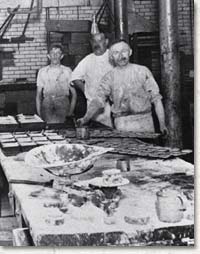
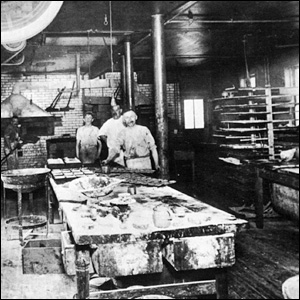
In honor of Tax Day, let’s take a visit to the most healthful bakery in Central New York, Lochner’s Bakery.

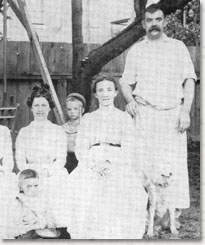
Standing on the right is Joseph Lochner.

joseph-lochner

Here are photographs of Lochner’s bakery in Utica, New York.

lochner-bakery

lochners-bakery

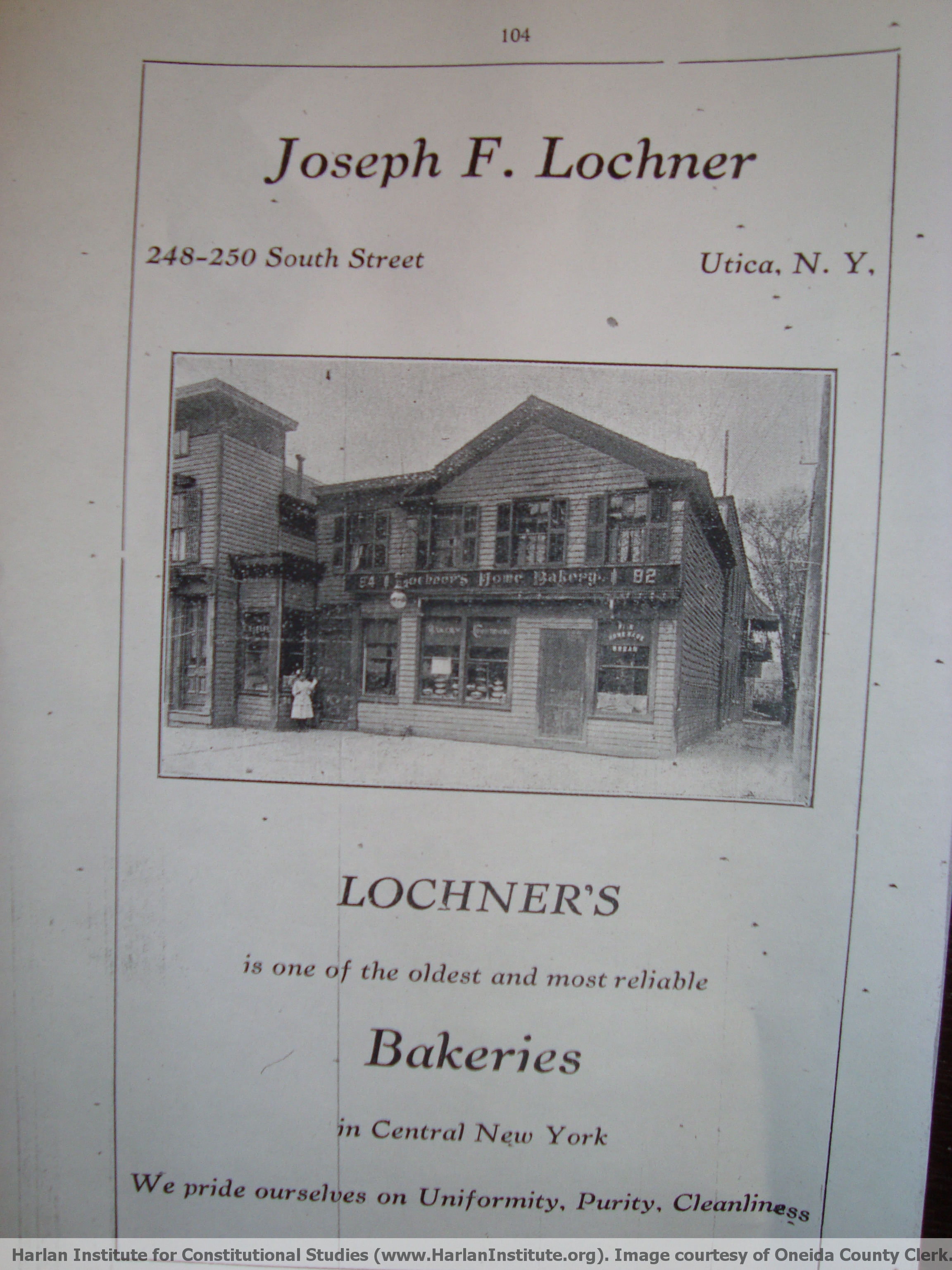
Through sleuthing at the Oneida County Clerk’s Office, I discovered this advertisement for Lochner’s bakery. According to the ad, Lochner’s Home Bakery “is one of the oldest and most reliable bakeries in Central New York. We pride ourself on Uniformity, Purity, Cleanliness.”

Advertisement for Lochner's Home Bakery - Harlan Institute for Constitutional Studies

Collins & Skover on McCuttcheon and Liberty v. Equality

April 4th, 2014

Kudos to Ron Collins and David Skover on publishing a 246 page book on McCutcheon v. FEC less than 48 hours after it has been released. You can buy an electronic copy on Kindle for only $2.99. I just did. So should you!

In this post I’d like to draw attention to their Epilogue, which traces the evolution of thinking of free speech from the liberalism of Floyd Abrams to the utilitarianism of Stephen Breyer (I wrote about SGB’s collective First Amendment here).

These two leading quotations from Floyd Abrams and Cass Sunstein sum up the divide nicely:

Unhappy with who is speaking these days and how much they are speaking, liberals are promiscuously signing on to a variety of positions that simply ignore the core of First Amendment jurisprudence. —Floyd Abrams (July 21, 1997) A system of unrestricted free speech markets can easily become a bizarre caricature of democratic goals. In these circumstances, well-designed reforms should be understood not as unconstitutional abridgements of the free speech principle but as consistent with the highest aspirations of that principle. —Cass R. Sunstein (July 21, 1997)

At the time of the Pentagon Papers, all liberals were on board with robust free speech.

FOR DECADES, Floyd Abrams was the darling of liberals. He was, after all, the man who, among other things, helped to secure a landmark victory in the 1971 Pentagon Papers case, the case that severely curbed the power of Richard Nixon and like-minded presidents to silence the press. In times past, to be liberal meant being a strong (nearly absolutist) defender of First Amendment rights. The Nation was on board; the ACLU was on board; progressive lawyers and activists were on board, and most liberal groups were on board. But over time things changed. With increasing frequency, the Left moved to the right on this issue, while the Right moved to the left on it.

But when free speech began to “thwart progressive reforms,” the roles reversed.

Sixteen years ago the Nation ran a cover story entitled “Speech and Power.” In the symposium issue, some prominent liberals questioned what was once sacred—out-and-out protection of First Amendment freedoms. In the preface to the symposium, the editors complained that “some of the most powerful actors in our society…are wielding the First Amendment in ways that often seem counter to [or] thwart progressive reforms.” Several liberal contributors to the symposium agreed, including such notable First Amendment scholars as Owen Fiss, C. Edwin Baker, and Cass Sunstein. Other distinguished First Amendment personae took a strikingly different view: “The First Amendment is not broken,” wrote Steven R. Shapiro of the ACLU, “but it may break if we keep trying to fix it.” Kathleen Sullivan, Wendy Kaminer, and, of course, Floyd Abrams agreed.

The authors view a 1996 edition of The Nation as a turning point in time:

The July 21, 1997, issue of the Nation marks as good as any point in time when the liberal community had become openly schizophrenic about its stance on the First Amendment. No longer was being liberal synonymous with being pro–First Amendment. That ambivalence, which later translated into a sort of antipathy, was largely due to the campaign finance and commercial speech rulings of the Burger and Rehnquist Courts. By that measure, the ideological strife can be traced back to Friday, January 30, 1976—the day the Court handed down Buckley v. Valeo. Thus, it took two decades for the transformation to develop. And when Citizens

United v. Federal Election Commission was decided thirteen years after the Nation’s symposium, that transformation from “liberal–First Amendment” to “neo-liberal–First Amendment” was all but complete, at least as to cases involving free speech claims related to money or corporations or to both. “In no First Amendment case that I have been involved in has the position I have articulated been more the subject of more condemnation by most of the press, let alone denounced by a sitting president, than the Citizens United ruling.” That is how Floyd Abrams put it in his book Friend of the Court (2013).

And, the ironies that the right supports the First Amendment more than the left:

If the Supreme Court’s campaign finance rulings have divided the Left, they have just as surely unified the Right when it comes to devotion to the First Amendment. Who would have imagined that the likes of bona fide conservatives such as Rush Limbaugh and George Will would rally behind First Amendment absolutism, at least when in the service of striking down electoral reform laws? Conservative think tanks such as the Heritage Foundation and the libertarian Cato Institute are just as committed in their allegiance to that First Amendment gospel.

The theme is “liberty vs. equality.”

Where one stands on money, politics, and the First Amendment depends largely on whether one leans more to the liberty or equality principle. If we treat political contributions and expenditures as pristine examples of political speech, it is because we value liberty over equality. Then again, if we view such “speech” as corruptive of fundamental principles of democratic government, it is because we value equality over liberty.

Collins, Ronald; Skover, David (2014-04-02). When Money Speaks: The McCutcheon Decision, Campaign Finance Laws, and the First Amendment (SCOTUS Books-in-Brief) (Kindle Locations 3797-3800). Top Five Books. Kindle Edition.

Buy the book and read the rest.
Collective Liberty

April 3rd, 2014

In light of my earlier post on Breyer’s vision of free speech as a collective right, his jurisprudence on the 2nd Amendment being a collective right, and throw in views on association, I may write something titled “Collective Liberty.”

Update:  In WSJ, James Taranto writes a piece, titled “Welcome to the Collective.”

And here’s how Breyer sums it all up: “Accordingly, the First Amendment advances not only the individual’s right to engage in political speech, but also the public’s interest in preserving a democratic order in which collective speech matters.”

The emphasis on “matters” is again Breyer’s. We’d have italicized “collective” as the key concept. As with the Second Amendment, he and the other dissenters assert a “collective” right, the establishment of which is purportedly the Constitution’s ultimate purpose, as a justification for curtailing an individual right.

In this case they at least acknowledge the individual right exists. But then the First Amendment, unlike the Second, has no prefatory clause explaining its purpose; it simply says “Congress shall make no law . . .” Breyer has to venture outside the text to find a reason to read that prohibition equivocally.

It’s important to note that when Breyer refers to “collective” rights, what he does not have in mind is individuals exercising their rights by voluntarily collecting themselves into organizations. In fact, the prevailing left-liberal view, most notably with respect toCitizens United v. FEC (2010), is that collections of individuals, at least when they take corporate form, have (or should have) no rights.

The only “collective” that matters to Breyer is the one from which you cannot opt out except by the extreme measure of renouncing your citizenship: “the people” or “the public” as a whole. In Breyer’s view, the purpose of the First Amendment is to see that (in Chief Justice Hughes’s words) “the will of the people” is done. Individual rights are but a means to that end. To the extent they frustrate it, they ought to be curtailed. You will be assimilated.

That resolves the conundrum we noted atop this column. Fringe political speech like flag burning, funeral protests and Nazi parades is so broadly unappealing as to have no effect on “the will of the people.” The same is true of nonpolitical forms of expression such as pornography, violent video games and depictions of animal cruelty. (Breyer’s willingness to countenance restrictions of the first two has to do with the protection of children, not of the body politic.)

Only mainstream political expression has the potential to thwart the “collective” will, and thus, in the view of Breyer and his fellow dissenters, it alone is deserving of restriction on such a rationale. That stands the First Amendment on its head. Its purpose may be to “make government responsive,” as Wilson argued, but the means by which it does so is the limitation of government power and protection of individual freedom.


Mississippi Enacts Religious Freedom Law

April 3rd, 2014

What, you thought Governor Jan Brewer’s Veto of SB-1062 would end the debate? Of course not. Mississippi Governor Phil Bryan  has signed the measure, titled the Mississippi Religious Freedom Restoration Act, or MRFRA for the cool kids.

Here is the key operative language:

State action or an action by any person based on state action shall not burden a person’s right to exercise of religion, even if the burden results from a rule of general applicability, unless it is demonstrated that applying the burden to that person’s exercise of religion in that particular instance is both of the following:

(i) Essential to further a compelling governmental interest;

(ii) The least restrictive means of furthering that compelling governmental interest.

And people who feel that burden can raise this burden as a defense in any proceeding, regardless if a state or individual is bringing the action:

A person whose exercise of religion has been burdened or is likely to be burdened in violation of this section may assert that violation or impending violation as a claim defense in a judicial proceeding, regardless of whether the or a political subdivision of the state is a party to the proceeding. The person asserting that claim or defense may appropriate relief, including relief against the state or a political subdivision of the state. Appropriate relief includes, but is not limited to, injunctive relief, declaratory relief, compensatory damages, and the recovery of costs and reasonable attorney’s fees.

Interestingly, this law only requires a “burden” and not a “substantial burden,” which was the language used in the Federal RFRA, and Arizona’s SB 1062.

“Government shall not substantially burden a person’s exercise of religion even if the burden results from a rule of general applicability.”

Arizona SB 1062, dubbed the “Religions Freedoms Restoration Act, provides in relevant part:

STATE ACTION shall not substantially burden a person’s exercise of religion even if the burden results from a rule of general applicability.

These are IDENTICAL. Mississippi’s is not.

To the courts we go!