Blog

Between 2009 and 2020, Josh published more than 10,000 blog posts. Here, you can access his blog archives.

2020
2019
2018
2017
2016
2015
2014
2013
2012
2011
2010
2009

What is the proper compensation for a person who was forcibly sterilized by the eugenic board of North Carolina?

January 13th, 2012

$50,000.

In the first instance of a state moving to compensate victims of forced sterilization, a gubernatorial panel in North Carolina voted Tuesday to pay victims of a state eugenics program that forcibly sterilized more than 7,500 people.

The Governor’s Eugenics Compensation Task Force, established by Gov. Beverly Perdue in March, voted to pay verified victims $50,000. The payments must still be approved by the Legislature.

At least seven of 33 states that carried out eugenics programs have acknowledged or apologized for the policies, but North Carolina is the first to propose paying compensation. The state’s forced-sterilization program, designed to weed out the mentally disabled, criminals and other “undesirables,” was in effect from 1929 to 1974. North Carolina formally shut down its discredited Eugenics Board in 1977.

The rate of sterilizations in North Carolina picked up after World War II despite unfavorable comparisons to Nazi eugenics, and peaked in the 1950s. The task force has estimated that between 1,500 and 2,000 sterilization victims are still alive. The state has verified 72 victims.

Impoverished or uneducated African Americans were victimized by many eugenics programs, especially in the South. But the task force found that, although many victims of the North Carolina program were African Americans, the number of Caucasians who were sterilized was even higher.

If the payments are approved, victims would have three years to apply for compensation.

H/T Al Brophy

“the Snookified universe of reality TV”

January 13th, 2012

From the New York Times in an startling article about taxidermy and freeze-drying pets. No, I’m not kidding.

Politically Inept with Homer Simpson

January 13th, 2012

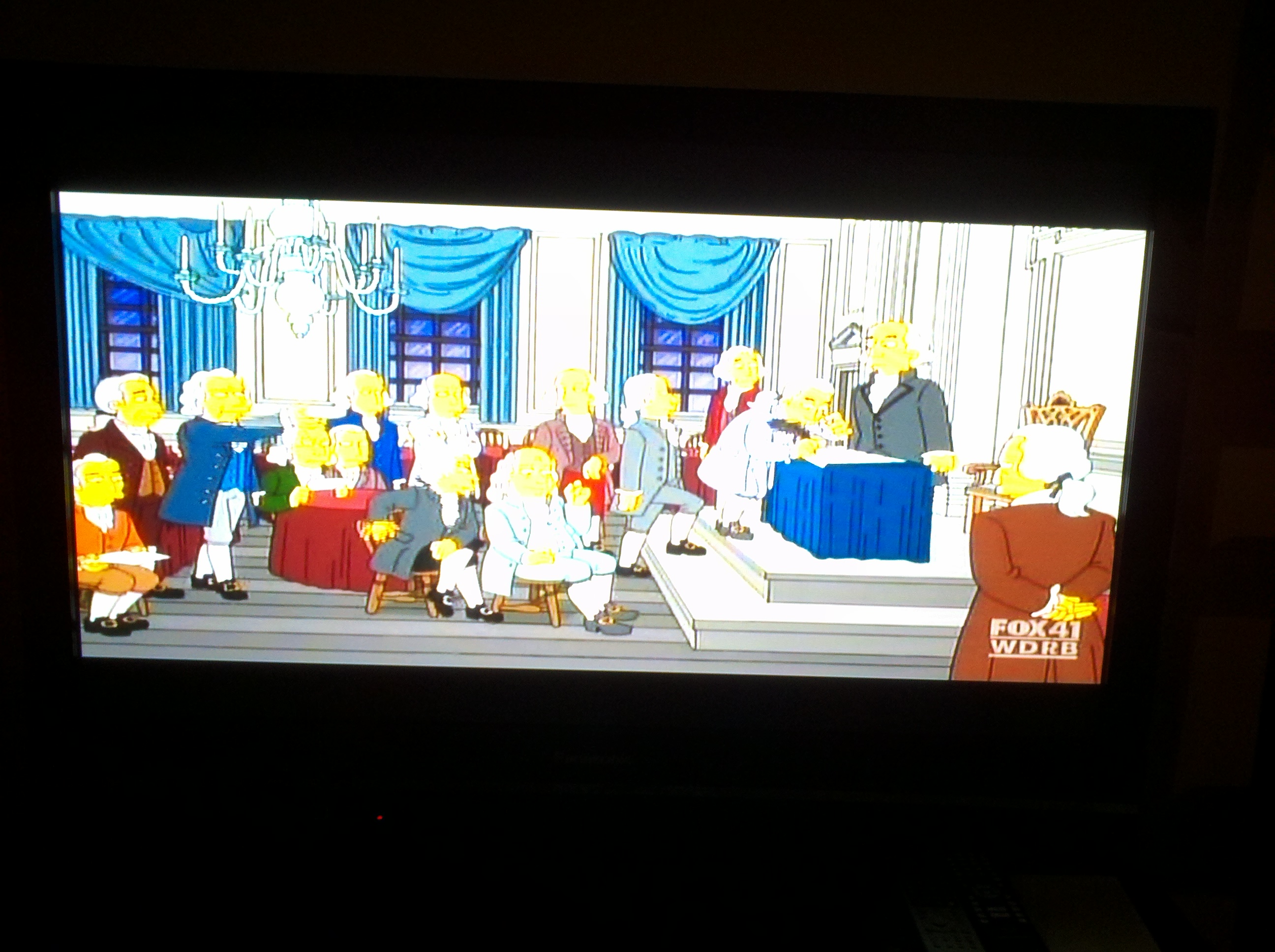
I just saw one of the best episodes of The Simpsons I’ve seen in a while–Politically Inept, with Homer Simpson. The basic plot is that Homer becomes a Tea Party Talking Head. But the best part, is that Homer has (what he thinks is) a dream where James Madison takes him to Independence Hall, shows him the Framers drafting the Constitution, and tells him not to pervert it!

Then the Framers bounce Homer in what can only be described as a Constitution trampoline, and as he is flying up, Homer goes, “Congress has the power to lay and collect taxes?”

It was pure awesomeness.

And they recreated half-way decently the Christy painting of the Signing of the Constitution on 9/17/1787.

The episode already expired from Hulu. A clip is available here.

Mike Sacks on the distinction between Scalia’s position in Hosanna-Tabor and Employment Division v. Smith.

January 11th, 2012

For. The. Win.

Distinction bw Hosanna-Tabor and Scalia’s E.D. v Smith the same as Scalia’s distinction of Lopez from Raich: Drugs are bad, mkay?

Ginsburg Benchslaps Sotomayor in 8-1 Perry v. New Hampshire

January 11th, 2012

Ouch in Perry v. New Hampshire.

The dissent, too, appears to urge that all suggestive circumstances raise due process concerns warranting a pretrial ruling. See post, at 6, 9, 14–17. Neither Perry nor the dissent, however, points to a singlecase in which we have required pretrial screening absent a policearranged identification procedure. Understandably so, for there are no such cases. Instead, the dissent surveys our decisions, heedless of thepolice arrangement that underlies every one of them, and inventing [sic should be invents] a “longstanding rule,” post, at 6, that never existed. Nor are we, as the dissent suggests, imposing a mens rea requirement, post, at 1, 7, or otherwise altering our precedent in any way. As our case law makes clear, what triggers due process concerns is police use of an unnecessarily suggestive identification procedure, whether or not they intendedthe arranged procedure to be suggestive.

And this:

Perry’s argument, reiterated by the dissent, thus lackssupport in the case law he cites. Moreover, his positionwould open the door to judicial preview, under the bannerof due process, of most, if not all, eyewitness identifications. External suggestion is hardly the only factor thatcasts doubt on the trustworthiness of an eyewitness’ testimony.

Sotomayor responds, but doesn’t really reject the lack of precedents. She just reads the precedents more “holistically.”

The Court’s opinion today renders the defendant’s dueprocess protection contingent on whether the suggestive circumstances giving rise to the eyewitness identificationstem from improper police arrangement. That view lies in tension with our precedents’ more holistic conceptionof the dangers of suggestion and is untethered from theevidentiary interest the due process right protects. In myview, the ordinary two-step inquiry should apply, whetherthe police created the suggestive circumstances intentionally or inadvertently. Because the New Hampshire Supreme Court truncated its inquiry at the threshold, I would vacate the judgment and remand for a proper analysis. I respectfully dissent.