Blog

Between 2009 and 2020, Josh published more than 10,000 blog posts. Here, you can access his blog archives.

2020
2019
2018
2017
2016
2015
2014
2013
2012
2011
2010
2009

Analysis of HHS Contraceptive Mandate 6.0

May 31st, 2017

Vox has published a leaked proposed rule of what is (by my count) the sixth version of the Affordable Care Act’s contraceptive mandate. The 125-page document, if accurate, would allow employers and insurers (both for-profit and non-profit) to seek exemptions from the mandate based on both religious and moral objections. The operative RFRA analysis in Part II begins on page 27.

First, the rule addresses a question which the Court punted on in Hobby Lobby: does the contraceptive mandate advance a compelling governmental interest. Here the Trump Administration expressly repudiates the Obama administration’s finding, citing, inter alia, the inability to accommodate religious objectors as well as the never-ending litigation

The Departments previously concluded that the Mandate served compelling governmental interests, including “public health and gender equality interests.” (78 FR 39872) Based in part on that determination, the Departments provided a narrow exemption covering only churches and their integrated auxiliaries. Other organizations with religious objections were either required to comply with the Mandate or offered only the accommodation process. Despite multiple rounds of rulemaking, however, that accommodation process has not satisfied the religious objections of numerous organizations with sincere religious objections to contraceptive coverage or resolved the pending litigation. To the contrary, the Departments have been litigating RFRA challenges to the Mandate and related regulations for more than five years, and dozens of those challenges remain pending today. That litigation, and the related modifications to the accommodation, have consumed substantial governmental resources while also creating uncertainty for objecting organizations, issuers, third party administrators, and employees and beneficiaries. One significant reason for granting the exemptions set forth in these interim final rules is the Government’s desire to resolve the pending litigation.

Beyond these interests, the government has determined that expanding the exemptions is the best way to comply with RFRA.

But the expanded exemptions for religious objectors also rests on an additional, independent ground: the Departments have determined that, in light of RFRA, an expanded exemption, rather than the existing accommodation, is the most appropriate administrative response to the substantial burden identified by the Supreme Court in Hobby Lobby.

Note the government stops short of saying RFRA compels this result, but that it is “appropriate.” The government makes this point explicit later in the rule:

At the same time, the Departments’ decision to exercise discretion to exempt objecting entities does not rest solely on the Departments’ conclusion that applying the contraceptive coverage requirement to those entities would violate RFRA.

But relying on RFRA is essential in order to reverse the position of the Obama administration, and rebalance the interests.

Nevertheless, given the Departments’ previous assertion that they had a compelling interest to overcome the objections when they were defending challenges to the Guidelines, see, e.g., 78 FR 39886–88, the Departments consider it important to rebalance the Government’s general interest in contraceptive coverage and with the respect the Government owes to the interests of conscientious objectors, and under RFRA, religious objectors specifically.

Further, the government restricts its findings whether a compelling interest exists to “this specific context” and “certain objecting employers.”

That determination rests in part on the Departments’ reassessment of the interests served by the application of the Mandate in this specific context. Although the Departments previously took the position that the application of the Mandate to certain objecting employers served a compelling governmental interest, the Departments have now concluded, after reassessing the relevant interests and for the reasons stated below, that it does not.

To this end, the government looks to RFRA as affording the requisite discretion to decide whether to grant a mere accommodation, or simply exempt objecting employers.

Particularly under those circumstances, the Departments believe that agencies charged with administering a statute that imposes a substantial burden on the exercise of religion under RFRA have discretion in determining whether the appropriate response is to provide an exemption from the burdensome requirement or instead to attempt to create an accommodation that would mitigate the burden. Here, the Departments have now determined that the appropriate administrative response is to create a broader exemption, rather than limiting non-church objecting entities to the accommodation process. That determination is informed by the Departments’ reassessment of the relevant interests, as well as by their desire to bring to a close the more than five years of litigation over RFRA challenges to the Mandate.

This is, to a tee, the precise remedy requested by the Little Sisters of the Poor and other plaintiffs in the contraception mandate litigation–grant a full exemption (as houses of worship received), and not an accommodation (whereby employees still receive coverage).

The question here is not whether the Government’s broad interests in health and equality are compelling. Instead, it is whether, under the ACA, the Government has a compelling interest in denying exemptions to those who object to the contraceptive coverage requirements, after the Departments have rebalanced the broad interests of coverage with the Government’s interests in providing for conscientious objection. Upon further examination of the relevant provisions of the ACA and the administrative record on which the Mandate was based, the Departments have concluded that the application of the Mandate to such entities does not serve a compelling governmental interest.

Apart from RFRA, government stressed the fact that the “Mandate was not imposed by Congress, but rather was the result of HRSA’s discretionary decision to include contraceptives among the preventive services required.”

We begin by noting that Congress did not mandate that contraception be covered at all under the ACA—merely that, among other preventive services to be covered are “such additional preventive care and screenings” for women “provided for in comprehensive guidelines supported by [HRSA].” Congress, thus, left the identification of the required preventive services to administrative discretion. And the fact that Congress granted HHS (through HRSA) discretion to decide whether to require contraceptive coverage at all indicates that the Departments’ judgment about the relative importance of the Government’s interest in applying the Mandate to the narrow category of entities at issue here should carry particular weight.

This argument inverts a point I raised at length in Cato’s brief in Zubik v. Burwell and in Gridlock. The fact that the contours of this mandate came not from Congress, but from an agency, should give pause before allowing the agency to intrude upon fundamental religious rights. (Ironically enough, this was the gravamen of Judge Wynn’s concurring opinion in the Fourth Circuit’s travel ban decision). However, the government claims that this delegation supports the fact that the agencies should be entitled to deference when deciding what the government’s interest is. To the contrary, the fact that Congress showed no awareness of the religious liberty implications of the provision suggests that the agencies don’t have the power to burden free exercise in this fashion. In the end, we reach the same conclusion, but the executive branch’s position (unsurprisingly) leaps over the implications of the major question doctrine.

Critically, the government highlighted what I deemed to be the most objectionable aspect of the HHS rulemaking: the conclusion that because houses of worship are more likely to employ people of the same faith, they receive an exemption, rather than an accommodation.

In previously denying an exemption to eligible organizations, the Departments did not identify data to support a distinction between the beliefs of employees of churches and their integrated auxiliaries on the one hand, and employees of non-profit organizations on the other. Yet the Departments reasoned that the exemption for churches “does not undermine the governmental interests furthered by the contraceptive coverage requirement” because “[h]ouses of worship and their integrated auxiliaries that object to contraceptive coverage on religious grounds are more likely than other employers to employ people of the same faith who share the same objection.” (78 Fed. Reg. 39874) As explained above, that reasoning extends further than the Departments had previously acknowledged, so as to include other non-profit organizations whose principles oppose contraceptive coverage.

This bifurcation, I wrote, was completely arbitrary, not supported by any evidence, and was not subject to any deference. Here, the government expressly repudiates this finding.

Further, the government notes that a number of states that have contraception mandates also have wide-ranging exemptions.

The Departments now find it significant that most other states either offer broader exemptions or impose no contraceptive requirement in the first place.17 The broadening of exemptions contained in these interim final rules does not remove any of the exemptions the Departments previously offered to churches, so that the exemption the Departments provided to group health plans established or maintained by religious employers (78 FR 39874) is continued by these interim final rules. =

This is a point that the original HHS rulemaking completely ignored.

Towards the end of Part II, the government reiterates that it is under no obligation to pay for these services:

As the Government is under no constitutional obligation to fund contraception, cf. Harris v. McRae, 448 U.S. 297 (1980), even more so may the Government refrain from requiring private citizens to cover contraception in violation of their religious beliefs or moral convictions. Cf. Rust v. Sullivan, 500 U.S. 173, 192–93 (1991) (“A refusal to fund protected activity, without more, cannot be equated with the imposition of a ‘penalty’ on that activity.”).

In my forthcoming article, Presidential Maladministration, I discus the concept of presidential reversals, where one administration changes a regulatory position simply because it disagrees with another administration’s policies. This precise issue will be litigated in the context of whether the change is arbitrary or capricious, or is the needed to comport with court rulings, end lengthy litigation a sufficient justification, and accommodate conscientious objectors. The rulemaking tees up this issue at page 54:

We acknowledge that the foregoing analysis represents a change from the policies and interpretations the Departments previously adopted with respect to the Mandate and the governmental interests that underlie the Mandate. These changes in policy are within the Departments’ authority. As the Supreme Court has acknowledged, “[a]gencies are free to change their existing policies as long as they provide a reasoned explanation for the change.” Encino Motorcars, LLC v. Navarro, 136 S. Ct. 2117, 2125 (2016) Here, for all of the reasons discussed above, the Departments have determined that the Government’s interest in the application of contraceptive coverage requirements in this specific context to objecting entities does not outweigh the objections of entities and individuals that object to contraceptive coverage on religious grounds or, based on the distinct analysis set forth above, on moral grounds.

Indeed, the government cites the fact that there have been so many modifications as evidence of why deference is appropriate:

Since the beginning of rulemaking on this Mandate, HRSA and the Departments have repeatedly exercised their discretion to create and modify various exemptions within the Guidelines. Over the past almost six years, the Departments: created an exemption only for houses of worship that primarily serve persons who share their religious tenets, and later expanded that exemption to all houses of worship; created a non-enforcement safe harbor for other religious nonprofit organizations, then an accommodation process for those organizations, and later an expanded accommodation to include some for-profit entities; adjusted the forms to be submitted under the accommodation process, expanded it to included additional notices, and later treated other documents as constituting constructive notice. As in Chevron, U.S.A., Inc. v. Natural Resources Defense Council, Inc., “the fact that the agency has adopted different definitions in different contexts adds force to the argument that the definition itself is flexible, particularly since Congress has never indicated any disapproval of a flexible reading of the statute.” 467 U.S. 837, 863–64 (1984).

Recall that the initial rulemaking was issued without going through the notice and comment process, citing the urgency of getting contraception coverage to female students at religious universities before the fall semester began. Alas, that deadline extended many, many times, so the urgency was misplaced.

This rule will almost certainly be challenged. Another chapter for the trilogy.
 

Who will be the next #SCOTUS? Predict now!

May 31st, 2017

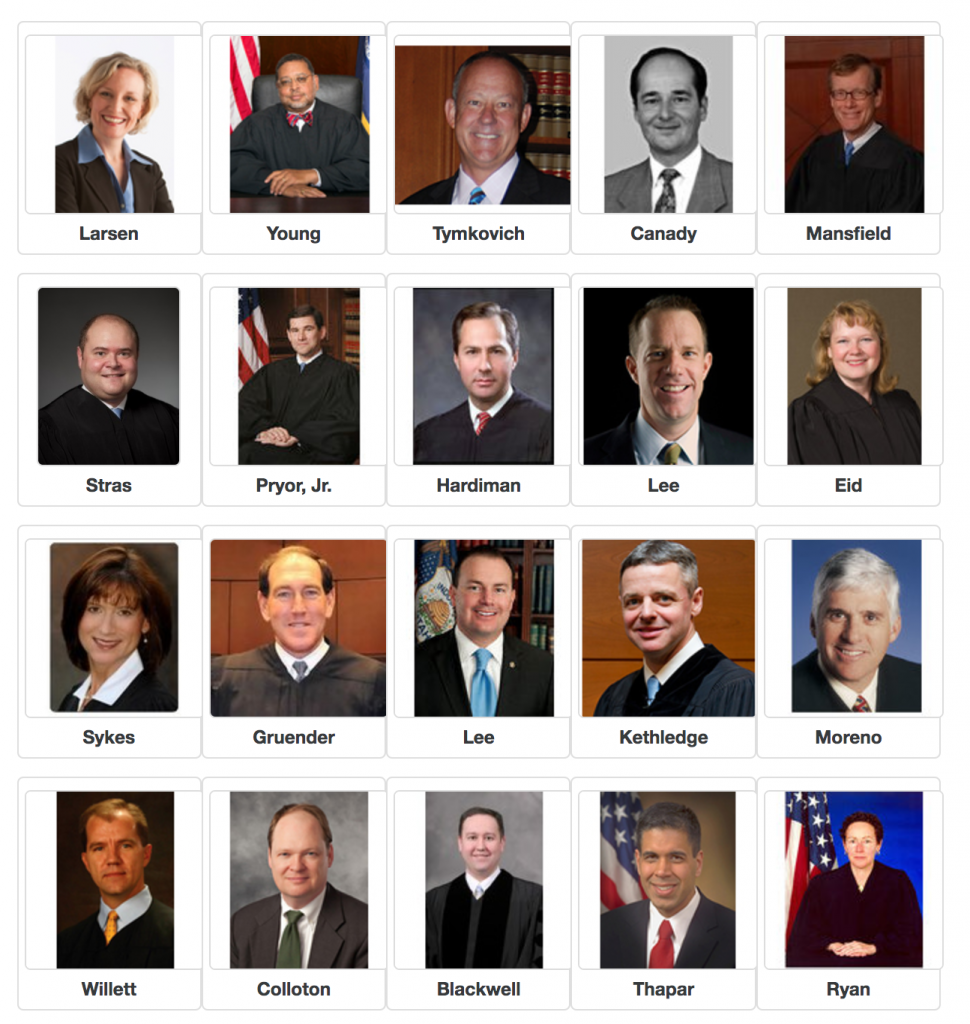
Shortly after the 2016 election, LexPredict launched a market to predict whom President-Elect Trump would nominate. Quickly, Judge Gorsuch jumped to the lead, and we called his nomination long before anyone else did.

Now, as the tumultuous October 2017 term winds down, we have launched a new market for the next seat. To keep things simple, we limited the roster to the judges on Trump’s final list, minus Judge Gorsuch. If a new list is issued, we will be happy to update our roster.

Predict your favorite choice!


Korematsu and the Travel Ban

May 31st, 2017

In Politico, Richard Primus writes that the imminent petition for certiorari in IRAP v. Trump affords the Court–really Justice Kennedy–an opportunity to overturn Korematsu. A few weeks ago, I explained why Judge Paez’s questions about Korematsu were non sequiturs–the civilian exclusion order at issue in that case was not facially neutral, but made explicit references to people of Japanese ancestry.

Primus makes a different points:

In both cases, the executive branch acts on the theory that members of a marginal demographic group are dangerous but officially insists that its actions are warranted by legitimate policy imperatives rather than flowing from prejudice. In both cases, the executive branch claims that the judiciary must not second-guess the executive because the case concerns dangerous subject matter where the executive’s expertise vastly exceeds that of any court and in which a mistake could be catastrophic: wartime national defense in Korematsu, immigration control as a form of defense against terrorism today.

If these two propositions amount to overruling Korematsu, then the deed has already been done, if not in name. First, there are many cases that infringed on the rights on “marginal demographic group”on the prejudiced belief that they are “dangerous.” Look no further than the Court’s free speech and association jurisprudence, which afforded protection for purportedly “dangerous” communists and marxists. More generally, racial classifications under the 5th or 14th Amendment are subjected to the strictest of scrutiny. Second, in the years following 9/11, the Supreme Court (and Justice Kennedy) voiced increasing skepticism towards the Bush administration’s invocation of national security as a defense its policies at Guantanamo Bay. Remember Justice Scalia’s vituperative dissent in Boumedienne, where he charged that the majority opinion “will almost certainly cause more Americans to be killed.” If there was ever an opportunity for Justice Kennedy to flat-out overrule Korematsu, that was the case (it was not cited in the decision).

Theses lines of cases are relevant, because they involve applications of domestic constitutional law. For purposes of the First, Fifth, and Fourteenth Amendments, courts routinely apply rigorous review. In contrast, the travel ban concerns aliens outside of our borders who have no connection to the United States. (The executive order’s waivers, which are available for relatives of U.S., have largely been forgotten in this litigation, especially with respect to ripeness concerns). Under Mandel, courts only perform a review of facial legitimacy.

Primus does raise a very important distinction that was also missing in Judge Paez’s questions.

And although the Japanese internment and the Trump administration’s travel ban are different in several important ways—discriminatorily refusing entry to aliens is not morally equivalent to discriminatorily imprisoning America’s own citizens—the constitutional issues surrounding the travel ban easily evoke central issues of Korematsu.

There are similarities and difference between discriminating against people within the United States and aliens without. Both are morally wrong, but only the former raises traditional forms of constitutional scrutiny. For this reason, the Korematsu comparisons are not apt.

Analysis of IRAP v. Trump Part III: The Concurring Opinions of Judges Thacker, Keenan, and Wynn

May 31st, 2017

This post is the third part of a four-part series on the Fourth Circuit’s recent en banc decision in IRAP v. Trump. Part I analyzed how the court considered pre- and post-inauguration statements. Part II analyzed how the court marshals the Supreme Court’s precedents concerning standing, reviewability of immigration decisions, and the Establishment Clause.

In this post, I will focus on the far more modest concurring opinions of Judges Keenan and Thacker, which were aimed right at the Supreme Court, and the less modest concurring opinion of Judge Wynn. Part IV will analyze the three dissents from Judges Niemeyer, Shedd, and Agee, which were aimed at highlighting for the Supreme Court how their colleagues selectively cited the record and deviated from precedent.

Judge Thacker’s Statutory Argument

Judge Thacker’s concurring opinion (pp. 129-47) parts with the majority opinion on both the constitutional and statutory questions. On the Establishment Clause question, she “would not consider remarks made by candidate Trump before he took his presidential oath of office.” However, limiting her review to “remarks made or sentiments expressed after January 20, 2017,” she would still find a violation of the Establishment Clause. As I indicated in Part I of my series on this case, my view is that Judge Thacker reads certain statements from Trump and his associates out of context and reaches unsupported conclusions about the president’s post-inauguration purpose. I won’t rehash those arguments here. Instead, I’ll focus on the second place where Judge Thacker differs from her colleagues.

The majority opinion declines to reach the statutory question about whether the travel ban violates the Immigration and Nationality Act (INA). In contrast, Judge Thacker “conclude[s] Appellees have demonstrated a likelihood of success on the merits of their argument that Section 2(c), as it applies to immigrant visas, violates 8 U.S.C. § 1152(a)(1)(A)” of the INA (p. 129). This conclusion does not appreciate the important distinction between entry and visa issuance under the statute.

§§ 1152 and 1182

Recall that there are two relevant statutory provisions. The first provision, 8 U.S.C. § 1182(f), gives the president the power to deny or restrict entry to certain classes of aliens “[w]henever the President finds that the entry of any aliens or of any class of aliens into the United States would be detrimental to the interests of the United States.”

The second provision, 8 U.S.C. § 1152(a)(1)(A), prohibits the government from discriminating based on nationality (but not religion) with respect to the issuance of immigrant visas. It states that, with exceptions, “no person shall receive any preference or priority or be discriminated against in the issuance of an immigrant visa because of the person’s race, sex, nationality, place of birth, or place of residence.” 8 U.S.C. § 1152(a)(1)(B) provides that subparagraph (A) does not “limit the authority of the Secretary of State to determine the procedures for the processing of immigrant visa applications or the locations where such applications will be processed.”

As a threshold matter, Judge Thacker limits her analysis to immigrant visas—properly, in my view, but thereby rejecting the line of argument put forth in parallel litigation by Neal Katyal, who urged the Ninth Circuit to extend § 1152(a)’s prohibition to immigrant visas and non-immigrant visa alike. Under Judge Thacker’s reasoning, § 1152(a) could not provide relief to those seeking non-immigrant visas. For that reason, the statutory argument does not resolve the entire case and the plaintiffs’ constitutional arguments must be considered at least as they apply to non-immigrant visas. In that sense, Judge Thacker’s position, which cannot address the legality of the travel ban as a whole, could still impact other areas of immigration law (pp. 140-49).

The core question is how § 1152 and § 1182 interact. Since the outset of this litigation, I have written that the statutory provisions are not in conflict because they operate based on different areas of immigration law. (See Parts I, II, III, and IV). Section 1182 accords the president broad discretion to bar entry into the United States, and Section 1152, which prohibits nationality-based discrimination, concerns the issuance of immigrant visas. The government reads the statutes in the same way. In fact, Solicitor General Wall explained that this is how the State Department has interpreted these provisions for decades, a position that warrants some degree of deference.

Judge Thacker rejects the government’s construction of these statute. She writes that it is “circular logic” for the government to argue that “when an alien subject to [EO-2] is denied an immigrant visa, he is not suffering discrimination on the basis of nationality of the sort prohibited by Section 1152(a)(1)(A); instead, he is being denied a visa because he has been validly barred from entering the country.” Under this logic, as she sees it, “an alien is barred from entry because he does not have and cannot attain a visa, but he is denied a visa because he is barred from entry.” Thus, she concludes, “the visa issuance and entry concepts are intertwined to the point of indistinguishability.”

Contrary to Judge Thacker’s assertion, the government’s position is not circular. In immigration law, a visa is a necessary but not sufficient condition for entry. This point, that the two statutory provisions deal with “two distinct actions in the context of immigration” and that aliens with a valid visa may still not be allowed to enter, is one that Judge Keenan highlights in her concurring opinion (in the only part not joined by Judge Thacker). As Judge Keenan points out, an alien with a visa could be denied admission “for a variety of reasons set forth elsewhere in the INA.” For example, a person with a valid visa could be denied entry at the airport due to the fact that he has a communicable disease or by providing incorrect information to a federal. Entry and visas are certainly related, but are not “intertwined to the point of indistinguishability.” More importantly, as Judge Keenan notes, Judge Thacker’s analysis has the effect of disregarding the usage of different terms in the “plain language” of the statute itself: “entry” and “visas.”

Assuming that § 1152 controls the travel ban, Judge Thacker adduces two primary reasons why the non-discrimination provision prevails.

First, Judge Thacker asserts that “[r]eading § 1182(f) as bestowing upon the President blanket authority to carry out a suspension of entry, which involves rejecting a particular country’s immigrant visa applications as a matter of course, would effectively nullify the protections in § 1152(a)(1)(A) and create an end-run around its prohibitions against discrimination” (p. 145). But § 1152(a)(1), as a whole, need not be so read. Subparagraph (B) of the provision allows the Secretary to adopt “procedures for the processing of immigrant visa applications” that could explicitly be based on national origin. That is, subparagraph (B) states that subparagraph (A) “shall [not] be construed to limit” the Secretary’s authority. Judge Thacker argued that reading subparagraph (B) in this fashion should render subparagraph (A) a nullity.

In my view, this is incorrect. The general policy is that visas should be issued without concern for nationality. The history of this provision reveals that Congress’s primary concern was to eliminate nationality-based quotas, which were a staple of our immigration law before 1965. But when the Secretary deems it necessary, he can adopt special procedures for issuing visas that take into consideration nationality. Simple examples could include the adoption of different procedures for embassies in certain countries where the risk of fraud is higher. Broader examples could include, as here, the adoption of stronger vetting processes to screen out risks of terrorism. The prohibition is not nearly as strict as subparagraph (A) suggests. In any event, the best way to avoid reading subparagraph (A) as a nullity is to treat “entry” and the issuance of visas as separate concepts. This reading is buttressed by § 1182(f), which gives the Secretary the ultimate trump card: deny entry to classes of aliens, even if they have validly issued visas, based on national security concerns. The greater power to deny entry includes the far lesser power to deny a visa.

Second, Judge Thacker notes that when enacting § 1152 more than a decade after § 1182, Congress intended to curtail the president’s authority under the older provision. But there appears to be nothing in the legislative history of the 1965 INA to suggest that Congress was attempting to restrict the president’s power over denial of entry. In addition, as a matter of experience, Judge Thacker fails to account for historical practice, such as the fact that President Reagan expressly barred Cubans from entering the United States under § 1182. In his Proclamation 5517 (1986), he justified this exclusion on the ground that he “found that the unrestricted entry into the United States as immigrants by Cuban citizens would . . . be detrimental to the interests of the United States.”

Judge Thacker was no doubt aware of the proclamation, as Judge Wynn addresses it in his concurring opinion. Judge Wynn argues in footnote 11, however, that this single action was never reviewed by a court, may be unconstitutional, and is not sufficient to establish a new precedent. While I agree that past practice does not suggest an action is constitutional, presidential custom provides a helpful gloss on our laws and the parameters of executive power. But beyond this gloss, there is another canon of statutory interpretation that bears on the resolution of these questions. Indeed, it is the elephant in the room: Article II.

Inherent Article II Power

President Trump’s denial of entry to nationals of six countries, like President Reagan’s denial of entry to Cubans, is premised not entirely on § 1182 but also on the president’s Article II authority. That invocation of power has implications for how we should interpret the parameters of his power, and the relevant statutory framework.

As I noted in one of my earlier posts on the topic, § 1182 can be viewed as a reaffirmation of the president’s Article II authority to turn away those at the border he deems detrimental to American interests. On this view, the president would not even need statutory authority. Consider if in the immediate aftermath of Pearl Harbor, even before the Declaration of War, President Roosevelt unilaterally halted the entry of Japanese nationals into the United States until Congress could act. Even in the absence of congressional authorization, such a temporary measure would almost certainly be lawful. (FDR had such statutory authority to bar entry to aliens pursuant to his declaration of a “national emergency,” though I suspect this statute was a reaffirmation of what the Commander in Chief would already do in such a scenario).

Here, however, we do not need to worry about unilateral authority in this case, because Congress gave the President. explicit statutory authority. This delegation brings us within Justice Jackson’s first tier of Youngstown. Here, presidential power is at its maximum, and judicial scrutiny is at a minimum. Courts should avoid any construction of § 1152 or § 1182 that intrudes on the president’s authority to deny entry to those he deems dangerous. But there is no need to rely on an avoidance canon, because both statutes are best read to allow the President to deny entry to classes of aliens, an act separate and apart from the issuance of visas.

Note that Judge Wynn directly addresses the argument concerning inherent constitutional authority:

Additionally, because the Executive Order cites the Immigration Act as the sole statutory basis for the President’s authority to proclaim Section 2(c)’s suspension on entry, I need not, and thus do not, take any position on the scope of the President’s delegated power to deny entry to classes of aliens under other statutes. Likewise, because the claim at issue relates only to Section 2(c)’s compliance with the Immigration Act, I do not address whether, and in what circumstances, the President may deny entry to classes of aliens under his inherent powers as commander-in-chief, even absent express congressional authorization. See The Prize Cases, 67 U.S. 635 (1862) (p. 98).

The Obama administration was hesitant to defend their actions based on inherent Article II powers, preferring instead to rely on intricate and multi-factored statutory arguments, aimed at cabining the authority of the Presidency. (See Jack Goldsmith’s commentary about the release of detainees at Guantanamo Bay and the longer-than-sixty-day bombing campaign of Libya). The Trump administration, perhaps like the Bush administration before it, may not be so hesitant. To the extent these statutory arguments prevail on appeal, the government may raise constitutional avoidance arguments.

Along similar lines, Judge Wynn suggests that Congress (and by extension, the president) has greater powers to exclude aliens during times of war. By implication, we are not at war, and such power is therefore lacking. Citing Justice Frankfurter’s concurring opinion in Korematsu (a case that is worlds apart from IRAP v. Trump), Judge Wynn argues that “Congress’s constitutional power to control immigration—and authority to delegate that control—fundamentally differs in a time of war.” He adds, “The Supreme Court’s broadest statements regarding the scope of the president’s delegated powers over immigration—which are relied upon by the Government—are in cases in which Congress expressly declared war and authorized the president to deny entry to aliens as part of his prosecution of the conflict.”

Are we at war? This argument raises the question of whether the 2001 and 2002 Authorizations for Use of Military Force, which both the Obama and Trump administrations have used to fight ISIS, provide support for the president’s terrorism-based travel ban. (To be precise, I do not think either AUMF provides authority to cover conflicts with ISIS). This is yet another reason to read the statues to avoid reaching these thorny constitutional questions. The Supreme Court has shied away from this question, as reflected in its decision to reverse Justice Douglas’s holding in Schlesinger v. Holtzman that the bombing runs in Cambodia were part of an undeclared, unconstitutional war.

Judge Keenan’s Concurring Opinion

Judge Keenan’s concurring opinion (pp. 81-93) proposes a different statutory argument. Unlike Judge Thacker’s reading of the INA, which would provide relief only to those seeking immigrant visas, Judge Keenan’s position would be something of a silver-bullet that wins the case for the challengers without touching on the constitutional question. In short, she argues that President Trump’s proclamation did not make sufficient findings to meet the requirements of Section 1182(f), and thus lacks the authority to deny entry to aliens from the six selected nations.

Recall that the second executive order provides that the unrestricted entry of nationals from the six target countries “would be detrimental to the interests of the United States” and then “direct[s] that the entry into the United States of nationals of those six countries be suspended for 90 days from the effective date of this order, subject to the limitations, waivers, and exceptions set forth in sections 3 and 12 of this order.”

Judge Keenan explains that Trump’s findings are too speculative to meet the stringent requirements of § 1182(f). She writes that “[t]he plain language of Section 1182(f) permits a president to act only if he ‘finds’ that entry of the aliens in question ‘would be detrimental to the interests of the United States’” and that “an unsupported conclusion will not satisfy this “finding” requirement.” Accordingly, she walks through the four corners of the executive order—avoiding any campaign-trail missives—and concludes that the “the Second Executive Order does not state that any nationals of the six identified countries, by virtue of their nationality, intend to commit terrorist acts in the United States or otherwise pose a detriment to the interests of the United States” (p. 88).

Here is her key analytical move: § 1182(f) concerns the exclusion of individuals, not countries. In contrast, President Trump’s executive order focuses on countries, not individuals. Because the executive order “does not identify a basis for concluding that entry of any member of the particular class of aliens, namely, the more than 180 million nationals of the six identified countries, would be detrimental to the interests of the United States,” the order does not meet the requirements of Section 1182(f), the text of which “plainly requires more than vague uncertainty regarding whether their entry might be detrimental to our nation’s interests” (p. 89).

In short, § 1182(f) mandates that the president find that “the entry of any aliens or of any class of aliens into the United States would be detrimental to the interests of the United States” (emphasis added). Judge Keenan asserts, and the Solicitor General’s argument does not dispute, that the executive order only concerns aliens that may be detrimental. So the question is: would the Supreme Court halt the travel ban because of the difference between would and may?

This is a very sophisticated textual argument, which I flagged on Lawfare and in the NY Daily News following oral arguments. Critically, it offers the Supreme Court a way to rule against the executive without impairing other government policies—indeed only Presidents Reagan and Trump employed § 1182(f) against nationals of specific country, rather than nationals with offending affiliations. It also avoids reaching difficult constitutional questions concerning the Establishment and Due Process Clauses. (Though constitutional avoidance may caution against such a construction).

Were this a run-of-the-mill statutory interpretation case, I would be inclined to agree with Judge Keenan’s textualist approach. But such is not the case. I think Judge Keenan’s parsimonious construction of § 1182(f) is inconsistent with the loose mode of statutory interpretation employed by the Supreme Court in Dames & Moore v. Regan.

Dames & Moore v. Regan

After the Iran hostage crisis, President Reagan agreed to suspend court proceedings involving Iran and to nullify pending attachments of Iranian property. The Dames & Moore company, which had a valid judgment against Iran, argued that Reagan’s actions were not supported by statutory authority. The opinion by Justice Rehnquist reaffirmed Justice Jackson’s seminal concurring opinion three decades earlier in Youngstown Sheet & Tube Co. v. Sawyer explaining that the president’s powers are their height when he is acting pursuant to congressional authorization and at their “lowest ebb” when acting contravention of congressional will. (Fun fact: Justice Rehnquist clerked for Justice Jackson the year Youngstown was decided; and Chief Justice Roberts clerked for Justice Rehnquist the year Dames & Moore was decided).

In Youngstown, recall that Justice Jackson found that Congress had not given President Truman the statutory authority to seize the steel mills to avert a labor strike. Along similar lines Justice Frankfurter noted in his concurring opinion, that Congress expressly considered granting the president such authority, but withheld it: “By the Labor Management Relations Act of 1947, Congress said to the President, ‘You may not seize. Please report to us and ask for seizure power if you think it is needed in a specific situation.’”

Under the Youngstown rubric, § 1182(f) is worlds apart from the Labor Management Relations Act of 1947. Here, we have a direct delegation of authority for the president to deny entry to those he deems detrimental to the interests of the United States. Against this backdrop, reading too much into the distinction between may versus would is inconsistent with the framework of cases affecting presidential power and national security. Indeed, as I’ve argued since the outset of this case, the statutory analysis reveals that we are in Jackson’s first tier, and scrutiny must be at a minimum.

But were the inquiry difficult under Youngstown, the task becomes far easier under Justice Rehnquist’s extremely flexible gloss from Dames & Moore. To find the requisite statutory authority to uphold President Reagan’s suspension of claims against Iran, the unanimous Court employed a form of interpretive limbo, reaching to two statutes that bear only indirectly on what President Reagan did: the International Emergency Economic Powers Act (IEEPA) and the Hostage Act. Neither expressly permitted the suspension of claims, but the Court did not find that fact dispositive. Justice Rehnquist deemed “both statutes highly relevant in the looser sense of indicating congressional acceptance of a broad scope for executive action in circumstances such as those presented in this case.” He explained:

We think both statutes highly relevant in the looser sense of indicating congressional acceptance of a broad scope for executive action in circumstances such as those presented in this case. . . . . Congress cannot anticipate and legislate with regard to every possible action the President may find it necessary to take, or every possible situation in which he might act. Such failure of Congress specifically to delegate authority does not, “especially . . . in the areas of foreign policy and national security,” imply “congressional disapproval” of action taken by the Executive. Haig v. Agee, ante at 453 U. S. 291. On the contrary, the enactment of legislation closely related to the question of the President’s authority in a particular case which evinces legislative intent to accord the President broad discretion may be considered to “invite” “measures on independent presidential responsibility,” Youngstown, 343 U.S. at 343 U. S. 637 (Jackson, J., concurring). At least this is so where there is no contrary indication of legislative intent and when, as here, there is a history of congressional acquiescence in conduct of the sort engaged in by the President. It is to that history which we now turn. (emphasis added)

In contrast, President Trump did precisely what § 1182(f) authorized him to do: deny entry to classes of aliens he deems detrimental. You don’t need to turn to a “looser” approach, or consider “closely related” measures to find that President Trump had the requisite statutory authority to act. Congress said so in the statute with unequivocal language.

For these reasons, I don’t think Judge Keenan’s textual argument will prevail. The Court has never employed such a stringent and rigid approach to construing Congress’s delegations to the president in matters of national security. To the contrary, the Court in Dames & Moore adopted extremely dubious constructions of statutes to find support for executive actions—far more implausible than reading the word “would” in § 1182(f) more permissibly.

Finally, construing § 1182(f) in the narrow fashion Judge Keenan suggests requires reconsideration of two questions addressed earlier. First, President Reagan’s proclamation concerning Cuban nationals made no specific findings about why Cuban nationals “would” be detrimental to the interests of the United States, beyond generalized concerns about “normal migration procedures between the two countries.” To say Trump’s declaration is void is to say Reagan’s declaration was also void. Second, even in the absence of the statute, the president arguably has the power to exclude certain aliens based on Article II and the 2001 and 2002 Authorizations for Use of Military Force. (Again, I disagree with the Obama and Trump administration’s constructions of the AUMF, but they could advance this argument in court). Reading the statute so narrowly would require the Court to broach that issue. Or, the Court can simply read § 1182(f) as Dames & Moore compels, and find the president met the requirements.

Judge Wynn’s Concurring Opinion

I turn last to Judge Wynn’s concurring opinion (pp. 94-128), which sounds in the major question doctrine. He writes, “the Immigration Act provides no indication that Congress intended the ‘broad generalized’ delegation of authority in Section 1182(f) to allow the President ‘to trench . . . heavily on [fundamental] rights’” (p. 96). That is, if Congress had intended to allow the president to encroach on protected classes or classifications, it would have made the delegation explicit. Or, as Justice Scalia noted in MCI v. AT&T, Congress “does not, one might say, hide elephants in mouseholes.”

Under Judge Wynn’s self-styled “delegation of authority cannon,” when a statute does not provide explicit evidence of that delegation and the delegation potentially encroaches on fundamental rights, the delegated powers must be construed narrowly.

The Supreme Court’s 1958 decision in Kent v. Dulles is important to Judge Wynn’s point. As I noted in the Harvard Law Review, long before the articulation of the major question doctrine in cases like MCI v. AT&T and FDA v. Brown & Williamson Tobacco, “the Court recognized [in Kent] that Congress does not cryptically delegate to agencies unbounded discretion to burden constitutional rights.” Judge Wynn’s position parallels the brief I co-authored in the Little Sisters of the Poor case, contending that the Affordable Care Act did not delegate to the executive branch the authority to infringe on religious liberty. Our brief contended that Congress never delegated to the agencies the power to decide which religious organizations receive “exemptions,” and which receive mere “waivers.” As a result, the regulation in question was beyond the departments’ ken.

The theory has gained influence elsewhere. For example, Judge Kavanaugh’s recent dissent from denial of rehearing en banc in the net neutrality case calls for a reinvigoration of what he calls the major rule doctrine. I second that call—though I suspect IRAP v. Trump is not the appropriate case.

Judge Wynn’s approach offers the benefit of avoiding a constitutional ruling; that is, the court could strike down the proclamation as ultra vires, instead of as unconstitutional. But the problem with his approach is that where the challenged action is itself unconstitutional, the major question doctrine adds nothing to the equation. To apply the major question doctrine, the court would still have to reach the question of whether the proclamation is unconstitutional. As he notes on page 106, his analysis requires determining whether “Section 1182(f) would encroach on the core constitutional values set forth in the First, Fifth, and Fourteenth Amendments.” This framework is avoidance in name only. Indeed, the statutory argument in the concurring opinion is indistinguishable from the constitutional argument in the majority opinion, relying on the same sorts of evidence to find animus.

Cross-Posted at Lawfare

Property I Final Exam Grades and Comments

May 30th, 2017

Hello everyone. I apologize for interrupting your summer break with this note. I have submitted grades for Property. You can download the exam question, and the A+ paper (If this is yours, please drop me a line!). I am very proud of this class–these are among the highest grades I’ve given yet in Property I.

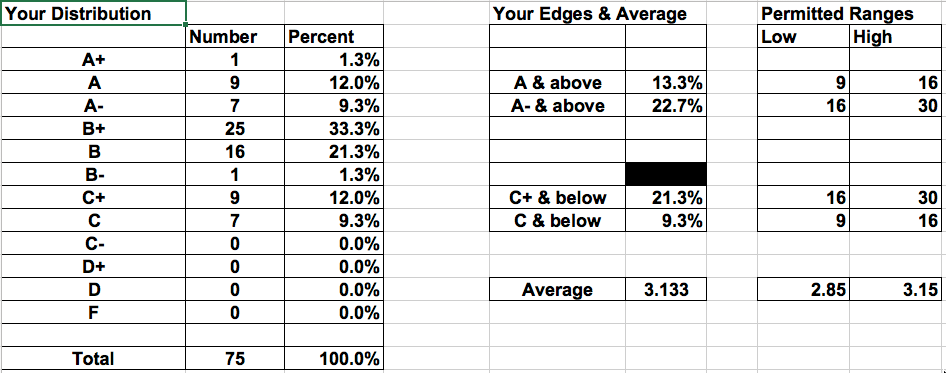
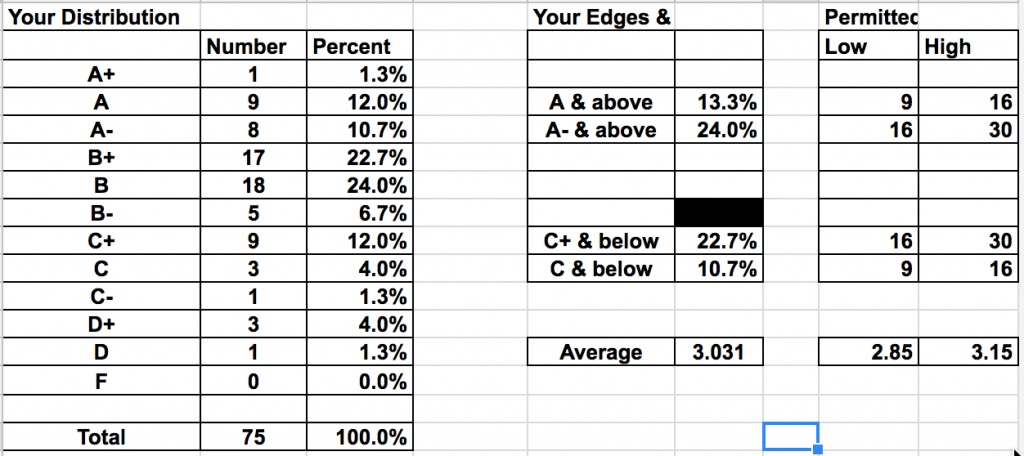
Here is the distribution for the final exam. The mean was 3.13.

This is a significant improvement from the midterm, where the mean was 3.03.

In this post, I will provide some high-level feedback on the Terminator-themed exam.

Question 1.

1. The first question concerned the ownership of post-apocalyptic Los Angeles following Skynet’s “Judgment Day.” The best answers to this question involved our discussion of acquisition by conquest, stemming from Johnson v. M’Intosh. Some students assessed whether Skynet was civilized or savaged. Other answers incorporated discussions of Locke’s labor theory, as well as those of Pufendorf and Grotius.

2. This question concerned ownership of the man-machine chimera, Arnold. The best answers considered the doctrine of acquisition by creation, which we studied in INS v. AP and White v. Samsung. Further, because Arnold was also created with John’s eternal cells, Moore v. Board of Regents, and the related story of Henrietta Lacks, were on point.

3. This question involved the intellectual property rights of the manual to the time machine, which Arnold memorized and reproduced. Indeed, he improved upon it. These factors were relevant to deciding whether he violated any common law (no statutory patent) claims. INS v. AP and White v. Samsung was also relevant here.

4. This question involved a very, very complex conveyance involving present and future interests for Sarah, John, and John’s father (who we later learn to be Arnold). There were several acceptable answers here, though some stronger than others. First, John has a life estate pur autre vie that is subject to an executory limitation. Several students wrote that he has a fee simple determinable (due to the “so long as”), but his interest is better viewed as an estate that lasts until his father dies. The key point though is that the life estate is itself subject to an executory interest. They’re stacked. Specifically, John’s father has a shifting executory interest. But that is not enough. John’s father’s shifting executory interest is itself subject to a condition subsequent (due to the “but if”). Accompanying that condition subsequent is a right of entry in Sarah. I would also accept that Sarah had a contingent remainder (the heir is ascertained, but there is a condition precedent based on father’s survivorship). With this latter answer, because John is Sarah’s heir, he has a future interest as well. There were other permutations that were also acceptable. This question was designed so that you could explain why the interests line up one way or the other.

5. This policy question asks why in a post-Apocalyptic world property rights are important. The answer to this question concerns our very first week of class, when we discussed why we have property rights. Think of Robinson Crusoe (or Tom Hanks) alone on the island. Property rights serve no purpose. But when another castaway joins him, there is now a fierce competition for scarce resources, and property rules allow them to exist in (relative) harmony. Several students also referenced the Case of the Speluncean Explorers and acquisition by conquest/discovery.

Question 2

1. This question involved a fairly complicated community property question. California, like Texas, does not permit married couples to have joint tenancies in the same sense that common law property states allow. They are what we referred to in class as quasi-joint tenancies. This question takes a few twists and turns due to a possible ouster (locking Arnold out), Arnold’s mortgage (like the opening of a boxing ring), and John’s tenancy in common (which does not interfere with the couple’s joint tenancy).

2. This question called for an application of California’s “pro rata” rule, which concerned some payments made before and after the marriage. Here, the model answer missed the mark, as it applied Texas’s “time of vesting” rule. Five payments ($5,000 total) were made before the marriage. Those are Sarah’s separate property. Five payments ($5,000 total) were made after the marriage with joint assets. In the event of divorce, Sarah would receive her initial $5,000, and half of the joint-payments ($2,500) for a total of $7,500.

3. The ownership of the motorcycle involves several elements. First, Terminator stole it, such that his right is subordinate to the true owner. Second, Terminator promised Arnold that he could have the motorcycle “from my cold dead hands.” Was this an actual inter vivos gift? Or a gift causa mortis, as Arnold unplugged Terminator? Or did he, because Terminator later reanimated? Pardon my mixed 80s references, merging Terminator with the Princess Bride (“As you wish.”). Third, after Arnold is wounded, he promises it to John when he (Arnold) dies. But Arnold goes forward in time to 2029, and does not die for decades. Was this an inter vivos gift or a testamentary gift?

4. Question #4 was the flip side of question #3 from the first part. The answer here in large measure depended on how you handled the prior question. In short, John’s father (Arnold) had died, so the life estate pur autre vie terminated. Sarah had not exercised her right of entry, but that descends to her (only) heir John, who can now enter and claim it in fee simple. If you wrote that Sarah had a remainder, there is no need to enter. (As a side, the question established that John was Sarah’s only living heir, as the remainder of her family was wiped out on Judgment Day).

5. The final question was one asked by a student in class: why bother protecting marital property. We spent several spirited minutes discussing this question, which discussed fairness, efficiency, and equality of the sexes. Stronger answers brought in discussions of coverture, the Married Women’s Property Act, and community property regimes.

Thank you all for a wonderful semester.