If anyone is interested in considering a job as a legal academic, please check out my IHS Webinar next Tuesday at 7 EST. At the outset, I will go over the broad parameters and what it takes to be a legal academic–this may either disabuse you of the notion of becomming a professor, or convince you that this is the job for you. In any event, it is better to come to these realizations now, when you are still considering it, before you start investing time, money, and lots of writing to pursue this path.
I feel blessed that I have the job I do, which I believe is the greatest in the world. If you feel similarly, sign up.
Remember Hettinga v. United States? Of course you do. Judge Janice Rogers Brown concurred to lambaste the Court’s entire economic liberty jurisprudence, and assail the fecklessness of the rational basis test (see my earlier posts here, here, and here).
Here’s a sip from her opinion, which considered the constitutionality of the Milk Regulatory Equity Act of 2005:
Once again, the government has thwarted the free market, and ultimately hurt consumers, to protect the economic interests of a powerful faction. Neither the legislators nor the lobbyists broke any positive laws to accomplish this result. It just seems like a crime.
Many progressives would cry over that spilled milk.
Today, we filed this petition for certiorari with the United States Supreme Court, asking the justices to review a case that severely restricts Americans’ right to challenge the constitutionality of laws. The case, Hettinga v. United States, began when Arizona dairy owners Hein and Ellen Hettinga sued over a federal law that targeted their business alone, in order to force them to stop charging low prices for milk. They argued that this law violated the Constitution by singling them out for disfavored treatment in a manner that wasn’t “rationally related to a legitimate government interest.”
That phrase is important because that “rational relationship” test is the test judges use to evaluate the constitutionality of laws that restrict the rights of business owners, property owners, and most other people—in fact, this test is applicable to all but a few constitutional cases. (Those that involve “fundamental” rights or “suspect” classifications are treated differently.)
But the Hettingas’ case took a turn when the federal government filed a motion to dismiss, and stated in its brief that the law at issue was “rational.” The government introduced no facts or testimony to support that assertion—it just claimed it. And that, the trial court said, was enough. It ruled that under the “rational relationship” test, a court can throw a case out whenever the government simply claims, prior to any evidence or fact-finding, that a law is rational. The Hettingas appealed, but three judges of the D.C. Circuit Court of Appeals affirmed that dismissal, declaring that the trial judge was allowed to “draw[] factual conclusions at the pleading stage,” and that if “the government provide[s] an explanation that is…only rational on its face,” a court can dismiss case without hearing any evidence.
Now, we’re asking the U.S. Supreme Court to take the case, to decide whether the “rational relationship” test goes that far.
“This case is about more than restrictions on dairies and other businesses,” said Timothy Sandefur, a principal attorney with Pacific Legal Foundation, who represents the Hettingas. “This is about whether people challenging the constitutionality of any law can get a fair trial, or whether the government can just recite some magic words and make the case disappear.”
He continued: “The trial court said that the Hettingas were not even allowed to introduce evidence to prove their case — simply because the government said the law was constitutional. The government’s mere say-so was deemed sufficient. And that just cannot be right.”
This petition is a stretch for sure. I had some difficulty thinking of the last pure-economic liberty case the Supreme Court took that was not bundled together with another constitutional provision–such as the First Amendment, the Takings Clause, or perhaps some substantive due process case related to a fundamental right.
I gather the government will waive their response.
A big thank you to everyone at Drexel University Earl Macke School of Law for hosting a great conference that brought together lawyers, philosophers, political scientists, sociologists, and many others.
During my panel, I talked about my work on originalism, social movements, and the challenge to the Affordable Care Act. Towards the end I worked in a discussion of my newest piece, “Five Lessons from the Health Care Cases.”
Here is the video of my 20-minute presentation:
Here is the video of the Q&A session afterwards, where I received some excellent questions:
Here is the Dashboard cam view (like Nascar!):
Thanks to frequent reader, and fellow presenter, Lael Weinberger for his excellent videography skills.
Leading up to, and during the time of the American revolution, it was fairly common for people to make their own musket balls, and maybe even and rifle their own muskets. Today, that is not possible. In the age of mass production, the only way to realistically create a firearm is in a factory, or really a series of factories, that can create and assemble a series of specialized parts (if you think building a pencil is complicated, imagine all the work that goes into creating a gun!).
Today, it is simply impossible for an individual to create a firearm at home. People might be able to reload ammunition, but that still requires using existing shell casings manufactured elsewhere. This fact makes firearm laws viable. If a government wants to place a restriction on the nature and distribution of firearms, it can closely monitor and inspect those that manufacture and distribute the weapons.
But that may not always be the case. 3D Printing holds the potential of creating actual, working, functional three-dimensional objects using simple raw materials. At the present, the technology is somewhat limited, though it can already create items with moving parts–such as a pair of scissors. One of the biggest present fears concerns intellectual property piracy. If you thought illegally downloading music or videos or movies on a Torrent was bad, imagine if could download the design for a pair of Nike shoes, or a Rolex watch, or an iPhone, and print one up in your home. The Pirate Bay already offers a way to share designs of objects for 3D Printers. Gerard Magliocca’s has series of posts on IP issues concerning 3D printing.
US patent 8286236, granted on 9 October to Intellectual Ventures of Bellevue, Washington, lends a 3D printer the ability to assess whether a computer design file it’s reading has an authorisation code appended that grants access for printing. If it does not, the machine simply refuses to print – whether it’s a solid object, a textile or even food that’s being printed.
Who else will oppose 3D Printing? The manufacturing sector. The ability to create items at home has the potential to cripple, if not destroy manufacturing jobs. One point that may be lost on some, is that 3D Printers will reduce the need to outsource manufacturing. In fact, it may actually create jobs in the United States, where 3D Printing factories can produce items cheaply, and the items can be transported at a lower cost domestically.
Now there are a few benefits. One, it could enable countries without sophisticated manufacturing sectors, or the means of access to trade, the ability to create goods and products to improve the welfare of its people. That could be a serious international human rights boom. What if malaria nets could be created with a 3D Printer in Sub-Saharan Africa? Or if a water filtration system could be generated in a place without access to clean water? Or perhaps a solar powered generator? The list can go on and on.
But then, there is the gun. What happens if a 3D Printer can create a gun? And, a number of groups are working on this.
The WikiGun from PrintableGun.com, now known as DistributedDefense.com wants to do this. At 2:15, the video says, “The world no longer must rely on . . . regulations for certain objects.” That means gun control laws.
Is this legal? The FAQ section has this nonsensical legal statement:
Since its inception, it has been legal in the USA to fashion your own firearm, and to talk about doing so. More precise legalities are that it is legal to produce any category of weapon you could ordinarily legally own, so long as you are not providing it for sale or are not prohibited from possessing firearms in the first place. Everything else is free speech, ladies and gentlemen.
The video has some conspiratorial tones about the need to build weapons to combat potential gun control legislation (around 6:30)–somewhat troubling.
Here’s the director of the Wikigun project by the way, holding up an AK-47 and Bastiat’s The Law (I would highly recommend both!).
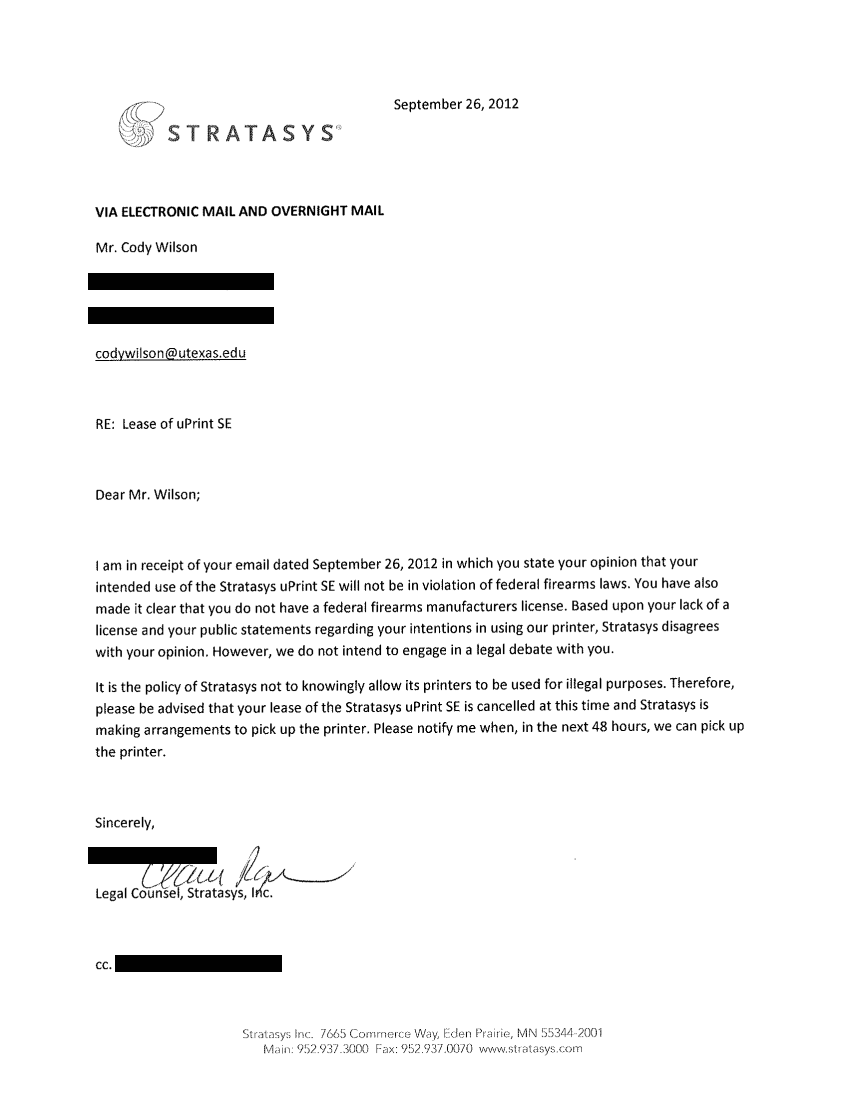
And it turns out the founder is a second year law student at the University of Texas School of Law. Here is a less ominous photo of Texas 2L Cody Wilson.
Cody Wilson, a law student at the University of Texas, is in the process of building a completely functional printed gun. “We hope to have this fully tested and put the files online in the next couple of months,” said Mr. Wilson, who runs a Web site called Defense Distributed.
He calls the gun the Wiki Weapon. In a video explaining the project’s goals, he describes the Wiki Weapon as the world’s first “3-D printable personal defense system.”
“What’s great about the Wiki Weapon is it only needs to be lethal once,” Mr. Wilson says in the video, in a monotone voice. “We will have the reality of a weapons system that can be printed out from your desk. Anywhere there is a computer, there is a weapon.”
“I didn’t know I would ever do anything like this,” says Wilson, a self-described civil libertarian. A former English literature major, he says he was on the phone with some more tech-minded friends, trying to figure out what they could do to live up to their libertarian principles. The question raised, he says, was, “How can we contribute to creating those kinds of realities we value, civil libertarian ideals?”. . .
“Everyone has got their opinion about what the Second Amendment really means, what it intended,” Wilson says. “I get involved in rhetorical battles about the second amendment; constitutional law has really helped me.”
And he’s applying for an FFL?
But first, Wilson says, he checked in with the Austin office of the Bureau of Alcohol, Tobacco, Firearms and Explosives. He says his group will set up a limited liability company and obtain the federally required gun manufacturing licenses
So there are several legal issues that may come into play here that concern the First and Second Amendments.
First. Assume 3D Printing gets to the stage where it is possible to upload to the web plans for a firearm, and anyone with an affordable 3D Printer can print one out at home. Could the government ban these plans? Is there any First Amendment interest in the designs and blue prints? Is there any precedent for Congress banning design specifications? Blueprints of bombs? The anarchist cookbook? Could Congress force 3D Printers to install some kind of DRM software that would not allow it to print guns? What else would the DRM ban? Is there any overbreadth challenge to limitations on what a person can create? What if someone hacks these DRM?
Second, and relatedly, would banning these designs in any way infringe on Second Amendment rights? Now in order to create firearms, manufacturers today need to apply to a whole host of permits and a Federal Firearm License. Could individuals seek to apply for those permits? Or would the activity be banned altogether? My guess is that the activity would likely be banned altogether. Though, the black market for firearms would be flooded. If people can create cheap and affordable firearms, why would anyone drop hundreds, if not thousands of dollars on a gun. And that means no background checks either. Some serious issues to think about.
This Wired Article addresses some of the legal issues.
Legally, however, Guslick did print a firearm. Well, maybe. Under the Gun Control Act of 1968, the receiver is what determines whether or not a gun is a gun. No receiver, no gun. For the nation’s gun lobbies — pro- and anti-gun — that may present a problem. . . .
“The laws were written assuming people could make their own guns … the law still does regulate and restrict that,” Daniel Vice, senior attorney at the Washington-based Brady Center to Prevent Gun Violence, tells Danger Room. Guslick likely didn’t violate any laws surrounding the manufacturing of the gun without a license, as it’s only for personal use. If he attempted to sell the pistol, or opened up a factory producing the weapons, he’d need authorization from the government.
But Vice said the weapon could possibly be illegal under the Undetectable Firearms Act of 1988, which bans the possession and manufacturing of firearms that can pass undetected through airport security. But U.S. law is unclear whether this would apply to a gun with metal parts. The Glock pistol, for example, uses plastic parts.
The National Rifle Association did not comment by press time. A representative from the Second Amendment Foundation would not speak on the record, either.
According to Dave Kopel, the research director of the Independence Institute, it is legal to create pistols, revolvers and rifles at home, although some states are stricter than others. As long as an inventor isn’t selling, sharing or trading the weapon, under federal law, a license isn’t necessary. Homemade creations also don’t need to be registered with the US Bureau of Alcohol, Tobacco, Firearms and Explosives (ATF) and are legal for use by the individual who created the weapon. . . .
But Kopel expects 3D gun printing to remain a hobbyist pursuit, at least in the United States.
“If this thing does work I think it would be great for the people in Syria to have a 3D printer so they could start making their own guns and start resisting the mass murderer Assad,” said Kopel. “The guy who is robbing a 7-Eleven isn’t going to buy a 3D printer.”
Under most circumstances, it is not illegal to build your own gun, but it has been pretty difficult. Ginger Colbrun, a spokeswoman for the Bureau of Alcohol, Tobacco, Firearms and Explosives, said people had made firearms out of pens, books and belt buckles. But those contraptions and conventional firearms require a certain amount of knowledge and skill.
Ms. Colbrun said the agency was keeping a close watch on 3-D printers. “A.T.F. always tries to stay ahead of the illegal activity and the novel firearms trafficking schemes, without impinging on individuals’ rights,” she said.
LOL. Sorry. Being a spokesperson for ATF must be almost as hard as being a spokesperson for the TSA. I digress.
But monitoring whether people make their own guns on a 3-D printer is going to be impossible, barring sticking an A.T.F. agent in every home. It’s also hopeless to try to build a technology into these printers that prevents people from printing a gun. One project mentioned in Mr. Wilson’s video, called the RepRap printer, will be capable of replicating itself by printing other 3-D printers.
After committing a crime with a printed weapon, a person could simply melt down the plastic and reprint it as something as mundane as a statue of Buddha. And guns made of plastic might not be spotted by metal detectors in airports, courthouses or other government facilities.
I’ll write about this at some point in the near future. Just some food for thought for now.
To get a sense of how large the Laurel region is in this case, it considers a 20 mile semicircle (Pi * 20^2 = roughly 1,200 sq miles!) of Camden, Burlington, and Gloucester County.
The issue of affordable housing for families is still pressing–see this article from this weekend’s Times.
When Mayor Michael R. Bloomberg announced that the city was planning to develop new super-small apartments — called “microunits” — it represented another step toward his ambitious goal of building or preserving 165,000 homes for poor and moderate-income families across New York by 2014.
But some housing advocates, community leaders and elected officials say this latest proposal only highlights that one demographic group has been left out: large, poor families.
This group includes members as disparate as West Africans in the South Bronx, Hasidic Jews in Brooklyn and Bangladeshi in Queens, who are united by their inability to afford the high prices for large market-rate rentals and their inability to find publicly subsidized alternatives even as the overall housing stock has swelled.